
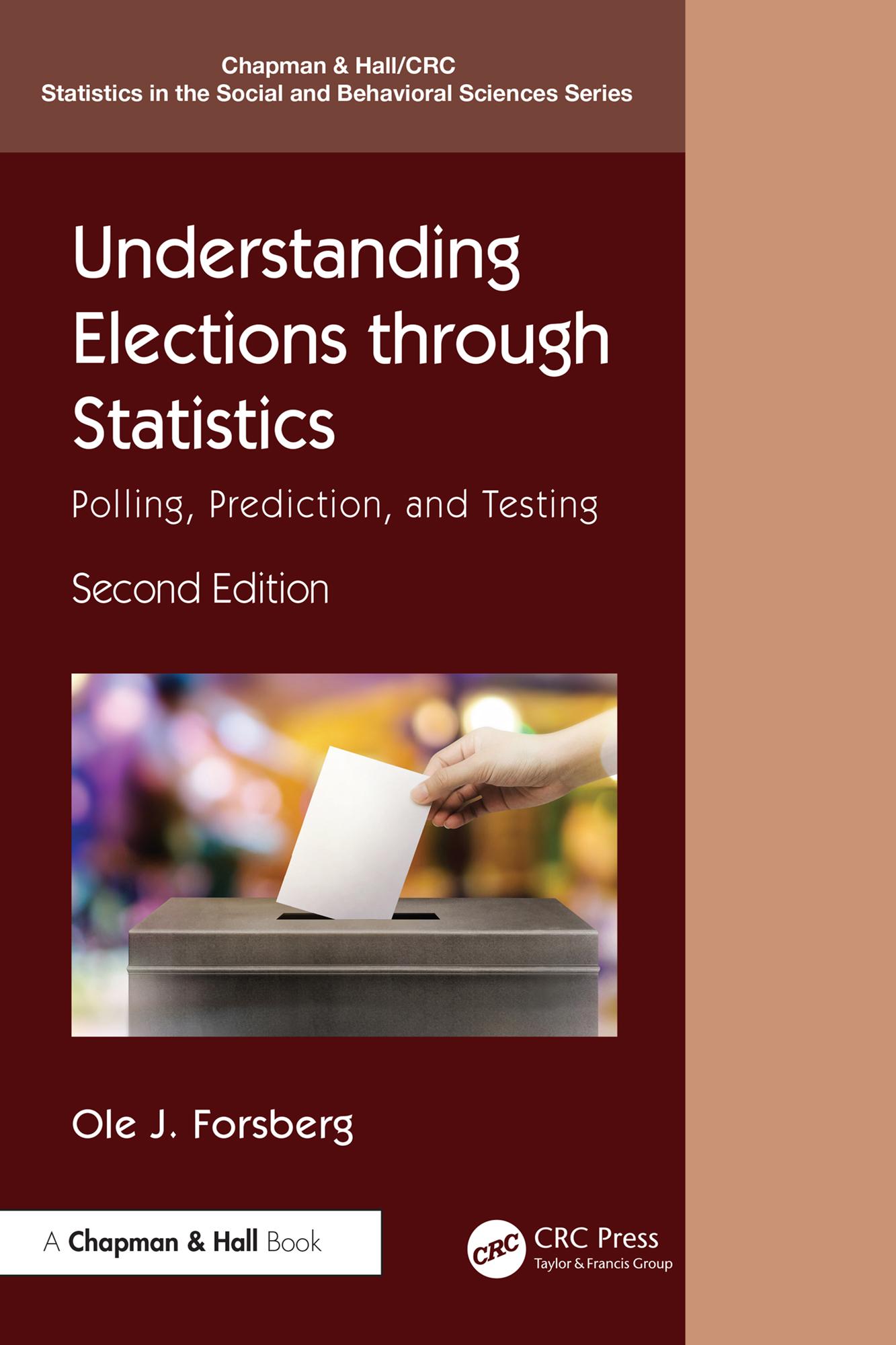
Elections are random events.
From individuals deciding whether to vote, to individuals deciding who to vote for, to election authorities deciding what to count, the outcomes of competitive democratic elections are rarely known until election day… or beyond. Understanding Elections through Statistics explores this random phenomenon from three primary points of view: predicting the election outcome using opinion polls, testing the election outcome using government-reported data, and exploring election data to better understand the people.
Written for those with only a brief introduction to statistics, this book takes you on a statistical journey from how polls are taken to how they can—and should—be used to estimate current popular opinion. Once an understanding of the election process is built, we turn toward testing elections for evidence of unfairness. While holding elections has become the de facto proof of government legitimacy, those electoral processes may hide the dirty little secret of the government, illicitly ensuring a favorable election outcome.
This book includes these features designed to make your statistical journey more enjoyable:
- Vignettes of elections, including maps, starting each chapter to motivate the material
- In-chapter cues to help one avoid the heavy math—or to focus on it
- End-of-chapter problems designed to review and extend what was covered in the chapter
- Many opportunities to turn the power of the R Statistical Environment to the enclosed election data files, as well as to those you find interesting
The second edition improves upon this and includes:
- A rewrite of several chapters to make the underlying concepts more clear
- A chapter dedicated to confidence intervals, what they mean, and what they do not
- Additional experiments to help you better understand the statistics of elections
- A new introduction to polling, its terms, its processes, and its ethics
From these features, it is clear that the audience for this book is quite diverse. It provides the statistics and mathematics for those interested in statistics and mathematics, but it also provides detours for those who just want a good read and a deeper understanding of elections.
Pay easily by card, Klarna, Apple Pay or Google Pay. Not happy? You always have a 14-day money-back guarantee. Read more in our terms. If you have any questions, email us at hello@memmo.org.
Memmo makes studying easier – wherever you are in the world. We bring your course books and smart study tools together in one place: summaries, quizzes, podcasts and flashcards. Plus Ted, your study buddy who answers anything you wonder. Over 75,000 students already study here – built to help you learn faster and stress less.