
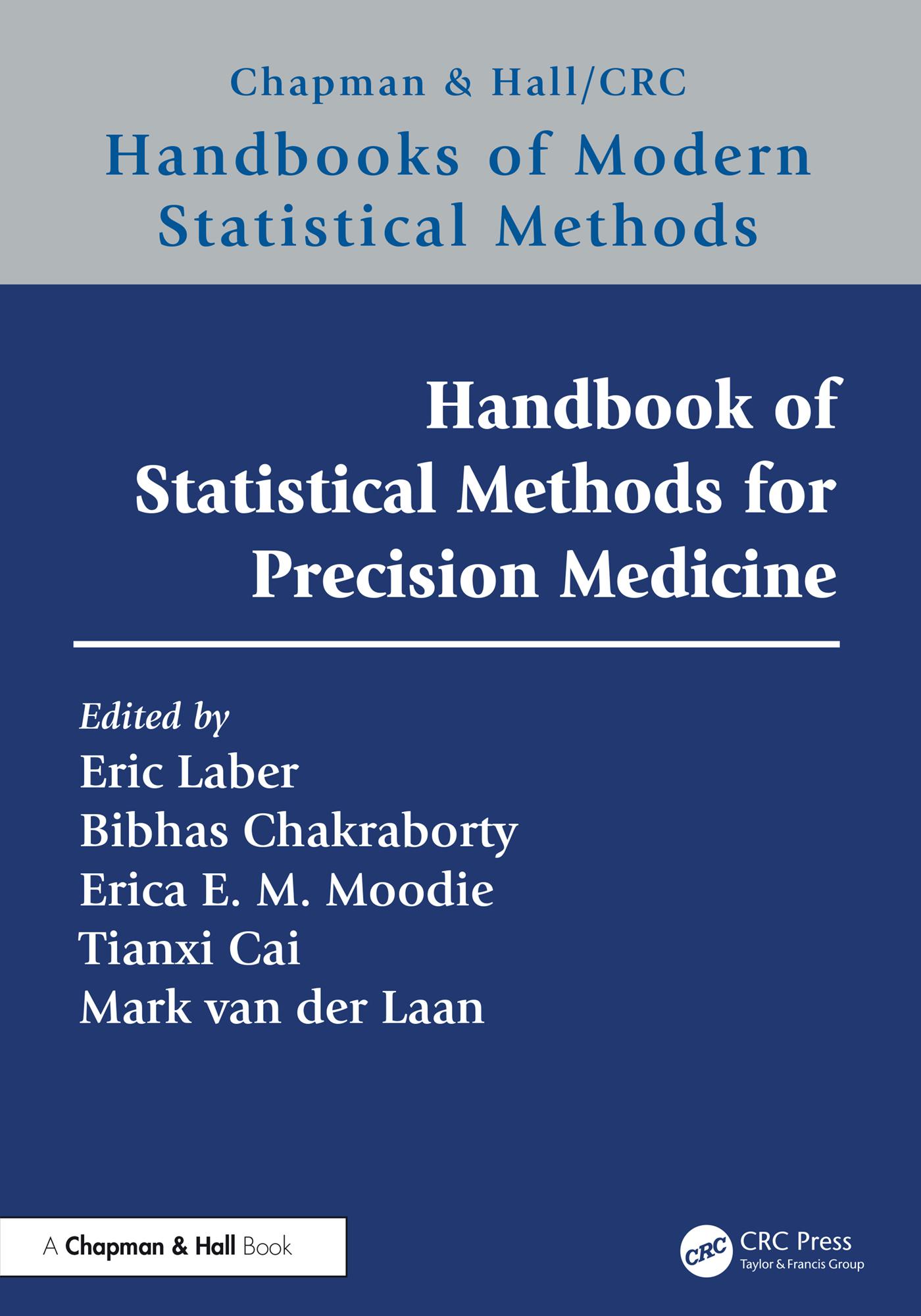
The statistical study and development of analytic methodology for individualization of treatments is no longer in its infancy. Many methods of study design, estimation, and inference exist, and the tools available to the analyst are ever growing. This handbook introduces the foundations of modern statistical approaches to precision medicine, bridging key ideas to active lines of current research in precision medicine.
The contributions in this handbook vary in their level of assumed statistical knowledge; all contributions are accessible to a wide readership of statisticians and computer scientists including graduate students and new researchers in the area. Many contributions, particularly those that are more comprehensive reviews, are suitable for epidemiologists and clinical researchers with some statistical training. The handbook is split into three sections: Study Design for Precision Medicine, Estimation of Optimal Treatment Strategies, and Precision Medicine in High Dimensions.
The first focuses on designed experiments, in many instances, building and extending on the notion of sequential multiple assignment randomized trials. Dose finding and simulation-based designs using agent-based modelling are also featured. The second section contains both introductory contributions and more advanced methods, suitable for estimating optimal adaptive treatment strategies from a variety of data sources including non-experimental (observational) studies. The final section turns to estimation in the many-covariate setting, providing approaches suitable to the challenges posed by electronic health records, wearable devices, or any other settings where the number of possible variables (whether confounders, tailoring variables, or other) is high. Together, these three sections bring together some of the foremost leaders in the field of precision medicine, offering new insights and ideas as this field moves towards its third decade.
Pay easily by card, Klarna, Apple Pay or Google Pay. Not happy? You always have a 14-day money-back guarantee. Read more in our terms. If you have any questions, email us at hello@memmo.org.
Memmo makes studying easier – wherever you are in the world. We bring your course books and smart study tools together in one place: summaries, quizzes, podcasts and flashcards. Plus Ted, your study buddy who answers anything you wonder. Over 75,000 students already study here – built to help you learn faster and stress less.