
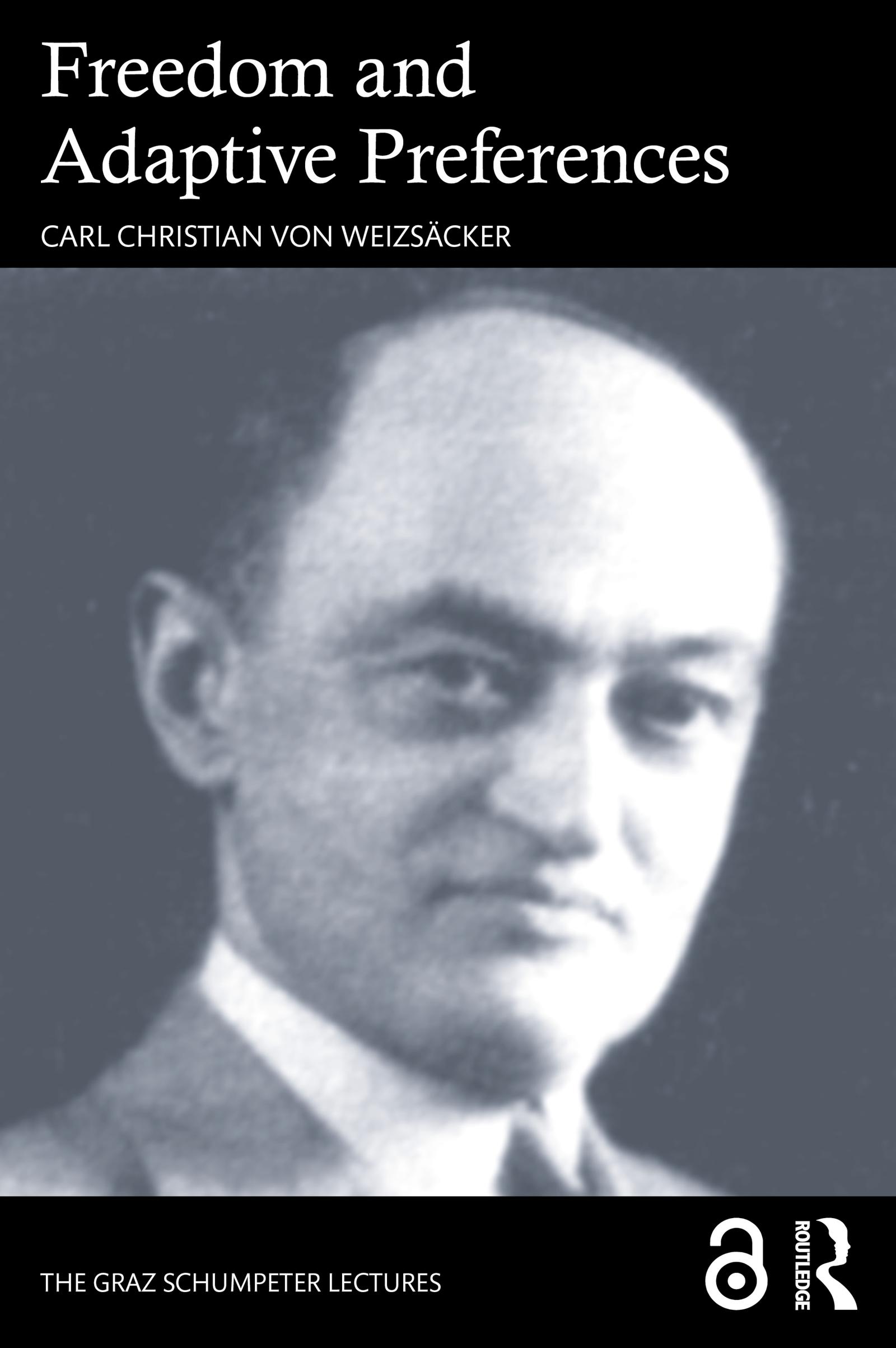
Traditional welfare economics works with the assumption of the fully rational economic agent (homo economicus) whose preferences are fixed: that is, they are not influenced by their economic environment. To the contrary, this book presents a theory of welfare economics that maintains the principles of normative individualism while allowing for adaptive or changeable preferences.
Why do economists talk of preferences? In this book, Carl Christian von Weizsäcker shows that the concept is intimately related to freedom of action. The concept of preferences is the mode by which normative economics introduces the idea of freedom or liberty into its theory of human interaction. Moreover, the economic research of recent decades has provided a large amount of experimental and other empirical findings – e.g. the work on bounded rationality – which contradicts the assumption of fixed preferences. This book argues that this large body of findings is consistent with the hypothesis of adaptive preferences. This, together with the proposition that adaptive preferences allow a generalization of traditional welfare economics, has implications for policy applications of behavioral economics based on “normative individualism”. Normative individualism is an approach which intrinsically connects with the value of liberty or freedom. It is argued that normative individualism is indispensable for a society of free citizens, thus providing the foundations of civil liberty.
This book will be of great interest to readers of welfare economics, behavioral economics and economic theory.
The Open Access version of this book, available at http://www.taylorfrancis.com, has been made available under a Creative Commons Attribution-NonCommercial-No Derivatives (CC-BY-NC-ND) 4.0 license. Any third party material in this book is not included in the OA Creative Commons license, unless indicated otherwise in a credit line to the material. Please direct any permissions enquiries to the original rightsholder.
Pay easily by card, Klarna, Apple Pay or Google Pay. Not happy? You always have a 14-day money-back guarantee. Read more in our terms. If you have any questions, email us at hello@memmo.org.
Memmo makes studying easier – wherever you are in the world. We bring your course books and smart study tools together in one place: summaries, quizzes, podcasts and flashcards. Plus Ted, your study buddy who answers anything you wonder. Over 50,000 students already study here – built to help you learn faster and stress less.