
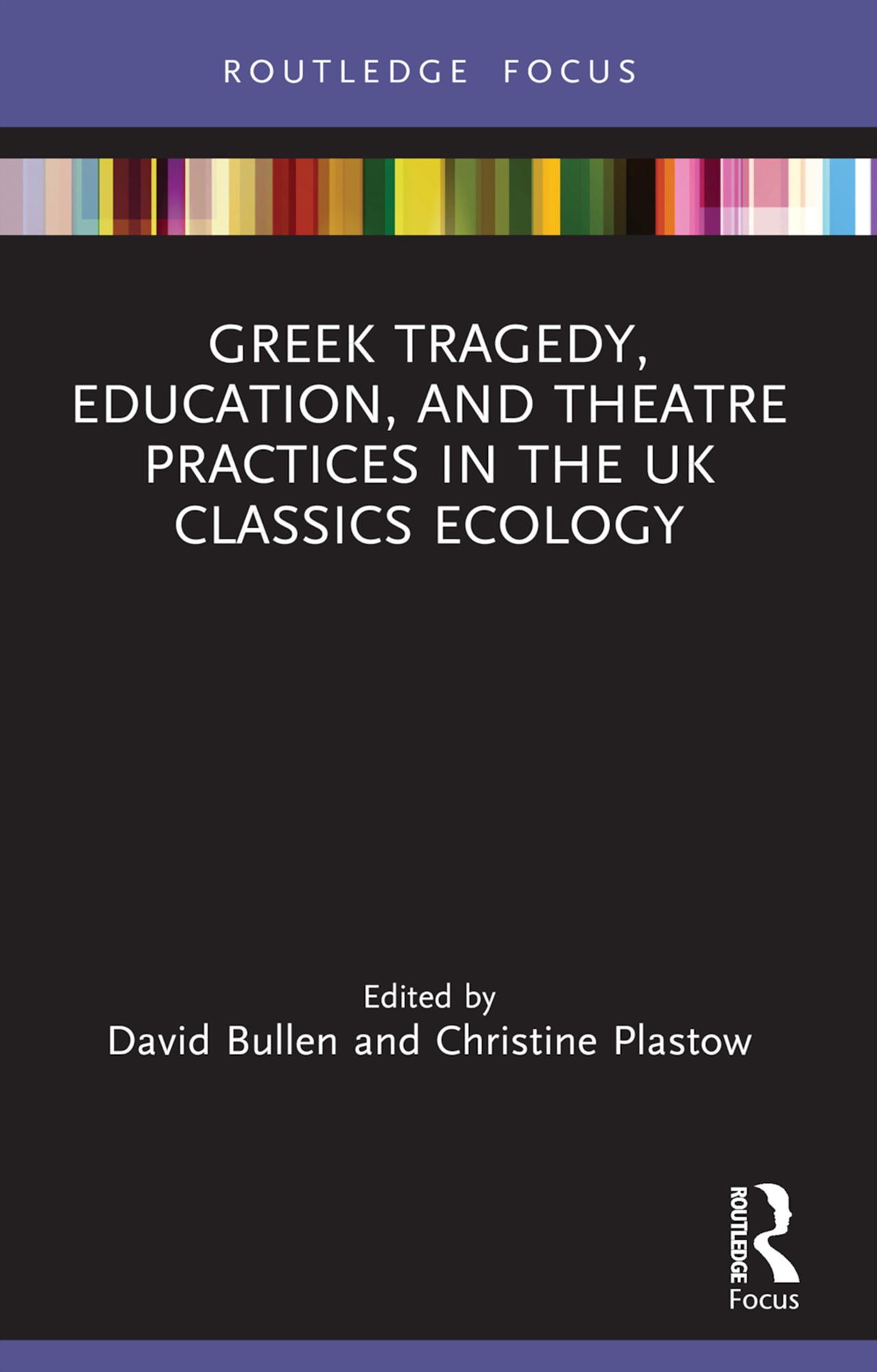
Through a series of case studies, this book explores the interrelations among Greek tragedy, theatre practices, and education in the United Kingdom. This is situated within what the volume proposes as ‘the Classics ecology’.
The term ‘ecology’, frequently used in Theatre Studies, understands Classics as a field of cultural production dependent on shared knowledge circulated via formal and informal networks, which operate on the basis of mutually beneficial exchange. Productions of Greek tragedy may be influenced by members of the team studying Classics subjects at school or university, or reading popular works of Classical scholarship, or else by working with an academic consultant. All of these have some degree of connection to academic Classics, albeit filtered through different lenses, creating a network of mutual influence and benefit (the ecology). In this way, theatrical productions of Greek drama may, in the long term, influence Classics as an academic discipline, and certainly contribute to attesting to the relevance of Classics in the modern world. The chapters in this volume include contributions by both theatre makers and academics, whose backgrounds vary between Theatre Studies and Classics. They comprise a variety of case studies and approaches, exploring the dissemination of knowledge about the ancient world through projects that engage with Greek tragedy, theories and practices of theatre making through the chorus, and practical relationships between scholars and theatre makers. By understanding the staging of Greek tragedy in the United Kingdom today as being part of the Classics ecology, the book examines practices and processes as key areas in which the value of engaging with the ancient past is (re)negotiated.
This book is primarily suitable for students and scholars working in Classical Reception and Theatre Studies who are interested in the reception history of Greek tragedy and the intersection of the two fields. It is also of use to more general Classics and Theatre Studies audiences, especially those engaged with current debates around ‘saving Classics’ and those interested in a structural, systemic approach to the intersection between theatre, culture, and class.
Pay easily by card, Klarna, Apple Pay or Google Pay. Not happy? You always have a 14-day money-back guarantee. Read more in our terms. If you have any questions, email us at hello@memmo.org.
Memmo makes studying easier – wherever you are in the world. We bring your course books and smart study tools together in one place: summaries, quizzes, podcasts and flashcards. Plus Ted, your study buddy who answers anything you wonder. Over 75,000 students already study here – built to help you learn faster and stress less.