
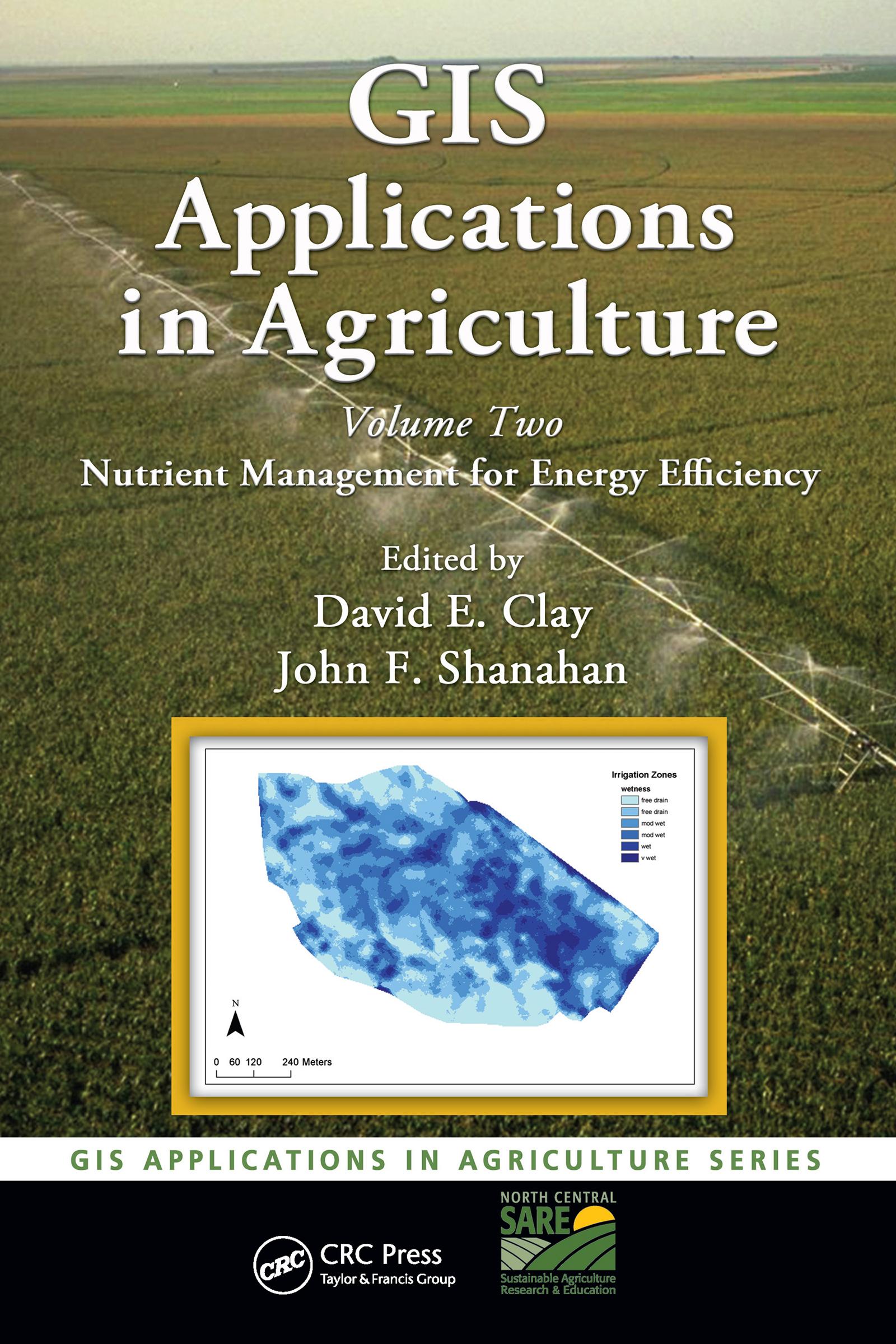
We are entering a new era in production agronomics. Agricultural scientists the world over call for the development of techniques that simultaneously increase soil carbon storage and reduce agriculture’s energy use. In response, site-specific or precision agriculture has become the focus and direction for the three motivating forces that are changing agriculture today: the expanding capacity of personal computers, the molecular biology revolution, and the recent developments in information technology such as the increasing use of geographical information systems (GIS).
Using mathematics, technology, and creativity, GIS Applications in Agriculture, Volume Two: Nutrient Management for Energy Efficiency examines the development of nutrient management practices that help producers improve their profitability and energy efficiency. Throughout the book, chapters demonstrate how complex mathematical and spatial modeling approaches can providethe basis for much of our present and certainly our future management practices.
Highlighting recent successes and the nuts and bolts associated with implementing the proposed techniques, the book covers energy efficiency calculations, techniques for overcoming yield-limiting factors, soil information collection and analysis, and remote sensing for improving management decisions. It describes the development of an economically optimum site-specific corn plant population equation based on an experiment containing many field sites, the estimation of soil productivity and energy efficiency using online data sources, and the assessment and implementation of site-specific carbon and water management systems, analyzing energy efficiency of compost and manures.
Emphasizing the mathematics that will enable producers to make full use of the technological advances made during the 21st century, GIS Applications in Agriculture, Volume Two holds the key to the successful, sustainable, and efficient production of food to feed the ever increasing world population.
Pay easily by card, Klarna, Apple Pay or Google Pay. Not happy? You always have a 14-day money-back guarantee. Read more in our terms. If you have any questions, email us at hello@memmo.org.
Memmo makes studying easier – wherever you are in the world. We bring your course books and smart study tools together in one place: summaries, quizzes, podcasts and flashcards. Plus Ted, your study buddy who answers anything you wonder. Over 50,000 students already study here – built to help you learn faster and stress less.