
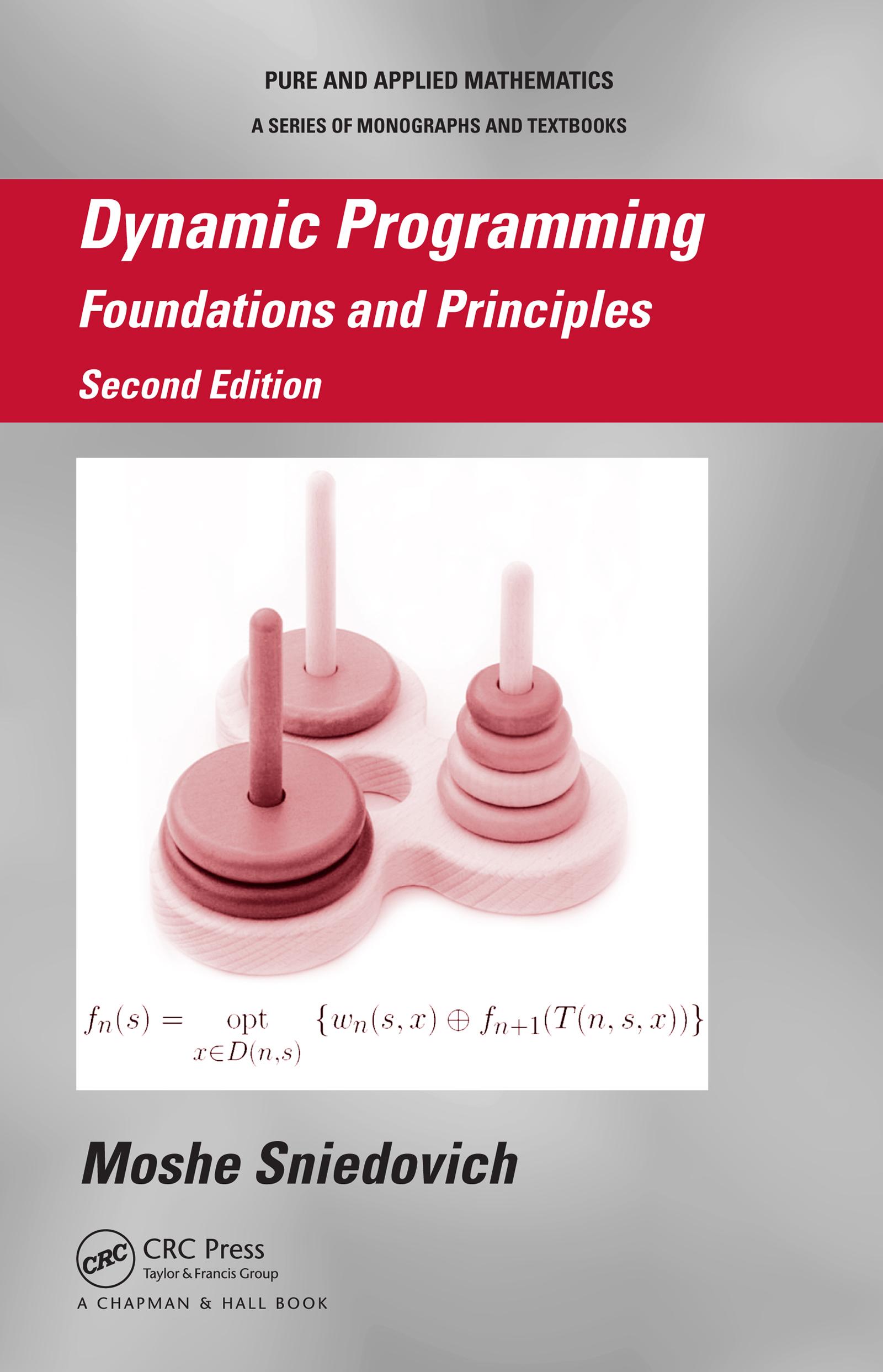
Incorporating a number of the author’s recent ideas and examples, Dynamic Programming: Foundations and Principles, Second Edition presents a comprehensive and rigorous treatment of dynamic programming. The author emphasizes the crucial role that modeling plays in understanding this area. He also shows how Dijkstra’s algorithm is an excellent example of a dynamic programming algorithm, despite the impression given by the computer science literature.
New to the Second Edition
- Expanded discussions of sequential decision models and the role of the state variable in modeling
- A new chapter on forward dynamic programming models
- A new chapter on the Push method that gives a dynamic programming perspective on Dijkstra’s algorithm for the shortest path problem
- A new appendix on the Corridor method
Taking into account recent developments in dynamic programming, this edition continues to provide a systematic, formal outline of Bellman’s approach to dynamic programming. It looks at dynamic programming as a problem-solving methodology, identifying its constituent components and explaining its theoretical basis for tackling problems.
Pay easily by card, Klarna, Apple Pay or Google Pay. Not happy? You always have a 14-day money-back guarantee. Read more in our terms. If you have any questions, email us at hello@memmo.org.
Memmo makes studying easier – wherever you are in the world. We bring your course books and smart study tools together in one place: summaries, quizzes, podcasts and flashcards. Plus Ted, your study buddy who answers anything you wonder. Over 75,000 students already study here – built to help you learn faster and stress less.