
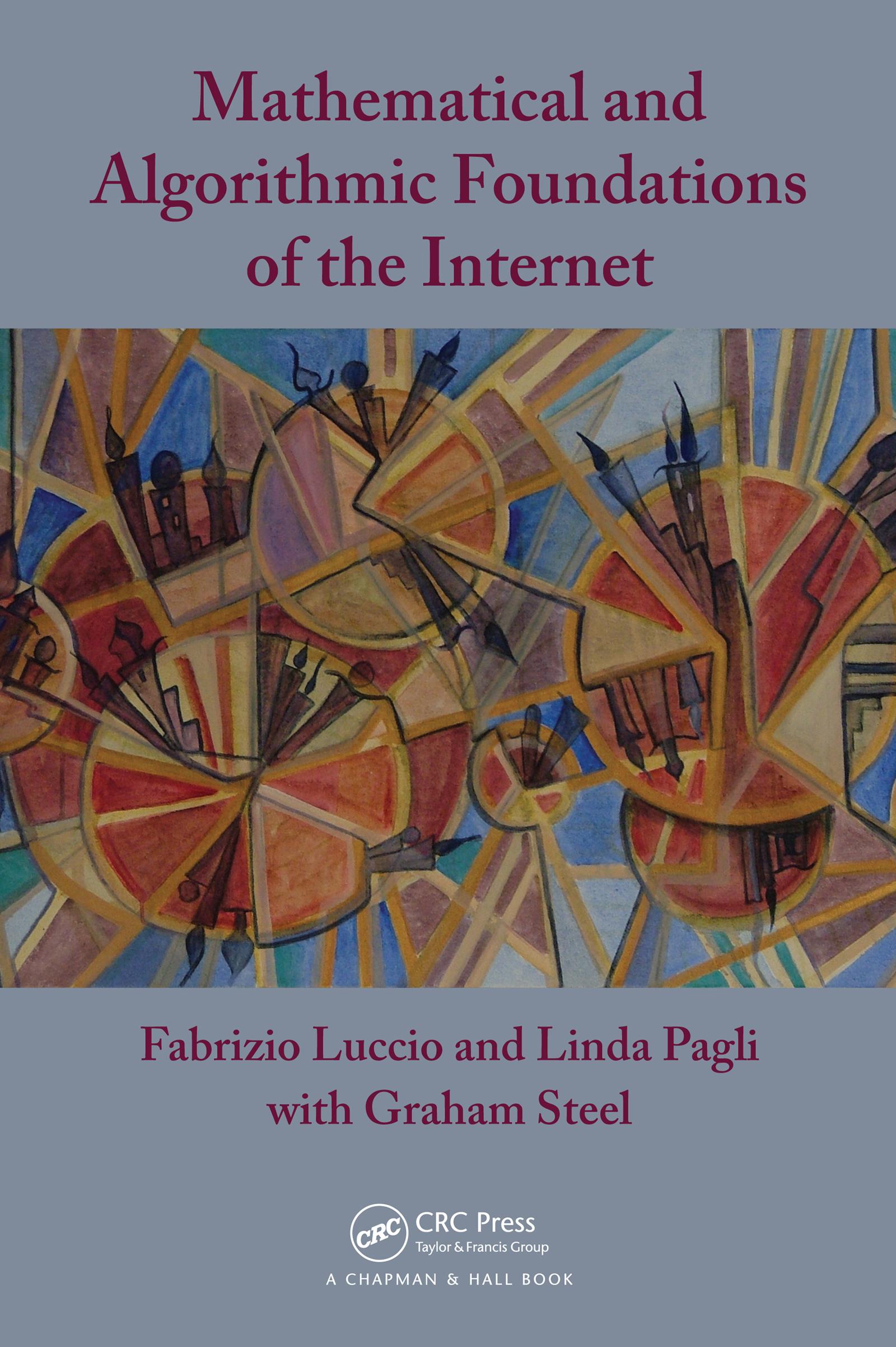
To truly understand how the Internet and Web are organized and function requires knowledge of mathematics and computation theory. Mathematical and Algorithmic Foundations of the Internet introduces the concepts and methods upon which computer networks rely and explores their applications to the Internet and Web. The book offers a unique approach to mathematical and algorithmic concepts, demonstrating their universality by presenting ideas and examples from various fields, including literature, history, and art.
Progressing from fundamental concepts to more specific topics and applications, the text covers computational complexity and randomness, networks and graphs, parallel and distributed computing, and search engines. While the mathematical treatment is rigorous, it is presented at a level that can be grasped by readers with an elementary mathematical background. The authors also present a lighter side to this complex subject by illustrating how many of the mathematical concepts have counterparts in everyday life.
The book provides in-depth coverage of the mathematical prerequisites and assembles a complete presentation of how computer networks function. It is a useful resource for anyone interested in the inner functioning, design, and organization of the Internet.
Pay easily by card, Klarna, Apple Pay or Google Pay. Not happy? You always have a 14-day money-back guarantee. Read more in our terms. If you have any questions, email us at hello@memmo.org.
Memmo makes studying easier – wherever you are in the world. We bring your course books and smart study tools together in one place: summaries, quizzes, podcasts and flashcards. Plus Ted, your study buddy who answers anything you wonder. Over 75,000 students already study here – built to help you learn faster and stress less.