
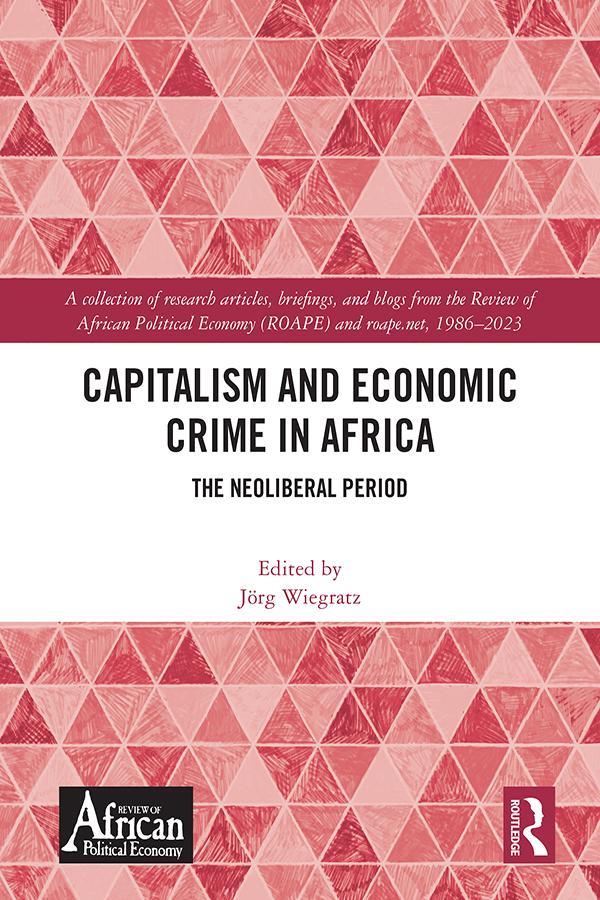
This book offers a comprehensive analysis of economic crimes and market irregularities, including matters of trickery, illicit trade, parallel economy, economies of violence and criminalisation of the poor in neoliberal Africa. It interrogates economic crime as a product of neoliberal reform and transformation (as well as of historical structures). It unpacks crime as a social – and particularly as a political-economic – phenomenon of capitalism. The book brings together a collection of research articles, briefings and blog posts that were published over a period of nearly 40 years (1986–2023), in the acclaimed journal Review of African Political Economy (ROAPE) and on its website roape.net.
Featuring contributions from leading experts in the field, including a foreword by Yusuf K. Serunkuma and an afterword by Laureen Snider, the volume explores what these economic crimes have to do with, and can tell us about power, class, accumulation, dependency, (under)development, state–business relations and capitalist transformation on the continent. In so doing, it sheds new light on the co-production of these crimes by a range of actors from the realms of economy, politics and international development, including international financial institutions and other donors. It responds to the imperative to advance the analysis of the link between capitalism and crime in Africa as more countries across the continent become fully capitalist societies.
Illustrating the relevance of African cases to debates in and across various disciplines – concerning, for example, corporate and white-collar crimes, state crimes, crimes of the powerful, (il)legality, regulation and social harm – this volume engages with a variety of literature to explain economic crimes as phenomena of global and local capitalism. It provides readers from academia, government, business, media, civil society and education with a striking source of information and analysis.
Pay easily by card, Klarna, Apple Pay or Google Pay. Not happy? You always have a 14-day money-back guarantee. Read more in our terms. If you have any questions, email us at hello@memmo.org.
Memmo makes studying easier – wherever you are in the world. We bring your course books and smart study tools together in one place: summaries, quizzes, podcasts and flashcards. Plus Ted, your study buddy who answers anything you wonder. Over 50,000 students already study here – built to help you learn faster and stress less.