
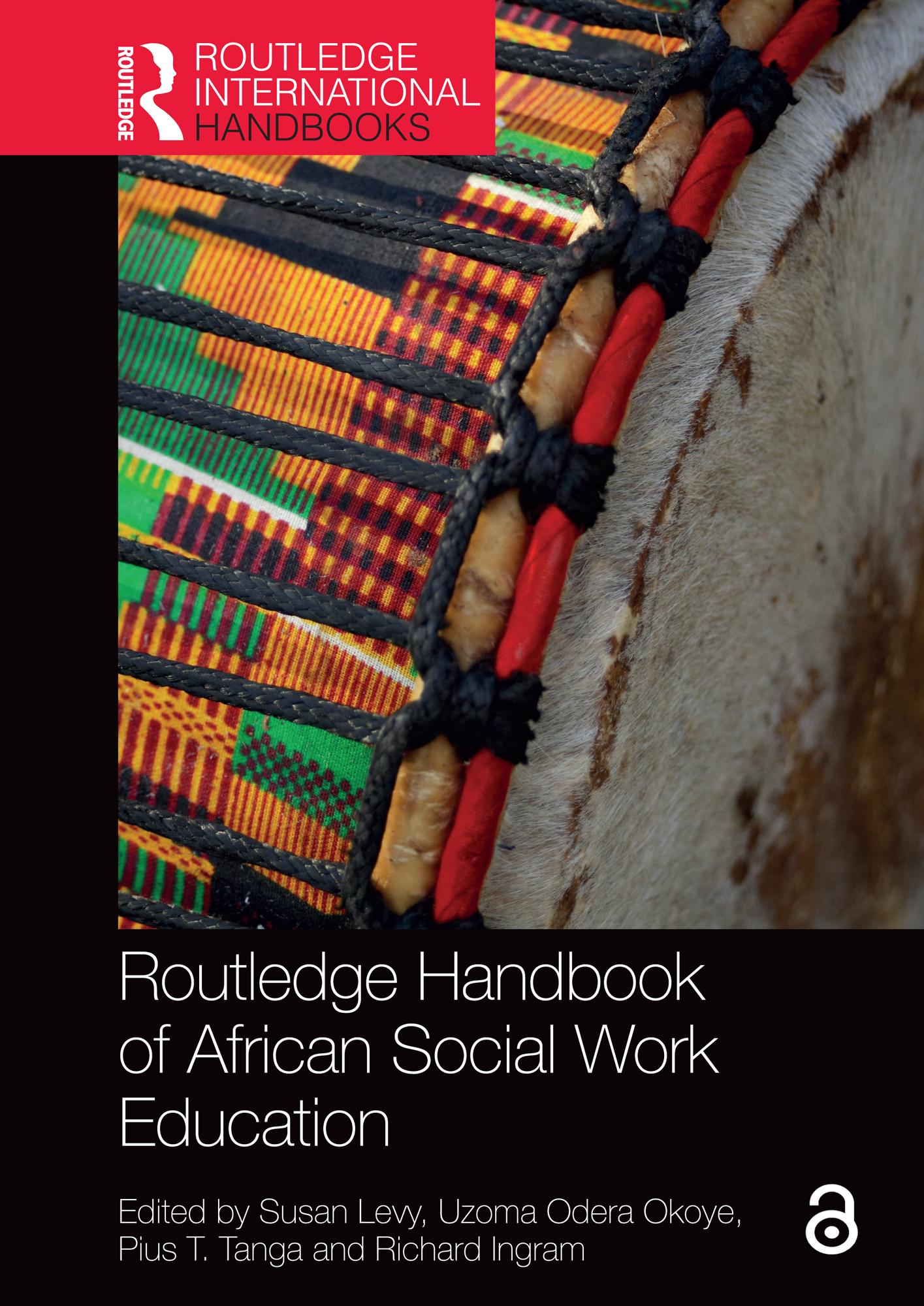
This timely Routledge Handbook creates a much-needed space to explore what makes social work uniquely African, as well as shaping, informing, and influencing a new culturally relevant era of social work. The specific focus on social work education offers approaches to transition away from the hegemony of Western literature, knowledge, and practice models underpinning African social work education. The authors identify what is relevant and meaningful to inform, influence, and reconceptualise culturally relevant social work curriculum.
Covering Botswana, Cameroon, Ethiopia, Ghana, Guinea, Kenya, Malawi, Nigeria, South Africa, Tanzania, Uganda, Zambia, and Zimbabwe, the Handbook comprises both empirical and conceptual chapters, multiple approaches, case studies, and key debates on social work education. It is structured in four parts:
• Approaches to Indigenising, Decolonising and Developing Culturally Relevant Social Work Education
• Social Work Education: Evolution across Contexts
• Embedding Field Practicum into Social Work Education
• Knowledge Exchange between the Global South and Global North.
The range of indigenous, local knowledge that the Handbook presents is crucial to social work evolving and facilitating for reciprocal learning and knowledge exchange between the Global South and Global North. Whilst the context of the Handbook is Africa, the topics covered are relevant to a global audience engaged in social justice work across social work, social welfare, social development, and sustainability.
Pay easily by card, Klarna, Apple Pay or Google Pay. Not happy? You always have a 14-day money-back guarantee. Read more in our terms. If you have any questions, email us at hello@memmo.org.
Memmo makes studying easier – wherever you are in the world. We bring your course books and smart study tools together in one place: summaries, quizzes, podcasts and flashcards. Plus Ted, your study buddy who answers anything you wonder. Over 50,000 students already study here – built to help you learn faster and stress less.