
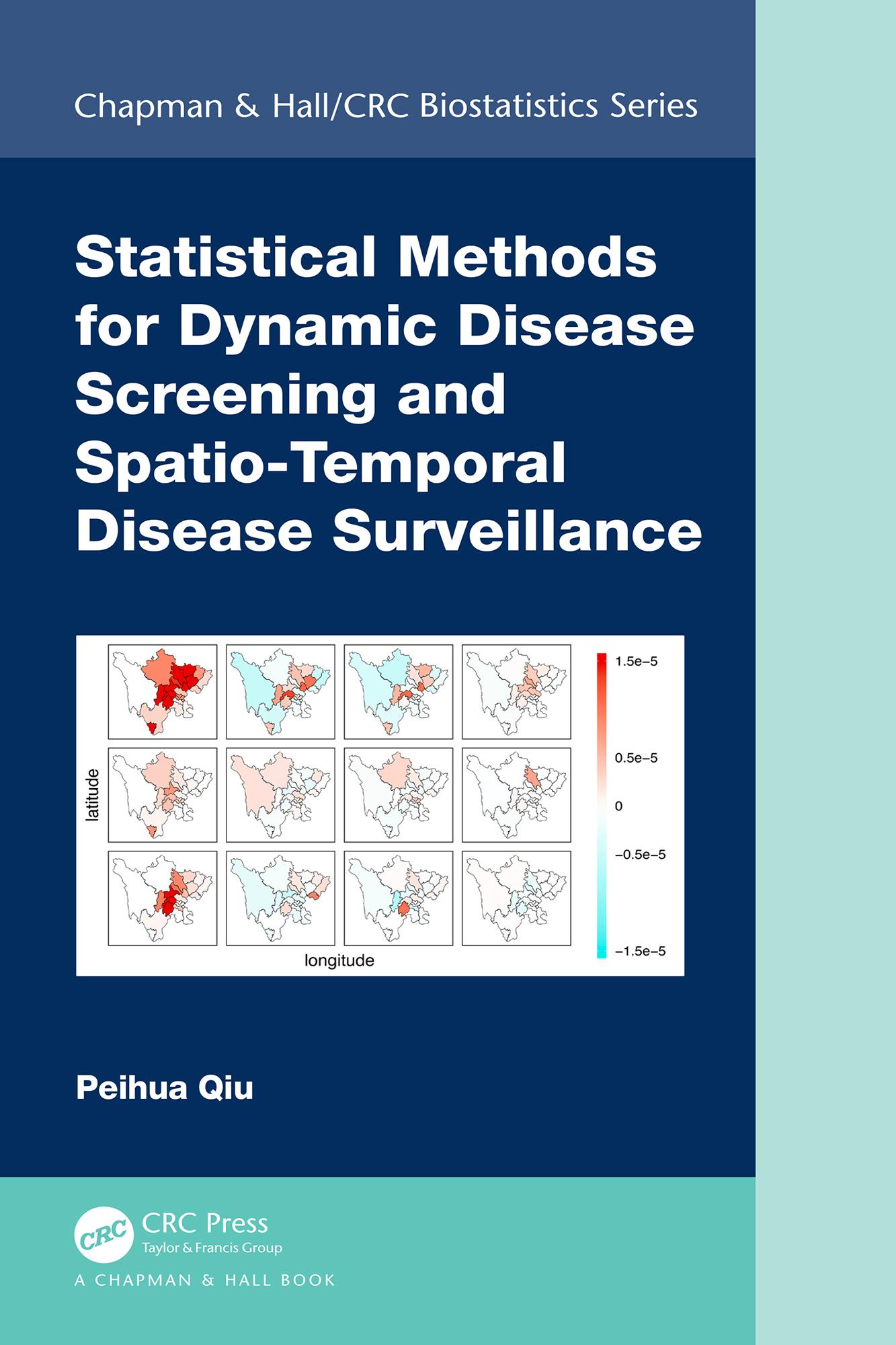
Disease screening and disease surveillance (DSDS) constitute two critical areas in public health, each presenting distinctive challenges primarily due to their sequential decision-making nature and complex data structures. Statistical Methods for Dynamic Disease Screening and Spatio-Temporal Disease Surveillance explores numerous recent analytic methodologies that enhance traditional techniques. The author, a prominent researcher specializing in innovative sequential decision-making techniques, demonstrates how these novel methods effectively address the challenges of DSDS.
After a concise introduction that lays the groundwork for comprehending the challenges inherent in DSDS, the book delves into fundamental statistical concepts and methods relevant to DSDS. This includes exploration of statistical process control (SPC) charts specifically crafted for sequential decision-making purposes. The subsequent chapters systematically outline recent advancements in dynamic screening system (DySS) methods, fine-tuned for effective disease screening. Additionally, the text covers both traditional and contemporary analytic methods for disease surveillance. It further introduces two recently developed R packages designed for implementing DySS methods and spatio-temporal disease surveillance techniques pioneered by the author's research team.
Features
• Presents Recent Analytic Methods for DSDS: The book introduces analytic methods for DSDS based on SPC charts. These methods effectively utilize all historical data, accommodating the complex data structure inherent in sequential decision-making processes.
• Introduces Recent R Packages: Two recent R packages, DySS and SpTe2M, are introduced. The book not only presents these packages but also demonstrates key DSDS methods using them.
• Examines Recent Research Results: The text delves into the latest research findings across various domains, including dynamic disease screening, nonparametric spatio-temporal data modeling and monitoring, and spatio-temporal disease surveillance.
• Accessible Description of Methods: Major methods are described in a manner accessible to individuals without advanced knowledge in mathematics and statistics. The goal is to facilitate a clear understanding of ideas and easy implementation.
• Real-Data Examples: To aid comprehension, the book provides several real-data examples illustrating key concepts and methods.
• Hands-on Exercises: Each chapter includes exercises to encourage hands-on practice, allowing readers to engage directly with the presented methods.
Pay easily by card, Klarna, Apple Pay or Google Pay. Not happy? You always have a 14-day money-back guarantee. Read more in our terms. If you have any questions, email us at hello@memmo.org.
Memmo makes studying easier – wherever you are in the world. We bring your course books and smart study tools together in one place: summaries, quizzes, podcasts and flashcards. Plus Ted, your study buddy who answers anything you wonder. Over 75,000 students already study here – built to help you learn faster and stress less.