
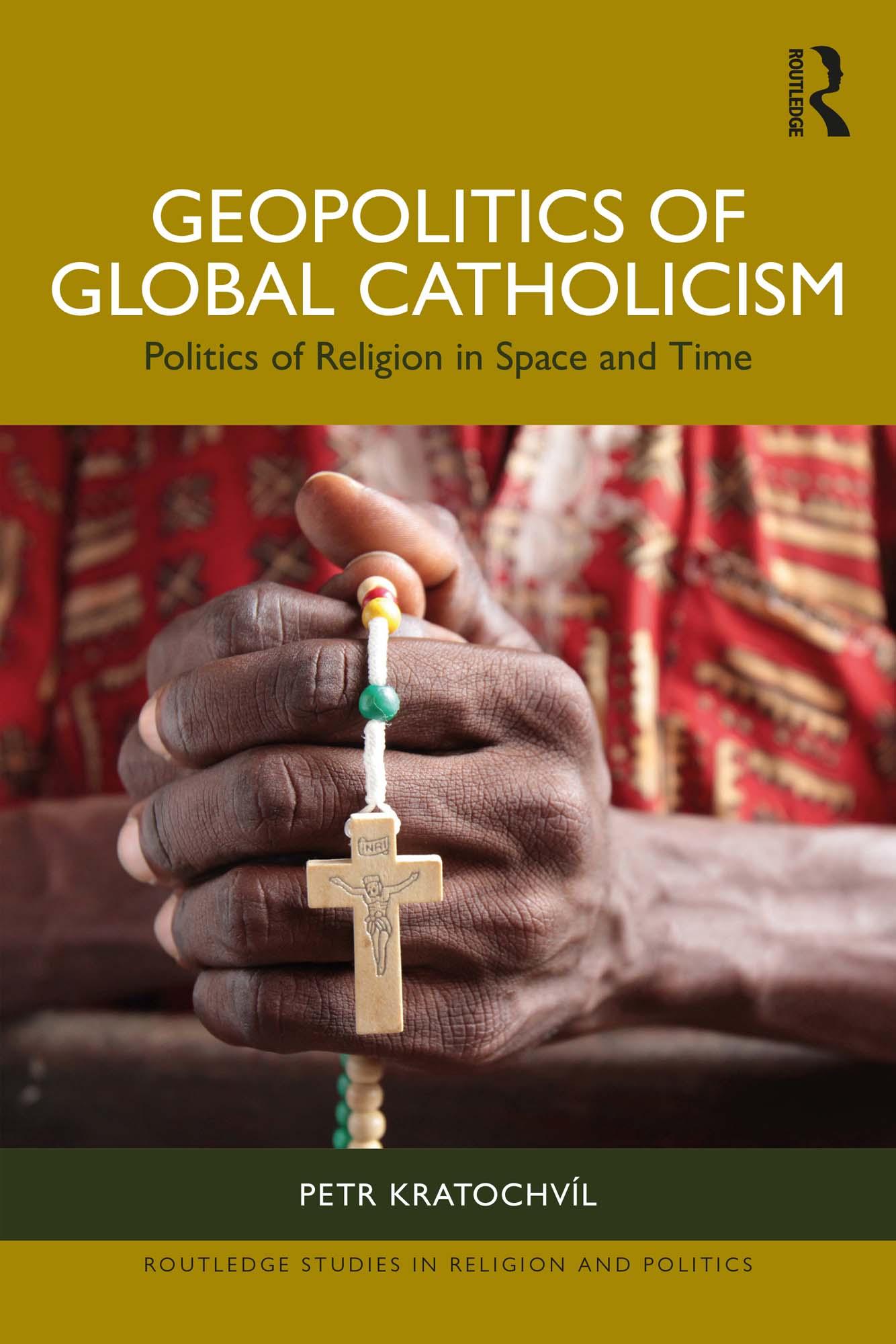
Geopolitics of Global Catholicism uncovers the key trends in today’s Catholicism, providing an incisive analysis of its deep entanglement with national, regional, as well as global politics.
This book offers an exciting exploration of five versions of local Catholicism(s) and sheds light on the various theo-political constellations that not only differ widely across these national contexts but also have global geopolitical consequences. It is built around a novel theoretical argument showing that Catholic geopolitics contains not only a spatial dimension (as classic geopolitical studies would have it) but also a temporal one. As a consequence, the Catholic role in the world cannot be simply understood as a result of the spatial expansion of the Church but rather as a result of the complex relationships between Catholicism and colonization, inculturation, backwardness, and modernization(s). To counter the lingering Eurocentrism of most studies of the Catholic Church, this book’s case studies explore Catholic geopolitics in five non-European contexts, focusing mainly on the Global South (plus the United States): Latin America (Brazil), North America (the United States), Asia (India and China), and Africa (the Democratic Republic of the Congo). These case studies also show that the successes and failures of Catholicism cannot be explained by a recourse to a single, top-down interpretation of Catholic geopolitics, but rather by exploring the various Catholic spatio-temporal constellations on the global, regional, and local levels. With the accelerating diversification of the Church and the growing role of the Global South, these local and regional influences gain further importance as they are likely to increasingly define the future of Catholicism.
This book will be of utmost interest to scholars of International Relations, Religious Studies, Political Science, and Theology, as well as Geopolitics, especially to those studying the global rise of religion. Its accessible language will also appeal to the wider public beyond academia, especially those interested in global Christianity, as well as church leaders, and members of Catholic organizations.
Pay easily by card, Klarna, Apple Pay or Google Pay. Not happy? You always have a 14-day money-back guarantee. Read more in our terms. If you have any questions, email us at hello@memmo.org.
Memmo makes studying easier – wherever you are in the world. We bring your course books and smart study tools together in one place: summaries, quizzes, podcasts and flashcards. Plus Ted, your study buddy who answers anything you wonder. Over 50,000 students already study here – built to help you learn faster and stress less.