
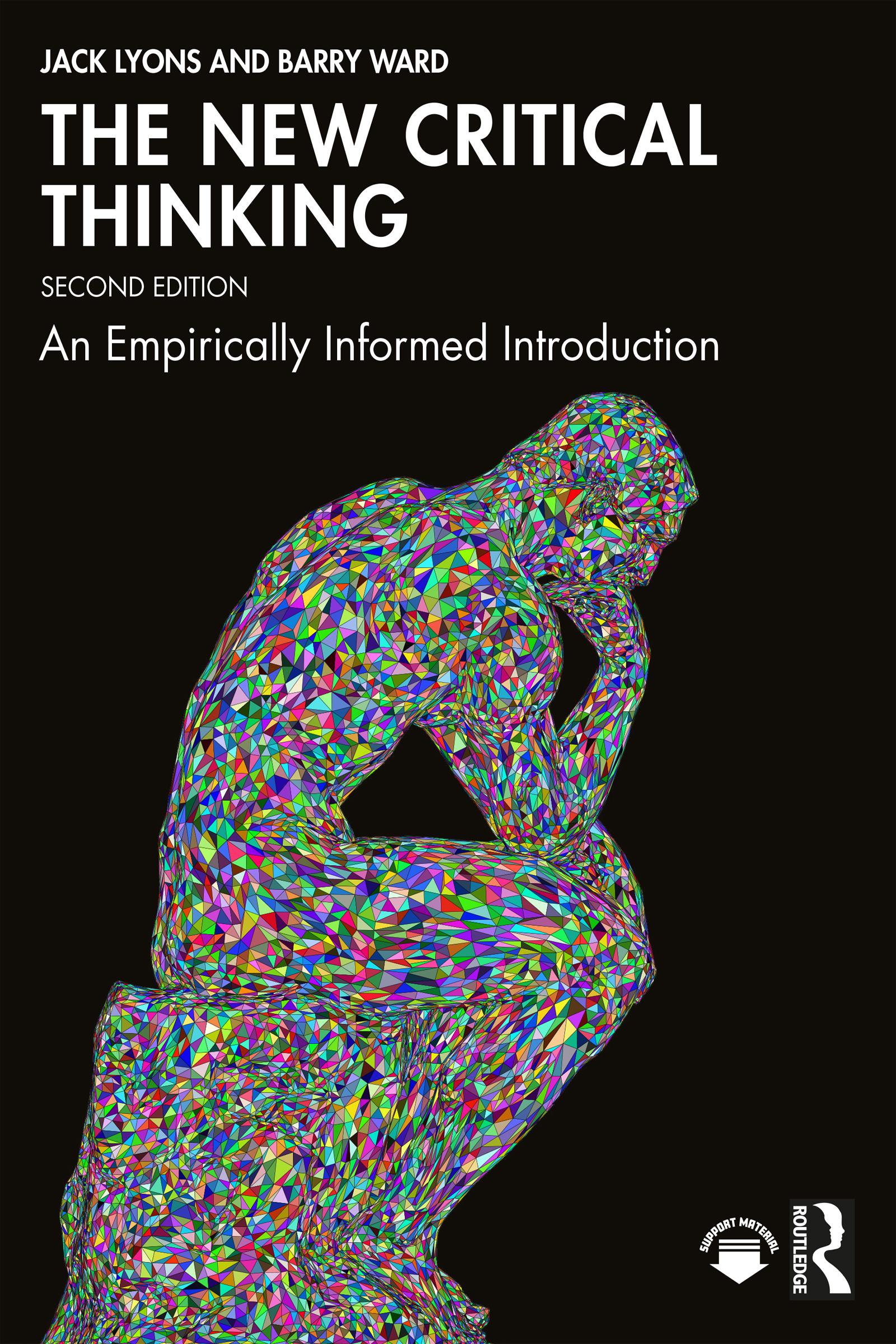
This book aims to improve real-world critical thinking.
Traditional critical thinking texts neglect two crucial facts. First, as psychologists have shown, many of our mistakes are caused not by faulty formal reasoning but because we bypass it in favor of intuitive, often unreliable heuristics. Second, good critical thinking requires not only the proper assessment of inference but also of our premises: the evaluation of information sources is of fundamental importance, especially in this internet era of fake news and politicized science.
This highly innovative text is psychologically informed, both in its diagnosis of inferential errors and in teaching students how to watch out for, and circumnavigate, their natural intellectual blind spots. It also incorporates insights from epistemology and philosophy of science to formulate best practices for assessing information sources on the internet and other media. The result is a practical, hands-on primer for real-world critical thinking.
The authors bring more than five combined decades of classroom experience to the subject, covering the usual core topics of deductive, inductive, causal, and probabilistic inference, argument identification, reconstruction, and diagramming, while also extending the text’s scope to include testimony, the nature and credibility of science, rhetoric, and dialectical argumentation.
The Second Edition further develops and refines these innovations, combining in-depth discussion of “fake news” and conspiracy theories with exercises and projects designed to teach broadly applicable source assessment skills. There is also a more nuanced positive account of science that emphasizes its continuity with commonsense causal reasoning. For instructors, there are additional online resources, notably banks of exam questions with solutions and various class projects.
Key Features:
- Uses contemporary psychological explanations and remedies for pervasive errors in belief formation. No other critical thinking text generally applies this psychological approach
- Rigorously addresses the evaluation of premises based on testimony, in particular the testimony of internet sources
- Carefully explains the concept of validity, paying particular attention to distinguishing logical possibility from other species of possibility
- Uses frequency trees as a simple and reliable alternative to more complicated Bayesian methods
- Uses arguments maps, which improve students’ reasoning and argument evaluation
Key Updates to the Second Edition:
- Expanded discussion of the psychology of reasoning and belief, including treatment of motivated reasoning
- Uses a conventional truth-table–based approach to propositional logic while incorporating a more intuitive, psychologically informed approach to the logic of conditionals
- New Summary Boxes
- Enhanced treatment of testimony, with an expanded discussion of fake news, conspiracy theories, and the application of general epistemic principles to navigate the extremes of gullibility and unmotivated skepticism.
- New exercises that emphasize practical, hands-on source assessment skills
- An improved discussion of the nature of science emphasizing the central role of causal inference and the multi-generational, cumulative character of scientific knowledge
- A new Index of Arguments, summarizing the most common argument forms and associated defeaters for the inductive forms
- New online content, including exams and additional questions (plus solutions), suitable for upload to course management software (e.g., Blackboard, etc.)
For online resources for students and instructors, use the Instructor & Student Resources and Support Material links below.
Pay easily by card, Klarna, Apple Pay or Google Pay. Not happy? You always have a 14-day money-back guarantee. Read more in our terms. If you have any questions, email us at hello@memmo.org.
Memmo makes studying easier – wherever you are in the world. We bring your course books and smart study tools together in one place: summaries, quizzes, podcasts and flashcards. Plus Ted, your study buddy who answers anything you wonder. Over 50,000 students already study here – built to help you learn faster and stress less.