
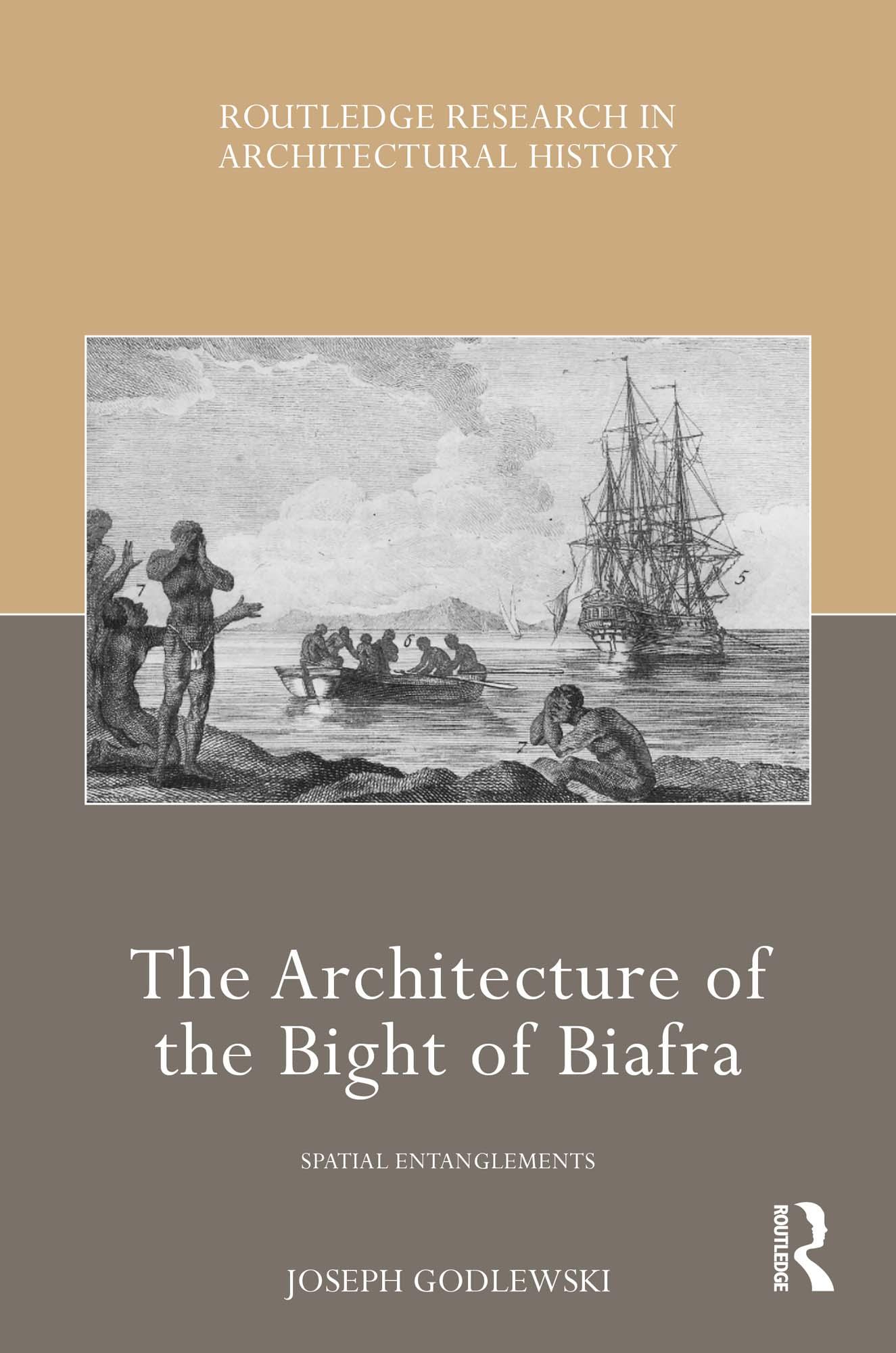
The Architecture of the Bight of Biafra challenges linear assumptions about agency, progress, and domination in colonial and postcolonial cities, adding an important sub‑Saharan case study to existing scholarship on globalization and modernity.
Intersected by small creeks, rivulets, and dotted with mangrove swamps, the Bight of Biafra has a long history of decentralized political arrangements and intricate trading networks predating the emergence of the Atlantic world. While indigenous merchants in the region were active participants in the transatlantic slave trading system, they creatively resisted European settlement and maintained indigenous sovereignty until the middle of the nineteenth century. Since few built artifacts still exist, this study draws from a close reading of written sources—travelers’ accounts, slave traders’ diaries, missionary memoirs, colonial records, and oral histories—as well as contemporary fieldwork to trace transformations in the region’s built environment from the sixteenth century to today. With each chapter focusing on a particular spatial paradigm in this dynamic process, this book uncovers the manifold and inventive ways in which actors strategically adapted the built environment to adjust to changing cultural and economic circumstances. In parallel, it highlights the ways that these spaces were rhetorically constructed and exploited by foreign observers and local agents. Enmeshed in the history of slavery, colonialism, and the modern construction of race, the spatial dynamics of the Biafran region have not been geographically delimited. The central thesis of this volume is that these spaces of entanglement have been productive sites of Black identity formation involving competing and overlapping interests, occupying multiple positions and temporalities, and ensnaring real, imagined, and sometimes contradictory aims.
This book will be of interest to researchers and students of architecture, architectural history, urban geography, African studies, and Atlantic studies.
This book was awarded the Cecil B. Currey Book Award by the Association for Global South Studies (AGSS) and Honorable Mention for the 2025 Anthony Leeds Prize in Urban Anthropology by the Critical Urban Anthropology Association (CUAA).
Pay easily by card, Klarna, Apple Pay or Google Pay. Not happy? You always have a 14-day money-back guarantee. Read more in our terms. If you have any questions, email us at hello@memmo.org.
Memmo makes studying easier – wherever you are in the world. We bring your course books and smart study tools together in one place: summaries, quizzes, podcasts and flashcards. Plus Ted, your study buddy who answers anything you wonder. Over 75,000 students already study here – built to help you learn faster and stress less.