
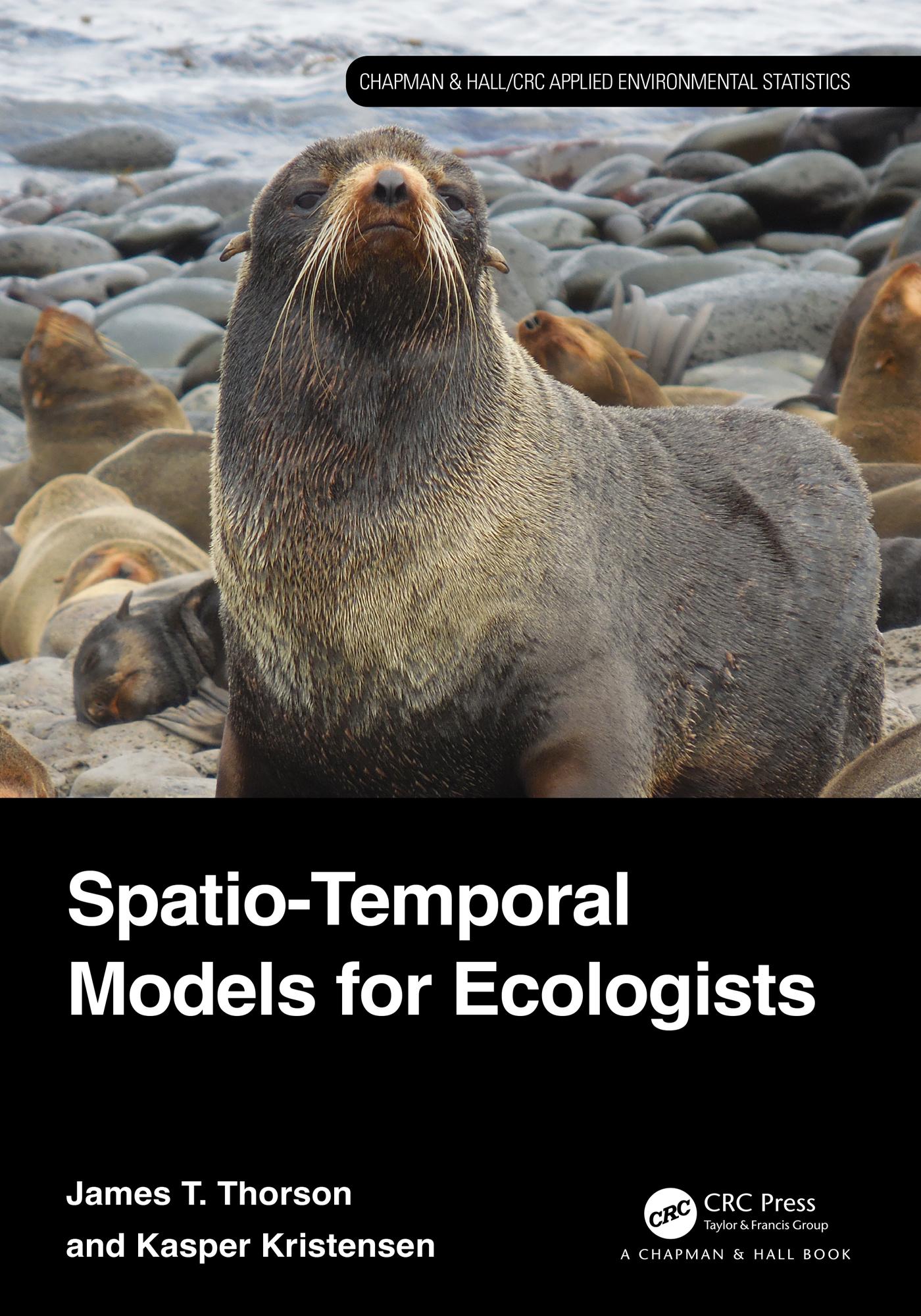
Ecological dynamics are tremendously complicated and are studied at a variety of spatial and temporal scales. Ecologists often simplify analysis by describing changes in density of individuals across a landscape, and statistical methods are advancing rapidly for studying spatio-temporal dynamics. However, spatio-temporal statistics is often presented using a set of principles that may seem very distant from ecological theory or practice. This book seeks to introduce a minimal set of principles and numerical techniques for spatio-temporal statistics that can be used to implement a wide range of real-world ecological analyses regarding animal movement, population dynamics, community composition, causal attribution, and spatial dynamics. We provide a step-by-step illustration of techniques that combine core spatial-analysis packages in R with low-level computation using Template Model Builder. Techniques are showcased using real-world data from varied ecological systems, providing a toolset for hierarchical modelling of spatio-temporal processes. Spatio-Temporal Models for Ecologists is meant for graduate level students, alongside applied and academic ecologists.
Key Features:
- Foundational ecological principles and analyses
- Thoughtful and thorough ecological examples
- Analyses conducted using a minimal toolbox and fast computation
- Code using R and TMB included in the book and available online
Pay easily by card, Klarna, Apple Pay or Google Pay. Not happy? You always have a 14-day money-back guarantee. Read more in our terms. If you have any questions, email us at hello@memmo.org.
Memmo makes studying easier – wherever you are in the world. We bring your course books and smart study tools together in one place: summaries, quizzes, podcasts and flashcards. Plus Ted, your study buddy who answers anything you wonder. Over 75,000 students already study here – built to help you learn faster and stress less.