
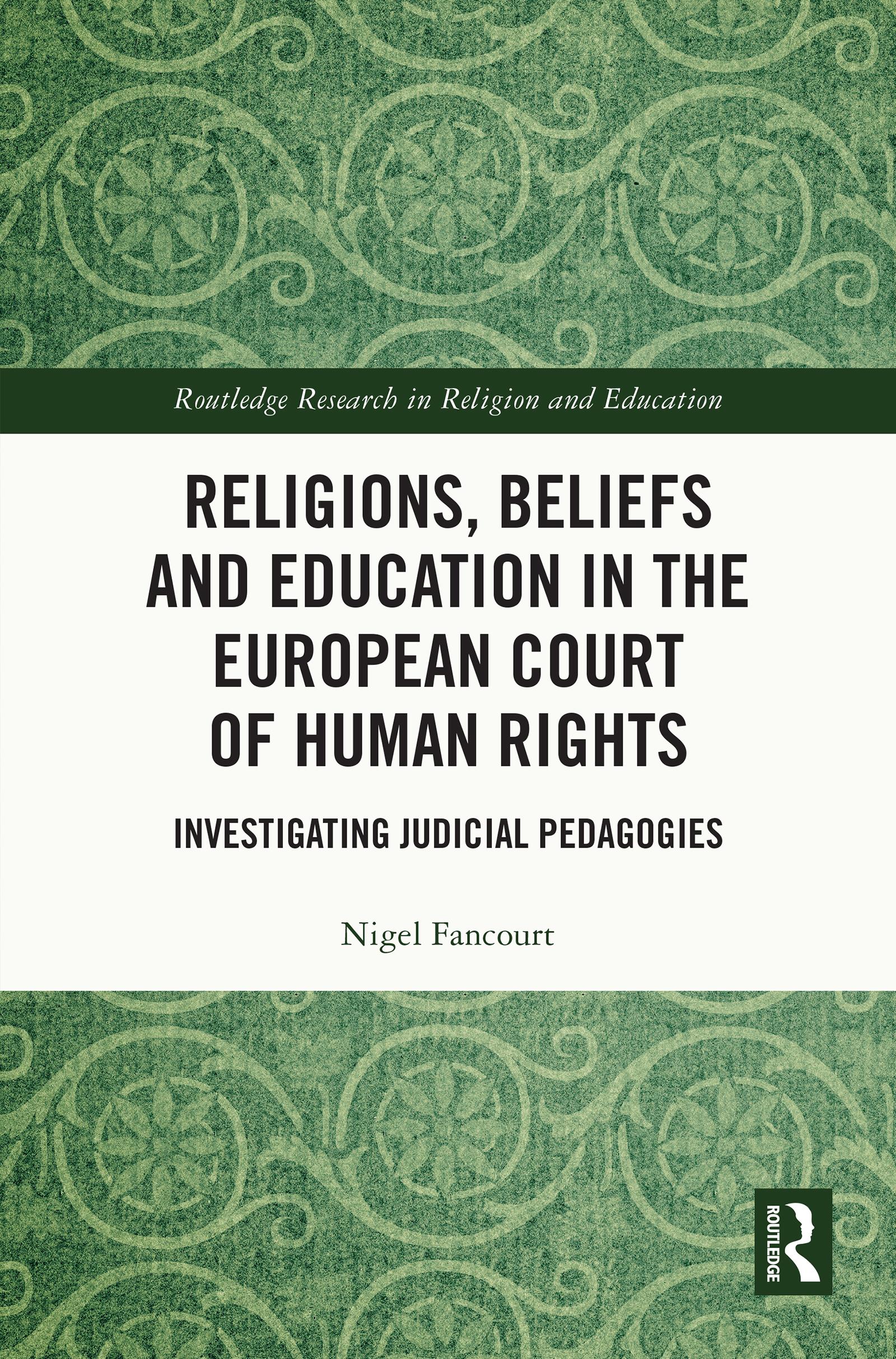
This book represents an exposition of ‘judicial pedagogies’ as a new concept, and discusses juridical-educational issues in detail, through an analysis of the educational claims and assumptions of judges’ decisions in the European Court of Human Rights (ECtHR).
It sheds light on how, within courtrooms around the world, judges are increasingly being asked to decide upon issues of religion and belief in schooling, whether about admissions policies, curriculum planning, or pupils’ and teachers’ dress and jewellery. With key human rights principles at stake, these proceedings are often fraught, clashing with strong opinions about education and schooling. Focusing on decisions made in the European Court of Human Rights (ECtHR), the author considers how the supranational court looks at these issues, and considers the ECtHR’s role within the European Education space. Drawing upon research and scholarship surrounding these questions, the book surveys a series of educational issues, including curriculum and assessment, and takes a comparative approach in the discussion of case studies to demonstrate the variety and depth of judges’ thinking. Thus, rather than considering the national or supranational legal principles and questions as jurisprudential issues, typically about religion or human rights, it reviews them from an educational perspective – as ‘folk’ theories of teaching and learning. Finally, it considers the implications of a theory of judicial pedagogy for the courts’ educational competence in deciding on these matters, for education and educational policy research, the European education space, legal scholarship, and for legal and judicial education.
Developing a novel and innovative approach to the pedagogies at play in a courtroom and providing fresh insights into the courts as agents of social change, it will appeal to scholars and researchers working across the disciplines of education, law, and religious studies.
Pay easily by card, Klarna, Apple Pay or Google Pay. Not happy? You always have a 14-day money-back guarantee. Read more in our terms. If you have any questions, email us at hello@memmo.org.
Memmo makes studying easier – wherever you are in the world. We bring your course books and smart study tools together in one place: summaries, quizzes, podcasts and flashcards. Plus Ted, your study buddy who answers anything you wonder. Over 50,000 students already study here – built to help you learn faster and stress less.