
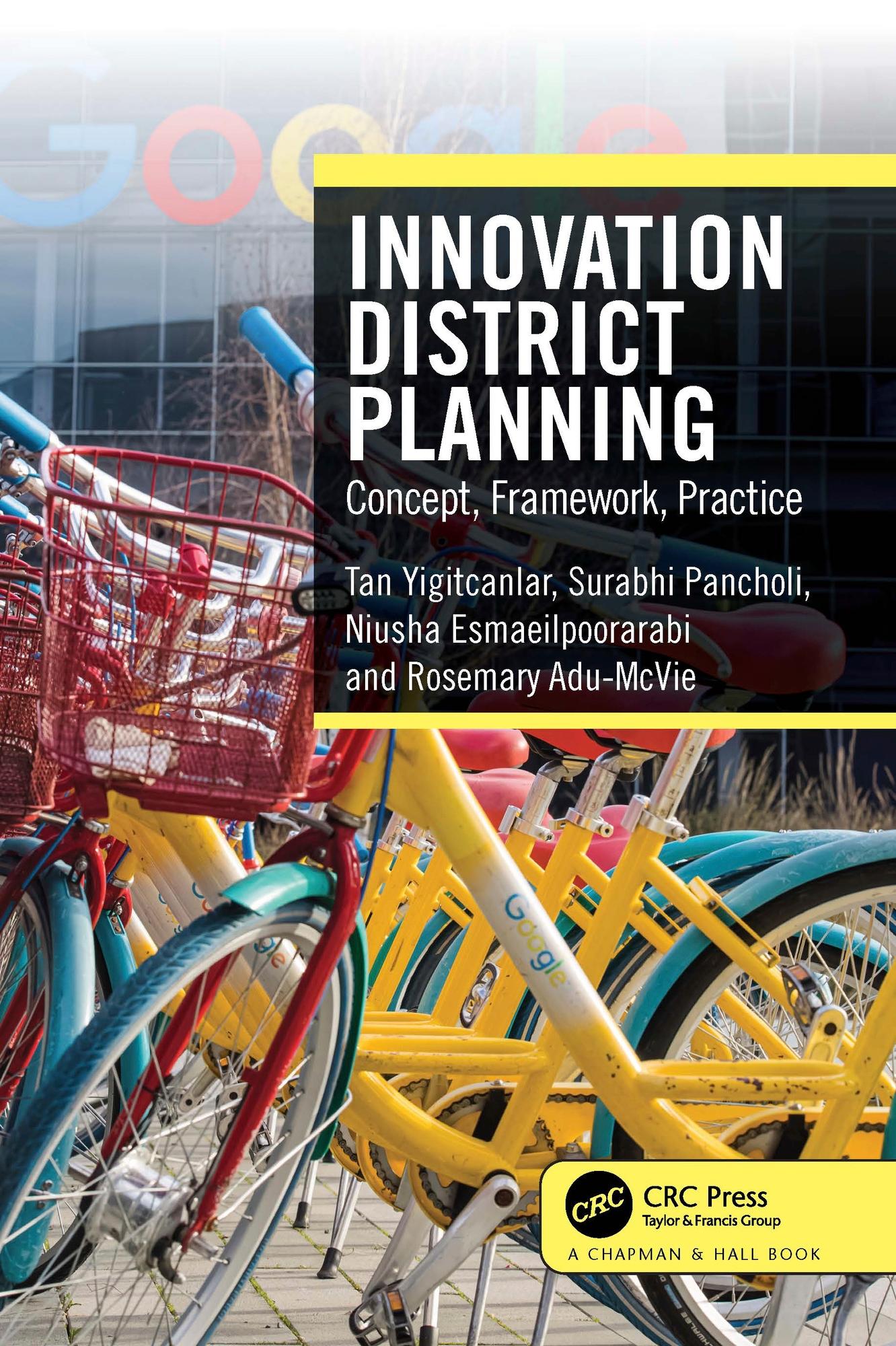
This book aims to fill the knowledge gap on how to plan, develop and manage innovation districts that are competitive in terms of both productivity and quality of living, justifying the massive investment put into place and at the same time doing both in a delicate and harmonious way.
There is a need for smart urban land use that is wired with both hard infrastructures (e.g., telecommunication and transport) and soft infrastructures (e.g., diversity and tolerance). The reader learns this knowledge through conceptual expansions for key insights, frameworks for potential and performance assessment and best practices for global innovation districts. The authors begin innovation district planning with the role and effectiveness of planning a branding in the development of innovation districts. The next key topic of place making is recognised as a key strategy for supporting knowledge generation and innovation activities in the contemporary innovation districts. Another important topic is place quality where the reader learns to identify and classify indicators of place quality by studying global innovation districts best practices. The reader also expands their understanding on the classification of innovation districts based on their key characteristics through a methodological approach. The book concludes with district smartness studied through the socio-cultural role played by anchor universities in facilitating place making in innovation districts. Smart campuses, enabled by digital transformation opportunities in higher education, are seen as a miniature replica of smart cities and serve as living labs for smart technology.
The book serves as a repository for scholars, researchers, postgraduate and undergraduate students as it communicates the complex innovation district phenomenon in an easy-to-digest form by providing both the big picture view and specifics of each component of that view.
Pay easily by card, Klarna, Apple Pay or Google Pay. Not happy? You always have a 14-day money-back guarantee. Read more in our terms. If you have any questions, email us at hello@memmo.org.
Memmo makes studying easier – wherever you are in the world. We bring your course books and smart study tools together in one place: summaries, quizzes, podcasts and flashcards. Plus Ted, your study buddy who answers anything you wonder. Over 75,000 students already study here – built to help you learn faster and stress less.