
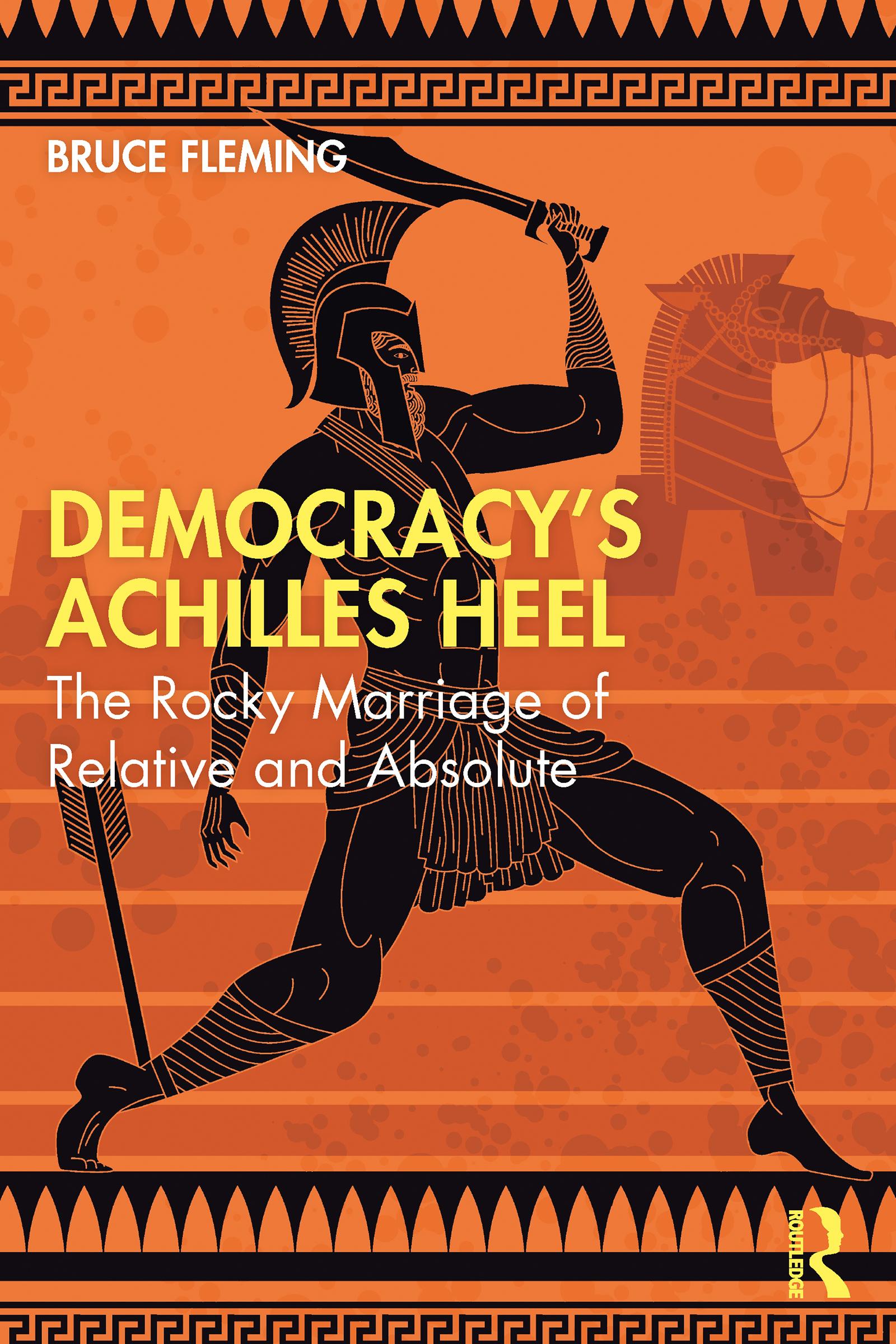
Democracy’s Achilles Heel argues that the structure of democracy is a combination of two incompatible worldviews: one relativist and liberal, the other absolutist and conservative. This combination of opposites is essential for its survival, yet places democracy at risk since each worldview is prone to trying to engulf the other, creating threats from both the right and the left. This is democracy’s Achilles heel: it never goes away and can only be avoided. The nature of open societies means that absolutisms, for example of a religious kind, can exist quite comfortably within democracy, yet for democracy to succeed, they must permit other belief systems and worldviews, absolute or otherwise, to exist alongside them. Likewise, relativism can undermine the liberal nature of democracy itself in seeking to reduce the existence of absolutisms to nothing, thus threatening freedom and destabilizing democracy. Reacting to the recent clashes in Western democracies between left and right, and drawing on the theories of such now-classic thinkers as Fromm, Berlin, and Hoffer, as well as more recent sources such as Levitsky and Ziblatt’s How Democracies Die, the author moves beyond the usual defenses of democracy, accepting the fact that democracy, because of its combination of opposites, is always unstable and always at risk, while urging those who live within democratic polities to strengthen its chances of survival by remembering its fundamental value and purpose. An impassioned defense of the democratic way of life even given (and indeed because of) its eternally threatened nature, Democracy’s Achilles Heel will appeal to scholars, students, and readers with interests in political sociology, philosophy, and political theory.
Pay easily by card, Klarna, Apple Pay or Google Pay. Not happy? You always have a 14-day money-back guarantee. Read more in our terms. If you have any questions, email us at hello@memmo.org.
Memmo makes studying easier – wherever you are in the world. We bring your course books and smart study tools together in one place: summaries, quizzes, podcasts and flashcards. Plus Ted, your study buddy who answers anything you wonder. Over 50,000 students already study here – built to help you learn faster and stress less.