
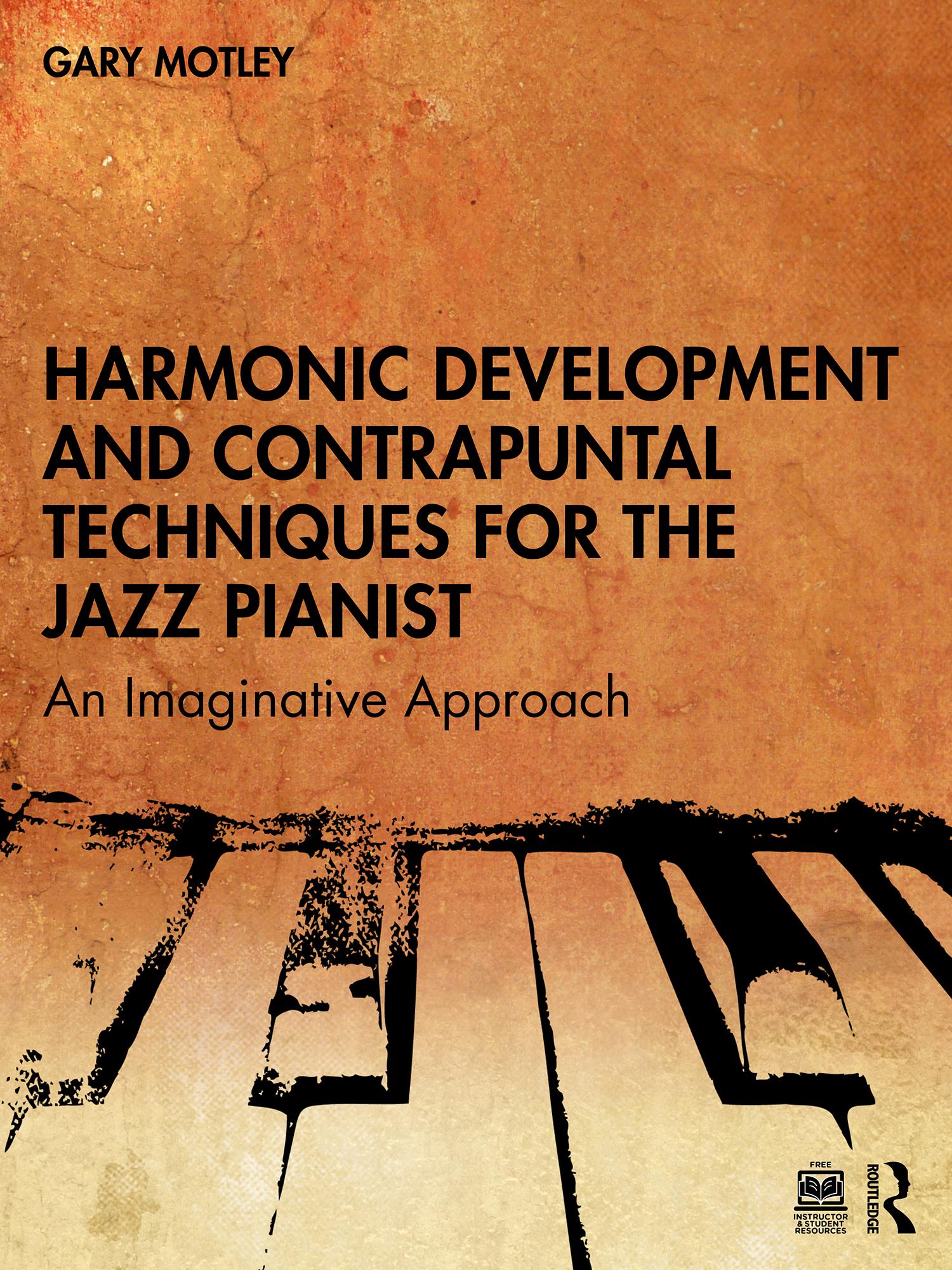
Harmonic Development and Contrapuntal Techniques for the Jazz Pianist serves as a guide for harmonic expansion and development for jazz piano, offering pianists both a rationale and methods to improve contrapuntal hand techniques.
The text focuses on the relationship between theory and execution and both of those components’ usefulness in creating a jazz sound at the piano. This kinaesthetic method provides the learner with a systematic approach to harmonic movement, revealing options that may not have been otherwise apparent. This method will allow pianists to add depth and dimension to their chord voicings in the same way that vocalists and wind instrumentalists give character and shape to the notes they create.
Key features include musical examples ranging from singular chord construction to sophisticated harmonic progressions and song application. Performance exercises are provided throughout the text. Learners and instructors are encouraged to create their own exercises. Related ancillaries at harmoniccounterpoint.com include:
- Musical examples
- Audio tracks
- Performance exercises
- Written assignments
Intended for the learner who is reasonably familiar with essential jazz harmony, this textbook will be both a significant resource for the advanced player and a fundamental component for the learner in a structured academic musical setting.
Pay easily by card, Klarna, Apple Pay or Google Pay. Not happy? You always have a 14-day money-back guarantee. Read more in our terms. If you have any questions, email us at hello@memmo.org.
Memmo makes studying easier – wherever you are in the world. We bring your course books and smart study tools together in one place: summaries, quizzes, podcasts and flashcards. Plus Ted, your study buddy who answers anything you wonder. Over 50,000 students already study here – built to help you learn faster and stress less.