
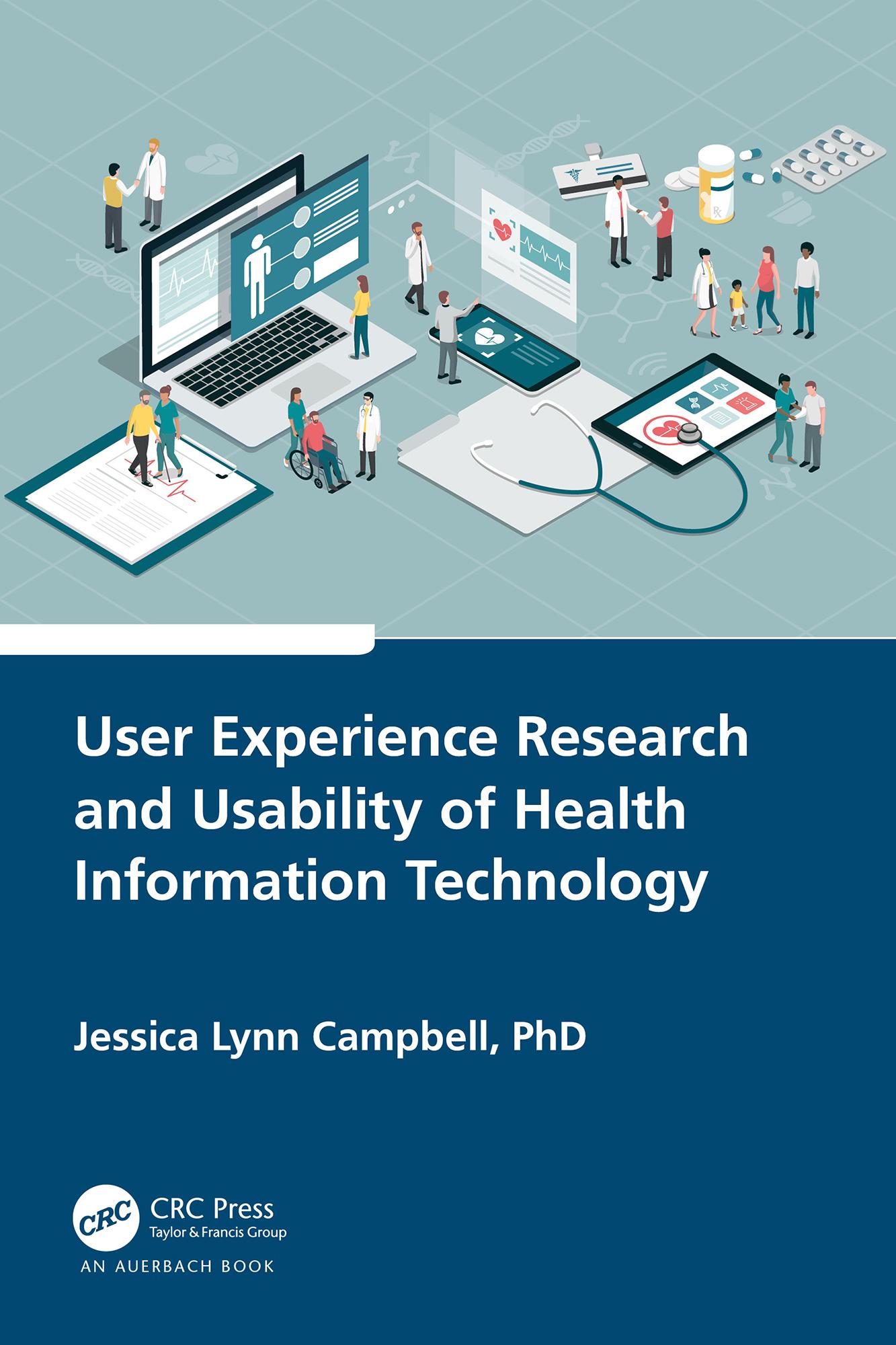
Health information technology (HIT) is a critical component of the modern healthcare system. Yet to be effective and safely implemented in healthcare organizations and physicians and patients’ lives, it must be usable and useful. User Experience (UX) research is required throughout the full system design lifecycle of HIT products, which involve a user-centered and human- centered approach. This book discusses UX research frameworks, study designs, methods, data-analysis techniques, and a variety of data collection instruments and tools that can be used to conduct UX research in the healthcare space, all of which involve HIT and digital health. This book is for academics and scholars to be used to design studies for graduate dissertation work, in independent research, or as a textbook for UX/usability courses in health informatics or related health information and communication courses. This book is also useful for UX practitioners because it provides guidance on how to design a user research or usability study and focuses on leveraging a mixed- methods approach, including step-by-step by instructions and best practices for conducting:
- Field studies
- Interviews
- Focus groups
- Diary studies
- Surveys
- Heuristic evaluation
- Cognitive walkthrough
- Think aloud
A plethora of standardized surveys and retrospective questionnaires (SUS, Post-study System Usability Questionnaire (PSSUQ)) are also included. UX researchers and healthcare professionals will gain an understanding of how to design a rigorous, yet feasible study that generates useful insights to inform the design of usable HIT. Everything from consent forms to how many participants to include in a usability study has been covered in this book. The author encourages user-centered design (UCD), mixed-methods, and collaboration amongst interdisciplinary teams. Knowledge from many inter-related disciplines, like psychology, technical communication (TC), and human-computer interaction (HCI), together with experiential knowledge from experts is offered throughout the text.
Pay easily by card, Klarna, Apple Pay or Google Pay. Not happy? You always have a 14-day money-back guarantee. Read more in our terms. If you have any questions, email us at hello@memmo.org.
Memmo makes studying easier – wherever you are in the world. We bring your course books and smart study tools together in one place: summaries, quizzes, podcasts and flashcards. Plus Ted, your study buddy who answers anything you wonder. Over 50,000 students already study here – built to help you learn faster and stress less.