
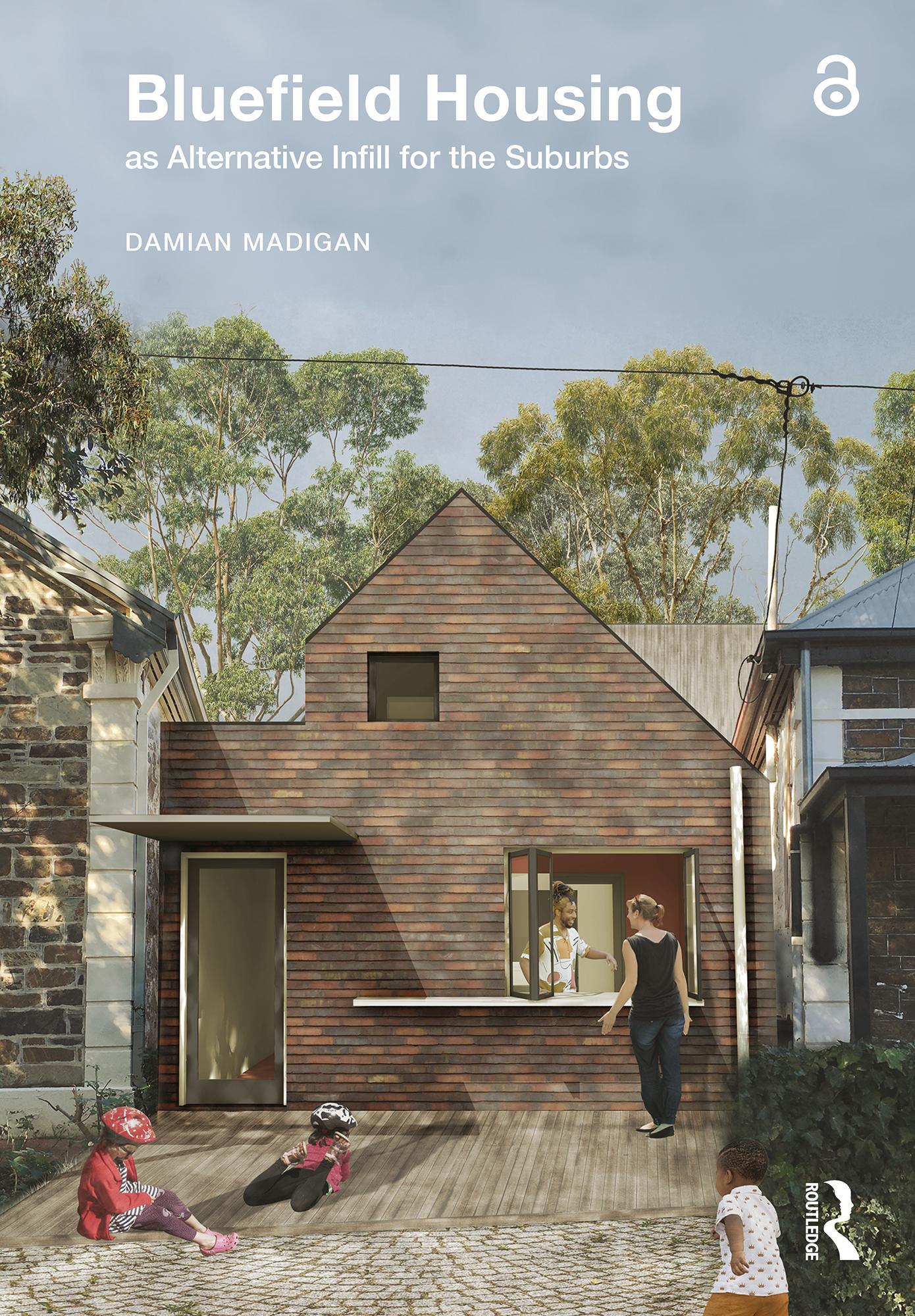
Suburbanised cities share a common dilemma: how to transition to more densely populated and socially connected urban systems while retaining low-rise character, avoiding gentrification, and opening neighbourhoods to more diverse housing choices. Bluefield Housing offers a new land definition and co-located infill model addressing these concerns, through describing and deploying the types of ad-hoc modifications that have been undertaken in the suburbs for decades. Extending green-, brown-, and greyfield definitions, it provides a necessary middle ground between the ‘do nothing’ attitude of suburban preservation and the ‘do everything’ approach of knock-down-rebuild regeneration.
An adjunct to ‘missing middle’ and subdivision densification models, with a focus on co-locating homes on small lots, Bluefield Housing presents a unified design approach to suburban infill: retrofitting original houses, retaining and enhancing landscape and urban tree canopies, and delivering additional homes as low-rise additions and backyard homes suited to the increasingly complex make-up of our households.
Extensively illustrated by the author with engaging architectural design studies, Damian Madigan describes how existing quirks of suburban housing can prompt new forms of infill, explains why a new suburban densification model is not only necessary but can be made desirable for varied stakeholders, and charts a path towards the types of statutory and market triggers required to make bluefield housing achievable. Using Australian housing as an example but addressing universal concerns around neighbourhood character, demographic needs, housing diversity, dwelling flexibility, and landscape amenity, Bluefield Housing offers innovative suburban infill ideas for policy makers, planners, architects, researchers and students of housing and design studies, and for those with a stake in the future of the suburbs.
The Open Access version of this book, available at www.taylorfrancis.com, has been made available under a Creative Commons Attribution-Non Commercial-No Derivatives (CC-BY-NC-ND) 4.0 license.
Pay easily by card, Klarna, Apple Pay or Google Pay. Not happy? You always have a 14-day money-back guarantee. Read more in our terms. If you have any questions, email us at hello@memmo.org.
Memmo makes studying easier – wherever you are in the world. We bring your course books and smart study tools together in one place: summaries, quizzes, podcasts and flashcards. Plus Ted, your study buddy who answers anything you wonder. Over 75,000 students already study here – built to help you learn faster and stress less.