
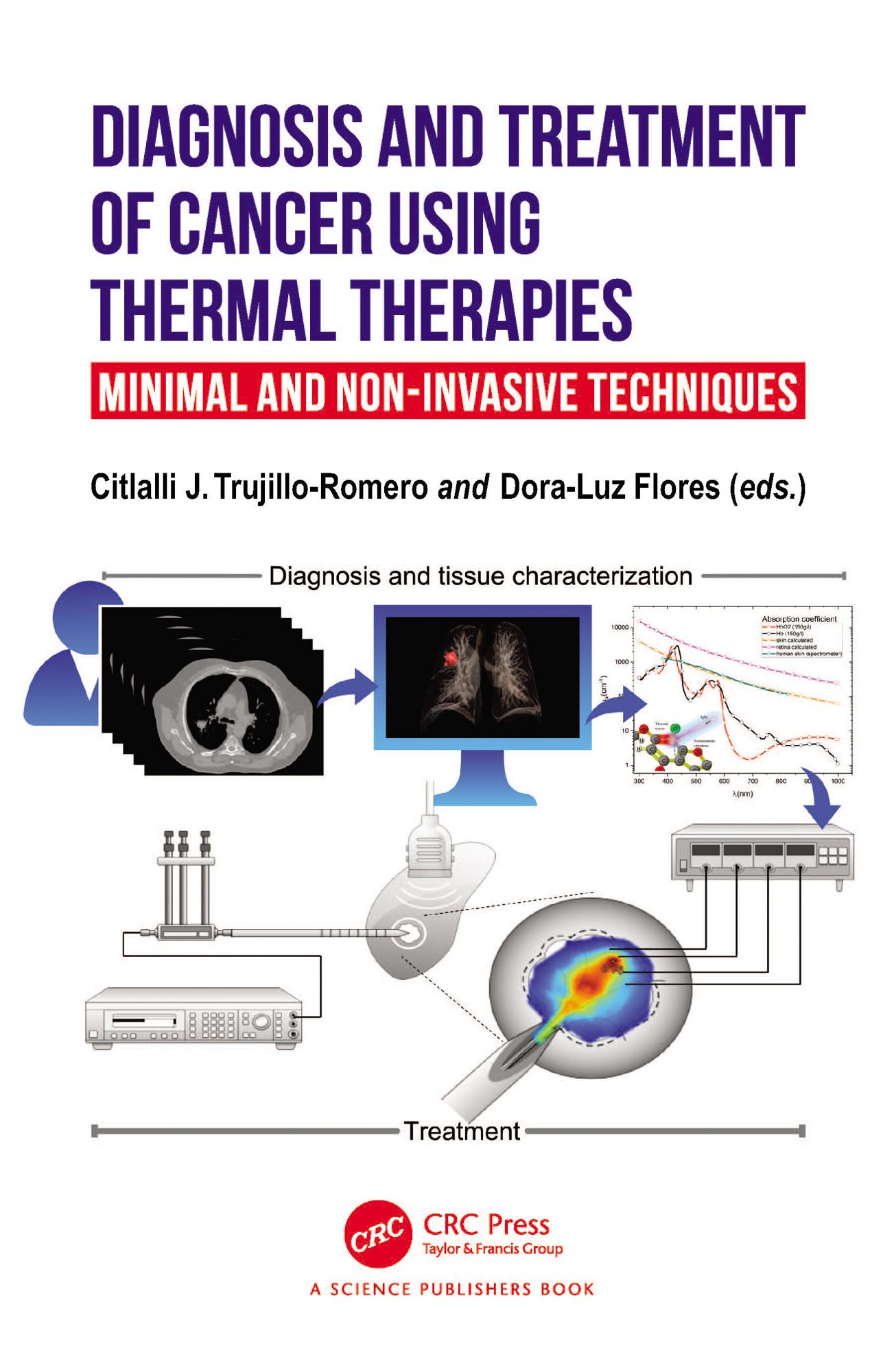
New research is being conducted in the diagnosis and new treatments of cancer that has high efficacy and are minimally invasiveness. Artificial intelligence, bioimpedance, thermal images and nanomaterials have been used to provide early diagnosis. New treatments based on the generation of microwaves, radiofrequency, or ultrasound have been proposed in the last couple of decades. Although thermotherapies have been shown to be efficient, for them to be considered as a primary treatment, they must overcome some hurdles. One of the main challenges is to ensure applicators that point the electromagnetic or the mechanical waves at a tumor, don't affect the surrounding healthy tissues. In some cases, nanoparticles have also been designed to achieve better focus. The design of new applicators can be made by computational models based on methods such as the finite element. However, to efficiently predict the applicator’s performance, it is important that dielectric, thermal, and acoustic properties (tissue characterization) are included in the models. Not only healthy tissue, but also tumors must be characterized. Patient specific treatment planning, which consists of a 3D patient model based on medical images, can be developed to implement a safety treatment. Moreover, tissue properties as well as the applicator must be defined. Parameters such as temperature increase, and heat pattern must be evaluated to ensure patient safety and treatment success.
Pay easily by card, Klarna, Apple Pay or Google Pay. Not happy? You always have a 14-day money-back guarantee. Read more in our terms. If you have any questions, email us at hello@memmo.org.
Memmo makes studying easier – wherever you are in the world. We bring your course books and smart study tools together in one place: summaries, quizzes, podcasts and flashcards. Plus Ted, your study buddy who answers anything you wonder. Over 75,000 students already study here – built to help you learn faster and stress less.