
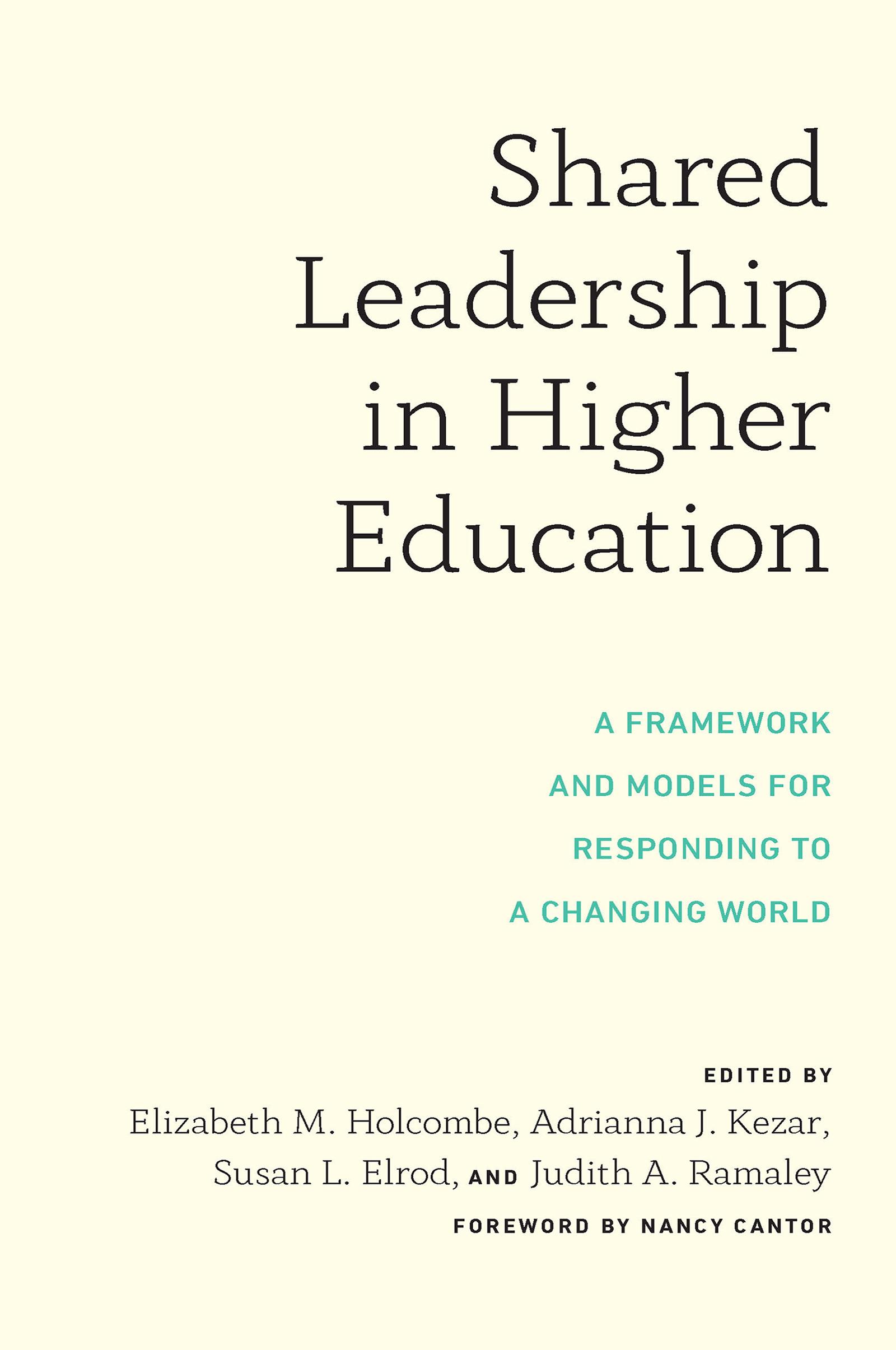
Today’s higher education challenges necessitate new forms of leadership. A volatile financial environment and the need for new business models and partnerships to address the impact of new technologies, changing demographics, and emerging societal needs, demand more effective and innovative forms of leadership. This book focusses on a leadership approach that has emerged as particularly effective for organizations facing complex challenges: shared leadership. Rather than concentrating power and authority in an individual leader at the top of an organization, shared leadership involves multiple people influencing one another across varying levels and at different times. It is a flexible, collective, and non-hierarchical approach to leadership. Organizations that have implemented shared leadership have been better able to learn, innovate, perform, and adapt to the types of external challenges that campuses now face and that will continue to shape higher education in the future. This book brings together the two foremost scholars of higher education who have studied, described and evaluated the impact of shared leadership, a university chancellor with prior experience of facilitating systemic institutional change at two university systems, and the former president of three universities where she coordinated processes that led to the transformational changes needed renew institutional mission and purpose. Opening with four chapters that define the nature of shared leadership, describe its key characteristics, and how to build institutional capacity, the book then presents ten institutional cases. Ranging from institution-wide initiatives at four year colleges and a community college, to examples of managing change in a college, a center, and across STEM departments, the contributing authors describe the context and drivers of the need for change, the building of shared vision to create coalitions, lessons learned, and outcomes. Intended as a resource for leaders at the highest levels such as Presidents and Provosts as well as mid-level leaders such as deans, directors, and department chairs, the book is also addressed to faculty and staff who are interested in collaborating with campus leaders on institutional decision-making or creating new change initiatives. It is intended to build capacity for shared leadership across institutions and for use in leadership courses and programs.
Pay easily by card, Klarna, Apple Pay or Google Pay. Not happy? You always have a 14-day money-back guarantee. Read more in our terms. If you have any questions, email us at hello@memmo.org.
Memmo makes studying easier – wherever you are in the world. We bring your course books and smart study tools together in one place: summaries, quizzes, podcasts and flashcards. Plus Ted, your study buddy who answers anything you wonder. Over 75,000 students already study here – built to help you learn faster and stress less.