
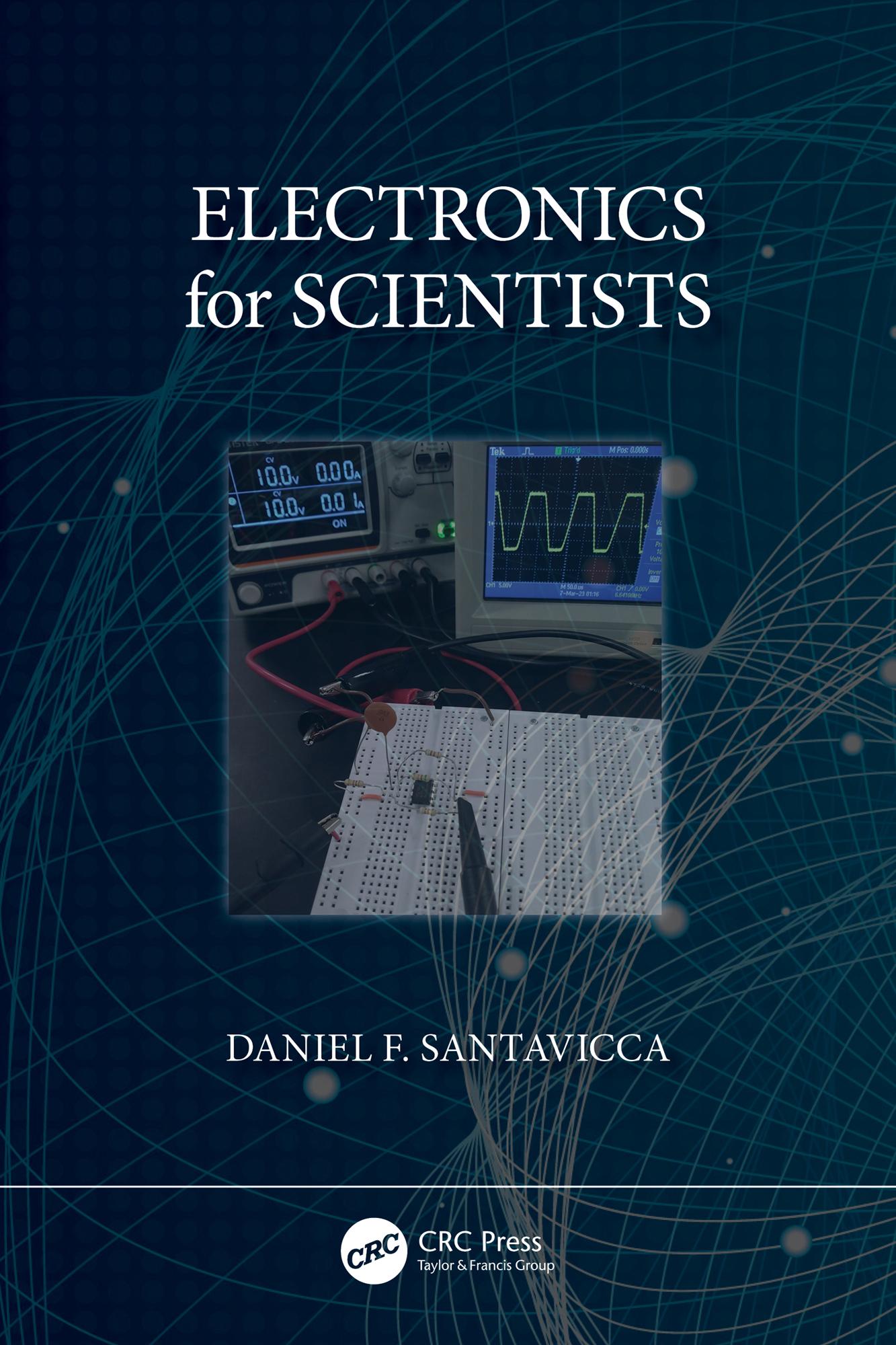
Electronics for Scientists provides a practical and concise introduction to electrical circuits, signals, and instrumentation for undergraduate students in the physical sciences. No previous familiarity with electronics is required and concepts are grounded in the relevant physics. The book aims to give students the electronics background needed to be successful in experimental science.
The book begins with the fundamentals of DC circuits. This is followed by AC circuits and their analysis using the concept of impedance. The transfer function is introduced and used to analyze different types of filter circuits. The conversion between time-domain and frequency-domain signal representations is reviewed. Transmission lines are introduced and used to motivate the different approach to designing microwave-frequency circuits as compared to lower-frequency circuits. The physics of semiconductors is reviewed and used to understand the behavior of diodes and transistors, and a number of diode and transistor circuits are analyzed. The operational amplifier (op-amp) is introduced and several op-amp circuits are analyzed. Techniques for quantifying noise in electrical measurements are described and common sources of noise are discussed. The last major topic is digital circuits, which include analog-to-digital conversion, logic gates, and digital memory circuits. The book concludes with a brief introduction to quantum computing.
Designed for a one-semester course, this book brings together a range of topics relevant to experimental science that are not commonly found in a single text. Worked examples are provided throughout the book, and each chapter concludes with a set of problems to reinforce the material covered. The subject of electronics is indispensable to a wide array of scientific and technical fields, and this book seeks to provide an approachable point of access to this rich and important subject.
Pay easily by card, Klarna, Apple Pay or Google Pay. Not happy? You always have a 14-day money-back guarantee. Read more in our terms. If you have any questions, email us at hello@memmo.org.
Memmo makes studying easier – wherever you are in the world. We bring your course books and smart study tools together in one place: summaries, quizzes, podcasts and flashcards. Plus Ted, your study buddy who answers anything you wonder. Over 50,000 students already study here – built to help you learn faster and stress less.