
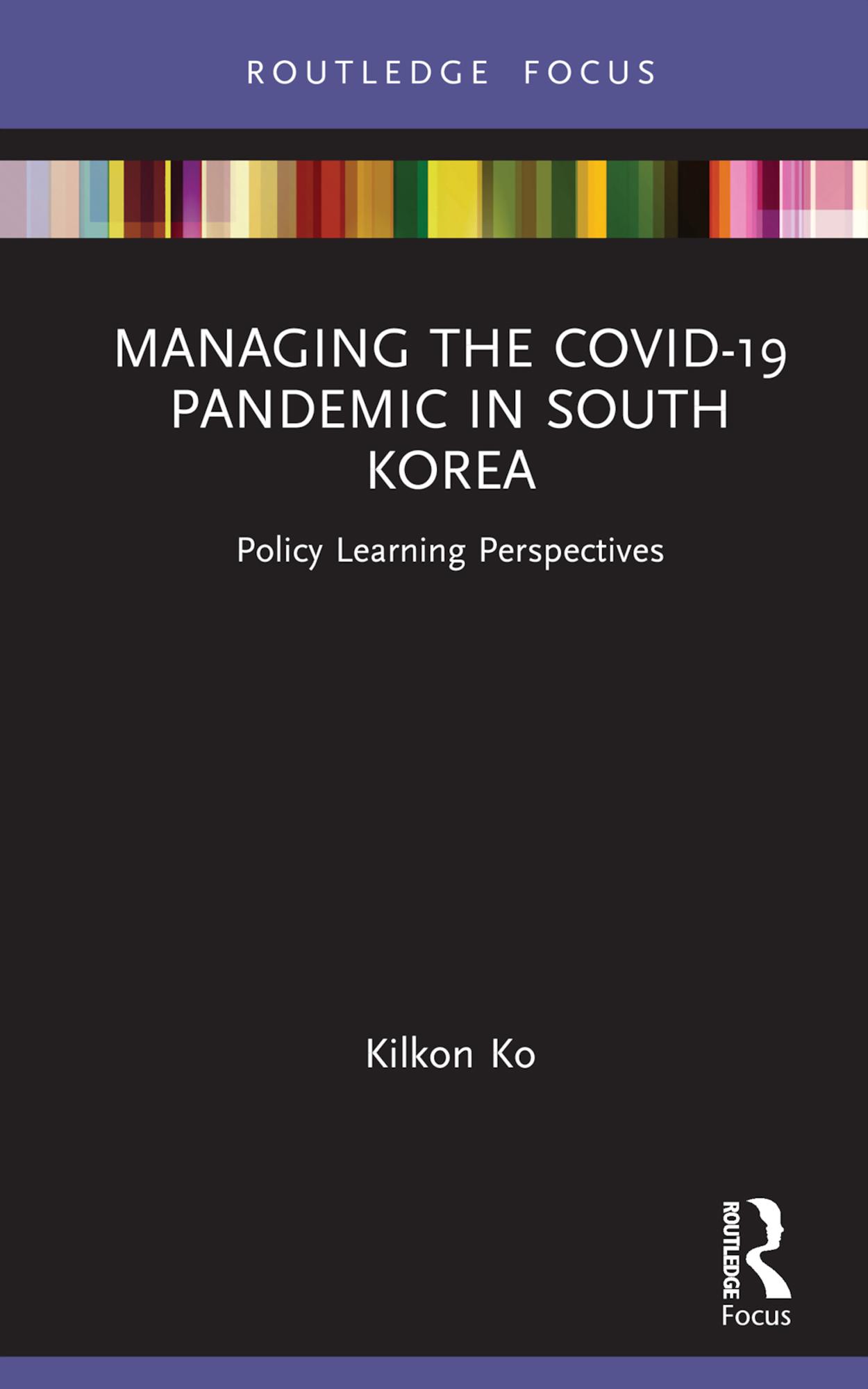
This book examines the importance of accumulated disaster management experience and the risk awareness of civil society by analyzing Korea’s COVID-19 response from the perspective of policy learning. Prior to the spread of COVID-19, Korea was a country with active exchange with China, with over six million Chinese visitors and over five million Korean visitors to China. Korea also has the highest population density among OECD countries and an urbanization rate exceeding 90%, making it vulnerable to the spread of infectious diseases. However, Korea had very low fatality and infection rates among OECD countries, despite foregoing border closures or city lockdowns.
Korea is known as a representative example of state-led economic development called the developmental state model. However, Korea’s COVID-19 response emphasizes citizen-led efforts, the use of information and communication technology, and successful disease control through cooperation between the government and civil society. This book presents examples that demonstrate the effectiveness of disaster response based on democratic values, by enhancing the capacity of civil society through social interaction resulting from various models such as rational models, heuristics, cooperative governance, policy networks, and complex adaptive systems. Additionally, it argues that the lesson learned from Korea’s COVID-19 experience is not that a strong state should control citizens’ freedom to increase the effectiveness of disease control, but rather that sharing the awareness of the risk enables voluntary citizen responses and solidarity consciousness of civil society is essential.
The book is a useful reference for anyone interested in learning more about the value of actors in policy networks.
Pay easily by card, Klarna, Apple Pay or Google Pay. Not happy? You always have a 14-day money-back guarantee. Read more in our terms. If you have any questions, email us at hello@memmo.org.
Memmo makes studying easier – wherever you are in the world. We bring your course books and smart study tools together in one place: summaries, quizzes, podcasts and flashcards. Plus Ted, your study buddy who answers anything you wonder. Over 50,000 students already study here – built to help you learn faster and stress less.