
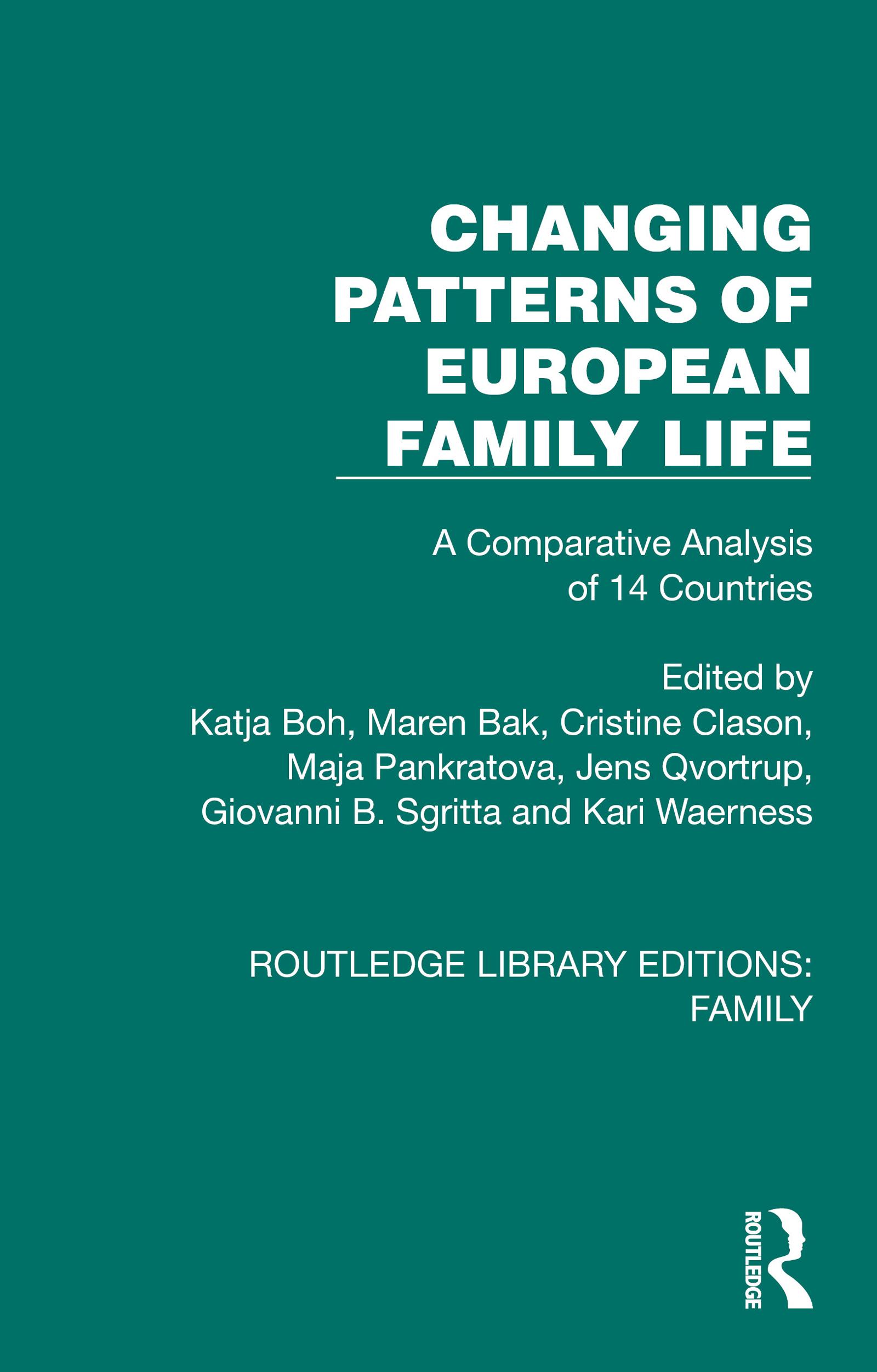
Originally published in 1989, this cross-national study investigates the role and pattern of family life in fourteen countries in contemporary Europe. Providing a wealth of information on European families, it is a key source for anyone wishing to understand the changes in the family at that time.
The contributors argue that, far from withering away, the family remained a very important social unit which continued to have considerable influence on other social institutions such as the state and the labour market. The central theme is the interrelation between changes in production and working life on one hand, and changes in family life and reproduction on the other. The contributors focus on the pressures and contradictions produced by the division of functions between family and work, and on problems which have arisen as a consequence of the sometimes incompatible and even conflicting demands of the two institutions. They show that the evolution of the nuclear family model in Europe had led to a great diversity of family patterns, and conclude that the family in modern European societies still had a contribution to make which no other institution could provide.
Pay easily by card, Klarna, Apple Pay or Google Pay. Not happy? You always have a 14-day money-back guarantee. Read more in our terms. If you have any questions, email us at hello@memmo.org.
Memmo makes studying easier – wherever you are in the world. We bring your course books and smart study tools together in one place: summaries, quizzes, podcasts and flashcards. Plus Ted, your study buddy who answers anything you wonder. Over 50,000 students already study here – built to help you learn faster and stress less.