
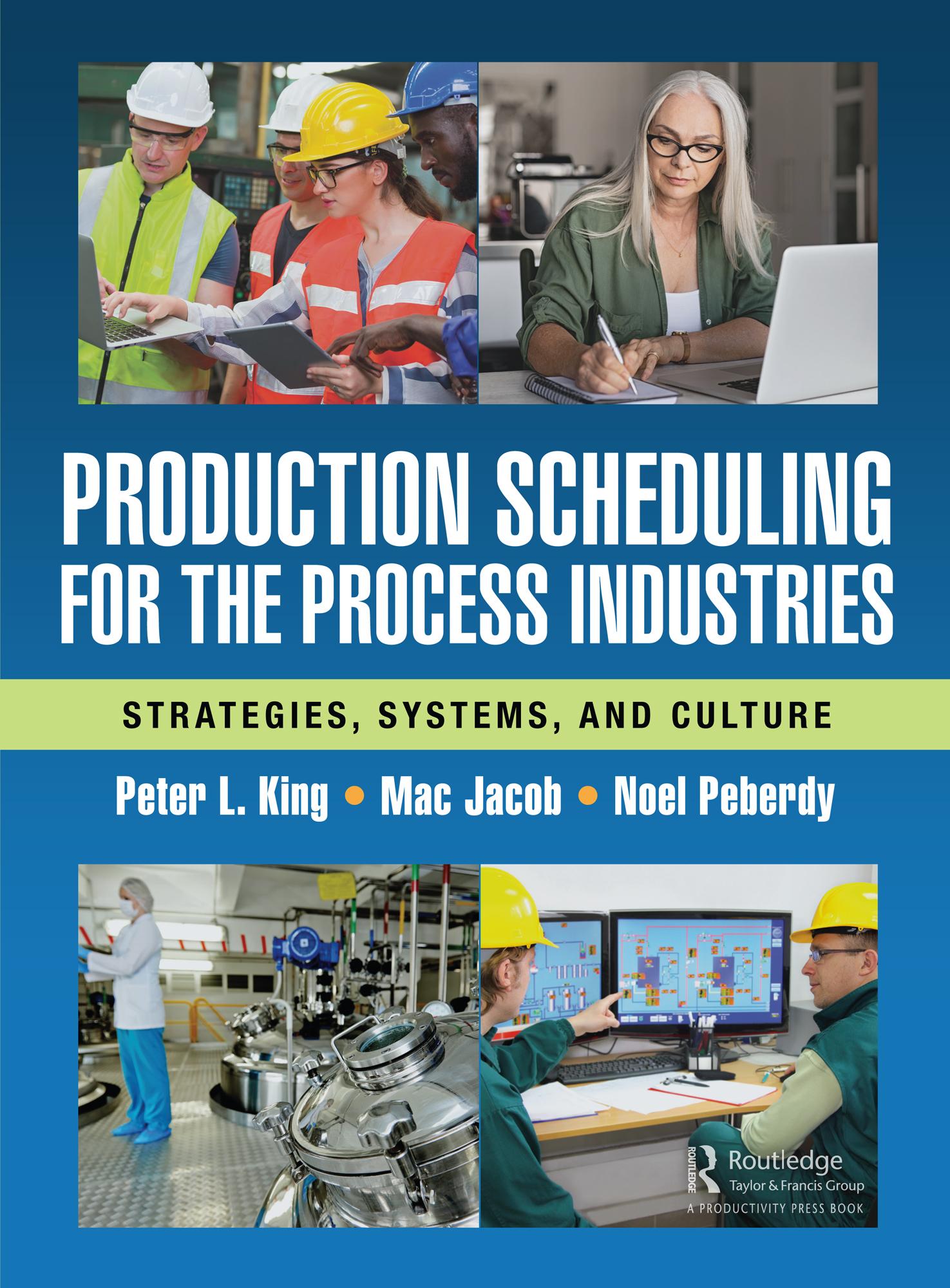
This book is aimed at manufacturing and planning managers who struggle to bring a greater degree of stability and more effective use of assets to their operations, not realizing the degree to which production scheduling affects those objectives. It has been reported that 75% of the problems on the manufacturing floor are caused by activities outside the plant floor. Poor production scheduling strategies and systems are often the biggest contributors to the 75%.
The book explains in detail that no scheduling strategy, and especially no transition to a different and better scheduling strategy, will succeed without strong commitment and guidance from senior leadership. Leadership must understand their active role in the transition, that people will feel uncomfortable and even threatened by change, and that they will need to be measured by different standards. Effective scheduling requires that following the schedule and production to plan is more important than trying to maximize each day’s throughput.
The book explains the advantages of a structured, regularly repeating schedule: how it can increase throughput, right-size inventory based on cycles and variabilities and therefore make it more usable, and improve customer delivery. It will explain the trade-offs between throughput, inventory, and delivery performance, how those trade-offs are actually decided in production scheduling, and how an appropriate scheduling strategy can make the trade-offs and their ramifications visible. It discusses several popular structured scheduling concepts, their similarities, and differences, to allow the readers to decide which might fit best in their environments.
In addition, the authors discuss what makes an appropriate scheduling software system, and why a package designed for structured scheduling offers capabilities well beyond the Excel workbooks used by many companies, and how it offers much more design capability and ease of use than the finite scheduling modules in SAP or Oracle.
Finally, the authors offer a proven roadmap for implementation, critical success factors necessary to achieve the full potential, and give examples of operations that have done this well. In addition, a guide for leaders and managers post-implementation is provided to help them fully exploit the advantages of a structured, repeating scheduling strategy.
Pay easily by card, Klarna, Apple Pay or Google Pay. Not happy? You always have a 14-day money-back guarantee. Read more in our terms. If you have any questions, email us at hello@memmo.org.
Memmo makes studying easier – wherever you are in the world. We bring your course books and smart study tools together in one place: summaries, quizzes, podcasts and flashcards. Plus Ted, your study buddy who answers anything you wonder. Over 50,000 students already study here – built to help you learn faster and stress less.