
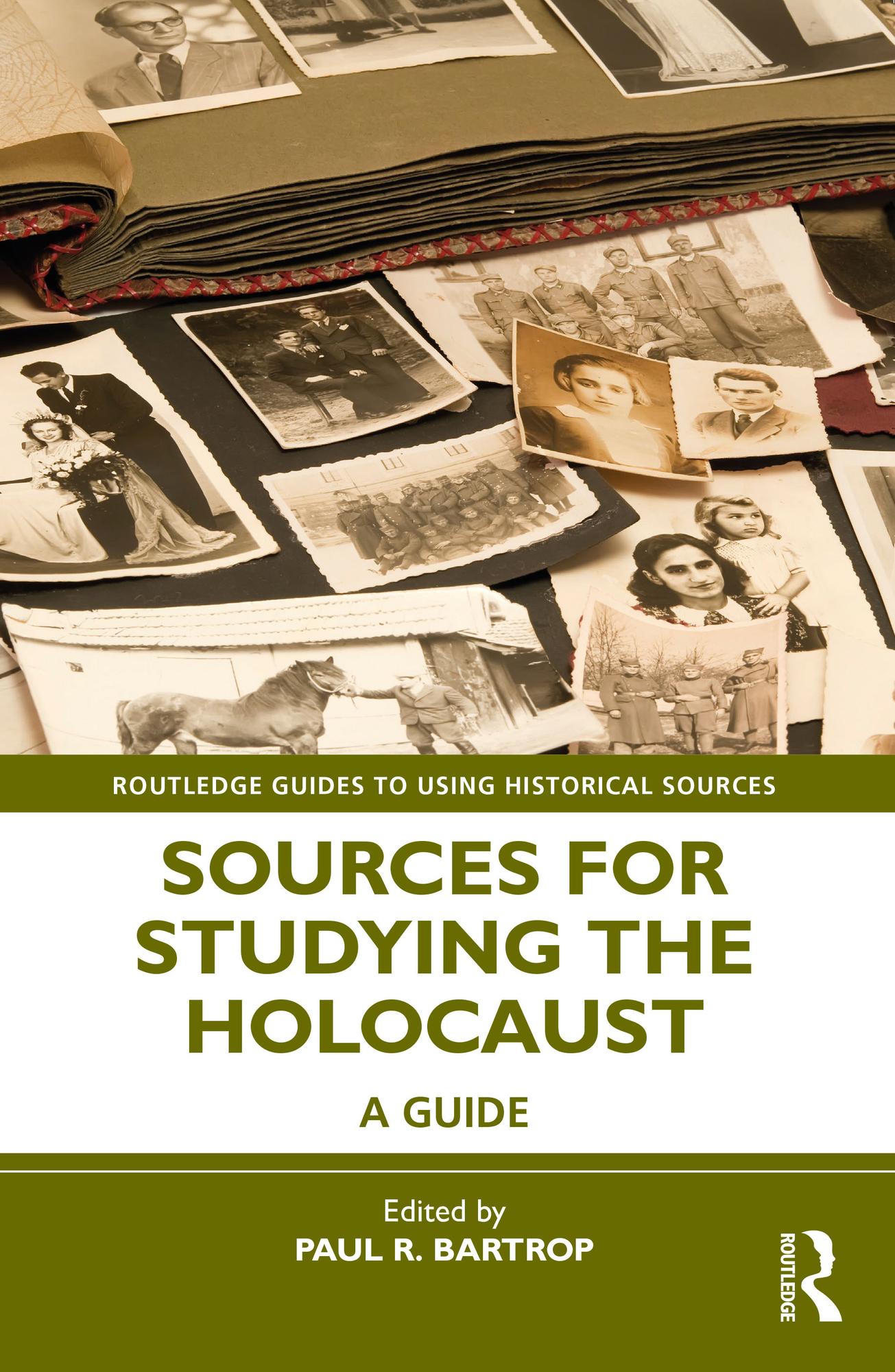
Sources for Studying the Holocaust provides a pathway for readers to engage with questions about what sources can be used to study the Holocaust.
For many historians, the challenge has been how to rescue the story from oblivion when oft-used sources for other periods of history introduce even more issues around authenticity and reliability. What can be learned of what transpired in villages and towns numbering several thousand people, when all its Jewish inhabitants were totally obliterated through Nazi action? Who can furnish eyewitness testimony, if all the eyewitnesses were killed? How does one examine written records preserving knowledge of facts or events, where none were kept or survived the onslaught? And what weight do we put upon such resources which did manage to endure the destruction wrought by the Holocaust? Each chapter looks at one of a diverse range of source materials from which scholars have rescued the history, including survivor testimony, diaries, letters, newspaper accounts, photographs, trial documents, artefacts, digital resources, memorials, films, literature, and art. Each chapter shows how different types of records can be utilised as accurate sources for the writing of Holocaust history. Collectively, they highlight the ways in which all material, even the most fragmentary, can be employed to recreate a reliable record of what happened during the Holocaust and show how all sources considered can be employed to find meaning and understanding by exploring a range of sources deeply.
This book is a unique analysis of the types of sources that can be used to access the history of Holocaust. It will be of invaluable interest to readers, students, and researchers of the Holocaust.
Pay easily by card, Klarna, Apple Pay or Google Pay. Not happy? You always have a 14-day money-back guarantee. Read more in our terms. If you have any questions, email us at hello@memmo.org.
Memmo makes studying easier – wherever you are in the world. We bring your course books and smart study tools together in one place: summaries, quizzes, podcasts and flashcards. Plus Ted, your study buddy who answers anything you wonder. Over 50,000 students already study here – built to help you learn faster and stress less.