
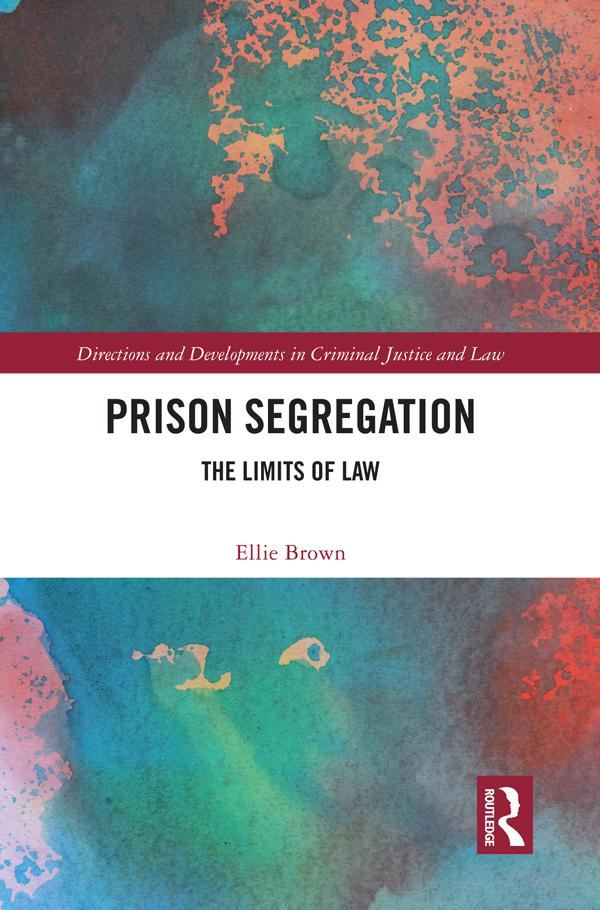
Prison Segregation: The Limits of Law explores the use of segregation in English prisons by examining how law is used and experienced, and how human rights are upheld. It draws on empirical research, through interviews with staff and prisoners, to understand how law ‘works’ (or not) in a site of the prison, which is traditionally characterised by real imbalances of power.
The book draws on one of the first research studies of its kind: an in-depth ethnographic study of law, culture and norms within the segregation unit. It adopts a socio-legal perspective to explore: (i) how segregation is and should be used in prisons, and how the law sets the parameters of that usage (in theory); (ii) the complex web of laws and rules, as applies to segregation, and their relationship with the actors responsible for their implementation; (iii) how laws and rules can be undermined by the culture and context within which they are implemented. It relies on the voices of prisoners and staff, as well as observations and descriptions, to bring experiences to life. The accounts from staff and prisoners – sometimes joyous, sometimes harrowing – provide a rich and rare insight into the segregation unit. It provides access to, and insights into, parts of our criminal justice system which are typically impenetrable. Whilst it is an academic study of law and power in segregation units (and prison more broadly), it is also a very human account of lived experiences.
The book is multi-disciplinary in nature and will appeal to those with an interest in law, sociology, criminology and psychology. It will also appeal to those seeking to understand socio-legal research methods in the field of criminal justice. However, the book is also pragmatic and has a number of recommendations which would be of interest to practitioners, lawyers, prison managers and policy-makers.
Pay easily by card, Klarna, Apple Pay or Google Pay. Not happy? You always have a 14-day money-back guarantee. Read more in our terms. If you have any questions, email us at hello@memmo.org.
Memmo makes studying easier – wherever you are in the world. We bring your course books and smart study tools together in one place: summaries, quizzes, podcasts and flashcards. Plus Ted, your study buddy who answers anything you wonder. Over 50,000 students already study here – built to help you learn faster and stress less.