
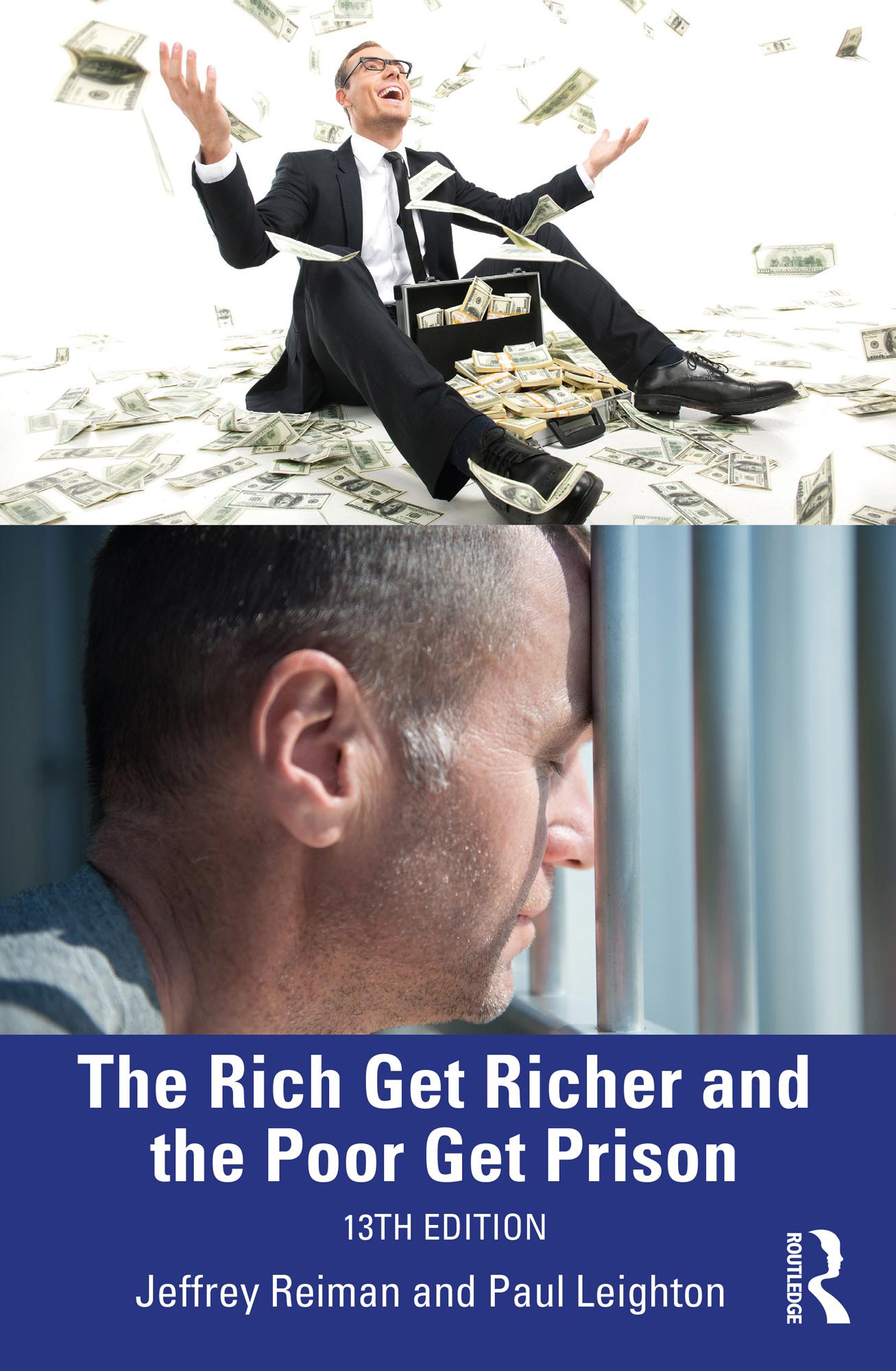
For 40 years, this classic text has taken the issue of economic inequality seriously and asked: Why are our prisons filled with the poor? Why aren’t the tools of the criminal justice system being used to protect Americans from predatory business practices and to punish well-off people who cause widespread harm?
This new edition continues to engage readers in important exercises of critical thinking: Why has the U.S. relied so heavily on tough crime policies despite evidence of their limited effectiveness, and how much of the decline in crime rates can be attributed to them? Why does the U.S. have such a high crime rate compared to other developed nations, and what could we do about it? Are the morally blameworthy harms of the rich and poor equally translated into criminal laws that protect the public from harms on the streets and harms from the suites? How much class bias is present in the criminal justice system—both when the rich and poor engage in the same act, and when the rich use their leadership of corporations to perpetrate mass victimization?
The Rich Get Richer, the Poor Get Prison shows readers that much of what goes on in the criminal justice system violates citizens’ sense of basic fairness. It presents extensive evidence from mainstream data that the criminal justice system does not function in the way it says it does nor in the way that readers believe it should. The authors develop a theoretical perspective from which readers might understand these failures and evaluate them morally—and they do it in a short text written in plain language.
Readers who are not convinced about the larger theoretical perspective will still have engaged in extensive critical thinking to identify their own taken-for-granted assumptions about crime and criminal justice, as well as uncover the effects of power on social practices. This engagement helps readers develop their own worldview.
New to this edition:
- Presents recent data comparing the harms due to criminal activity with the harms of dangerous—but not criminal—corporate actions
- Updates research on class discrimination at every stage of the criminal justice system
- Updates statistics on crime, victimization, incarceration, and wealth
- Increased material for thinking critically about criminal justice and criminology
- New material on global warming and why Black Lives Matter protests did not cause increases in crime in 2020
- Expanded discussion of marijuana and drug legalization
- Stronger chapter overviews, clearer chapter structure and expanded review questions
- Streamlined and condensed prose for greater clarity
Pay easily by card, Klarna, Apple Pay or Google Pay. Not happy? You always have a 14-day money-back guarantee. Read more in our terms. If you have any questions, email us at hello@memmo.org.
Memmo makes studying easier – wherever you are in the world. We bring your course books and smart study tools together in one place: summaries, quizzes, podcasts and flashcards. Plus Ted, your study buddy who answers anything you wonder. Over 50,000 students already study here – built to help you learn faster and stress less.