
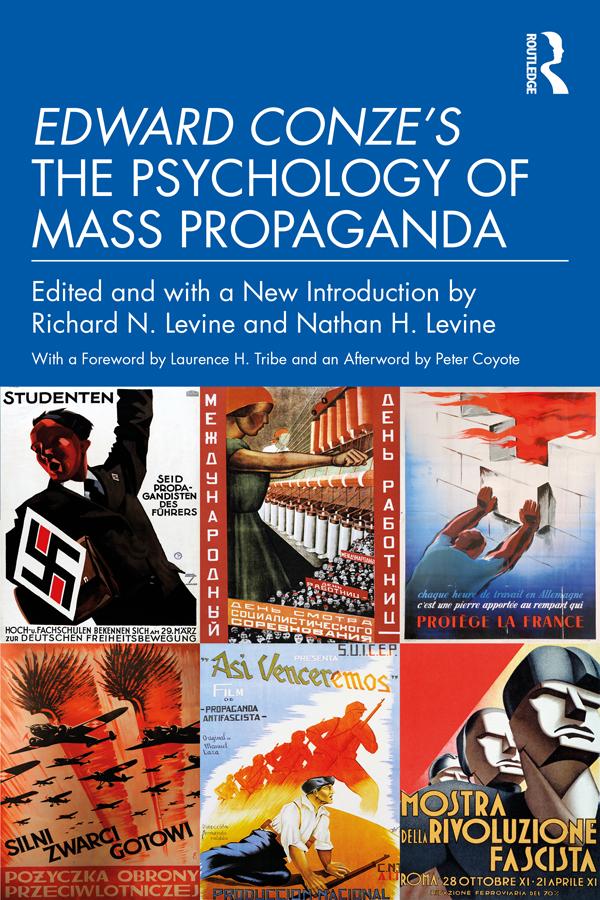
Edward Conze’s The Psychology of Mass Propaganda presents a commentary on the psychology of propaganda during the rise of fascism in Europe in the 1930s. It discusses the conditions which generate vulnerability to misinformation in human societies, and thus offers insight into how propaganda may be "withstood." Completed in 1939, during the period of Conze’s own inflection from Marxist philosophy to Buddhist studies, the original manuscript was never published and is now in print for the first time.
Presenting a unique historical perspective, while also appealing to an acutely topical interest in the conditions under which autocracy and fascism arise, the book examines the psychology of mass propaganda through copious contemporary and historical examples. Conze focuses especially on recent news articles and the statements of the propagandists of many of the governments that would go on to participate in the Second World War, including Germany, Italy, the USSR, USA and UK, all of which he interprets through the lens of recent psychological and historical research. The book has been edited and includes a new introduction by Richard N. Levine and Nathan H. Levine, also featuring a foreword by American legal scholar Laurence H. Tribe, and an afterword by actor, director, writer, and Buddhist priest Peter Coyote.
This is a fascinating opportunity for scholars across several disciplines, including political scientists and psychologists, historians and sociologists, to access one of Conze’s previously unpublished works. It will also be of importance to those interested in Conze’s work on Buddhist philosophy, and in the psychology of propaganda more broadly.
Pay easily by card, Klarna, Apple Pay or Google Pay. Not happy? You always have a 14-day money-back guarantee. Read more in our terms. If you have any questions, email us at hello@memmo.org.
Memmo makes studying easier – wherever you are in the world. We bring your course books and smart study tools together in one place: summaries, quizzes, podcasts and flashcards. Plus Ted, your study buddy who answers anything you wonder. Over 50,000 students already study here – built to help you learn faster and stress less.