
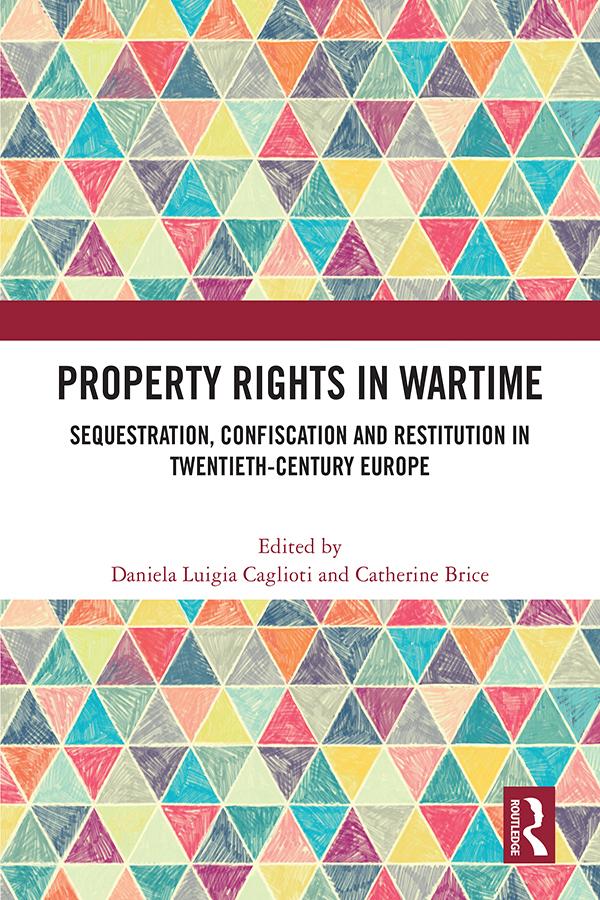
This book examines the violation of property rights in the two World Wars and in the interwar period centering on three keywords: sequestration, confiscation and restitution.
Political conflicts, regime change, revolutions and wars make not only people but also their property vulnerable. Plunder and confiscation were common ways of dealing with the enemy - either internal or external - in many conflicts, conquests and occupations during the Old Regime, and resurfaced as crucial political weapons in both the First and the Second World Wars, with disruptive effects. In the two World Wars and the interwar period, sequestration and confiscation grew in scale and scope, reaching an unprecedented magnitude because of three driving forces that were frequently intertwined: nationalism, socialism and antisemitism. Confiscation was a political weapon that furthered different aims. It helped to make the expulsion of enemy subjects irreversible. It was an instrument to exclude from the civic body those who did not belong - the 'internal enemies' - and to prevent undesirable people from acquiring citizenship. It also deprived “enemy aliens” of economic means during the conflict.
Bringing together new historical research on Serbia, Italy, Belgium, Turkey, Holland, Poland, Czechoslovakia, Germany and Austria, the chapters address state violence, law and human rights, as well as the entanglement between citizenship, nationality and property. It will be of great interest to those who study minorities, borders, migration, social and economic history as well as European History. This book was originally published as a special issue of European Review of History.
Pay easily by card, Klarna, Apple Pay or Google Pay. Not happy? You always have a 14-day money-back guarantee. Read more in our terms. If you have any questions, email us at hello@memmo.org.
Memmo makes studying easier – wherever you are in the world. We bring your course books and smart study tools together in one place: summaries, quizzes, podcasts and flashcards. Plus Ted, your study buddy who answers anything you wonder. Over 50,000 students already study here – built to help you learn faster and stress less.