
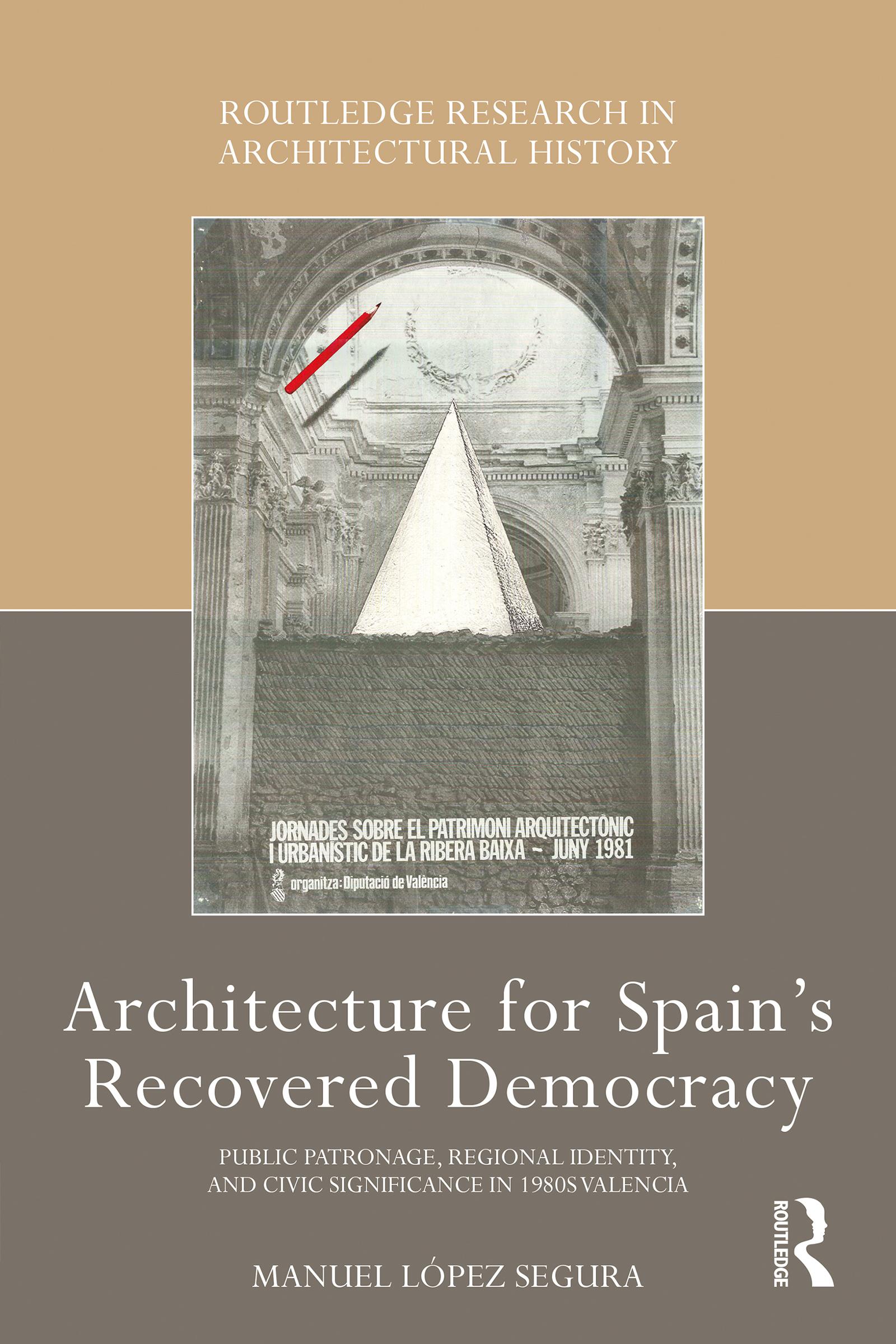
Historical studies on the involvement of architecture in twentieth-century politics have overlooked its contribution to building Spain’s democracy. This pioneering book seeks to fill that void. Between the late 1970s and early 1990s, Spain founded representative institutions, launched its welfare state, and devolved autonomy to its regions. The study brings forth the architectural incarnation of that threefold program as it deployed in the Valencian Country, a Catalan-speaking region on Spain’s Mediterranean shores. There, social democratic authorities mobilized architects, planners, and graphic artists to devise a newly open public sphere and to recover a local identity that Franco’s dictatorship had repressed for decades. The research follows the impetus of reform and its contradictions through urban projects, designs for cultural amenities, and the renovation of governmental and professional bodies. Architecture for Spain’s Recovered Democracy contributes to current debates on nationalism and the arts, the environments of democratic socialism, and postmodernism and neoliberalism. As a result, it widens our understanding of how peripheral regions may yield egalitarian architectures of resistance.
This book is written for students and researchers in architecture and planning, art history, spatial politics, and Hispanic studies, as well as for a general readership interested in inclusive politics in the built environment.
Pay easily by card, Klarna, Apple Pay or Google Pay. Not happy? You always have a 14-day money-back guarantee. Read more in our terms. If you have any questions, email us at hello@memmo.org.
Memmo makes studying easier – wherever you are in the world. We bring your course books and smart study tools together in one place: summaries, quizzes, podcasts and flashcards. Plus Ted, your study buddy who answers anything you wonder. Over 50,000 students already study here – built to help you learn faster and stress less.