
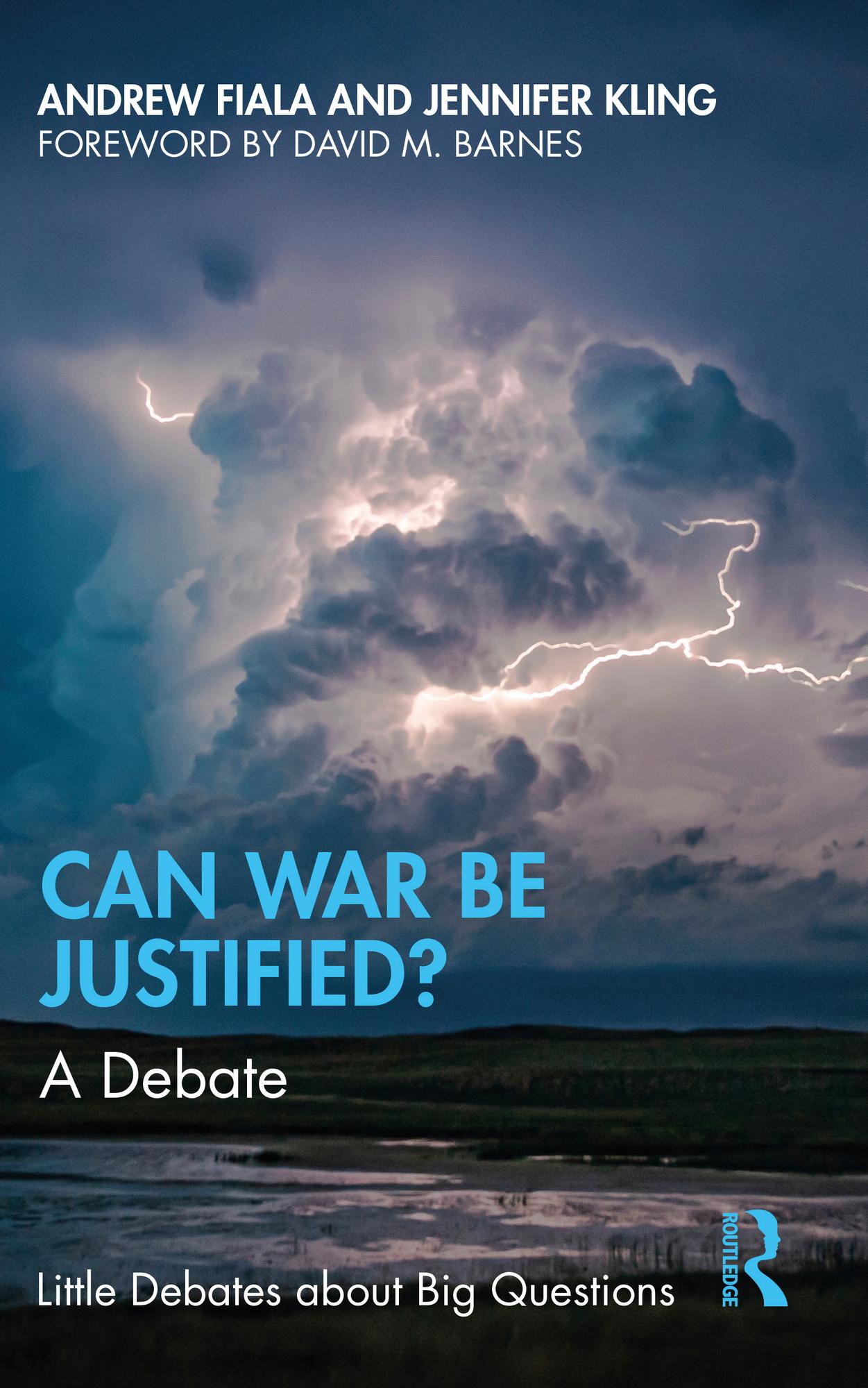
Can war be justified? Pacifists answer that it cannot; they oppose war and advocate for nonviolent alternatives to war. But defenders of just war theory argue that in some circumstances, when the effectiveness of nonviolence is limited, wars can be justified.
In this book, two philosophers debate this question, drawing on contemporary scholarship and new developments in thinking about pacifism and just war theory. Andrew Fiala defends the pacifist position, while Jennifer Kling defends just war traditions. Fiala argues that pacifism follows from the awful reality of war and the nonviolent goal of building a more just and peaceful world. Kling argues that war is sometimes justified when it is a last-ditch, necessary effort to defend people and their communities from utter destruction and death. Pulling from global traditions and histories, their debate will captivate anyone who has wondered or worried about the morality of political violence and military force. Topics discussed include ethical questions of self-defense and other-defense, the great analogy between individuals and states, evolving technologies and methods of warfighting, moral injury and post-traumatic stress disorder, broader political and communal issues, and the problem of regional security in a globalizing world. The authors consider cultural and religious issues as well as the fundamental question of moral obligation in a world saturated in military conflict. The book was written in the aftermath of the war on terrorism and includes reflection on lessons learned from the past decades of war, as well as hopes for the future in light of emerging threats in Europe and elsewhere.
The book is organized in a user-friendly fashion. Each author presents a self-contained argument, which is followed by a series of responses, replies, and counter-arguments. Throughout, the authors model civil discourse by emphasizing points of agreement and remaining areas of disagreement. The book includes reader-friendly summaries, a glossary of key concepts, and suggestions for further study. All of this will help students and scholars follow the authors’ dialogue so they may develop their own answer to the question of whether war can be justified.
Key Features
- Summarizes the debate between pacifism and just war theory
- Considers historical and traditional sources as well as contemporary scholarship and applications
- Models philosophical dialogue and civil discourse, while seeking common ground
- Discusses issues of concern in contemporary warfighting and peacemaking, while offering an analysis of the war on terrorism
Pay easily by card, Klarna, Apple Pay or Google Pay. Not happy? You always have a 14-day money-back guarantee. Read more in our terms. If you have any questions, email us at hello@memmo.org.
Memmo makes studying easier – wherever you are in the world. We bring your course books and smart study tools together in one place: summaries, quizzes, podcasts and flashcards. Plus Ted, your study buddy who answers anything you wonder. Over 50,000 students already study here – built to help you learn faster and stress less.