
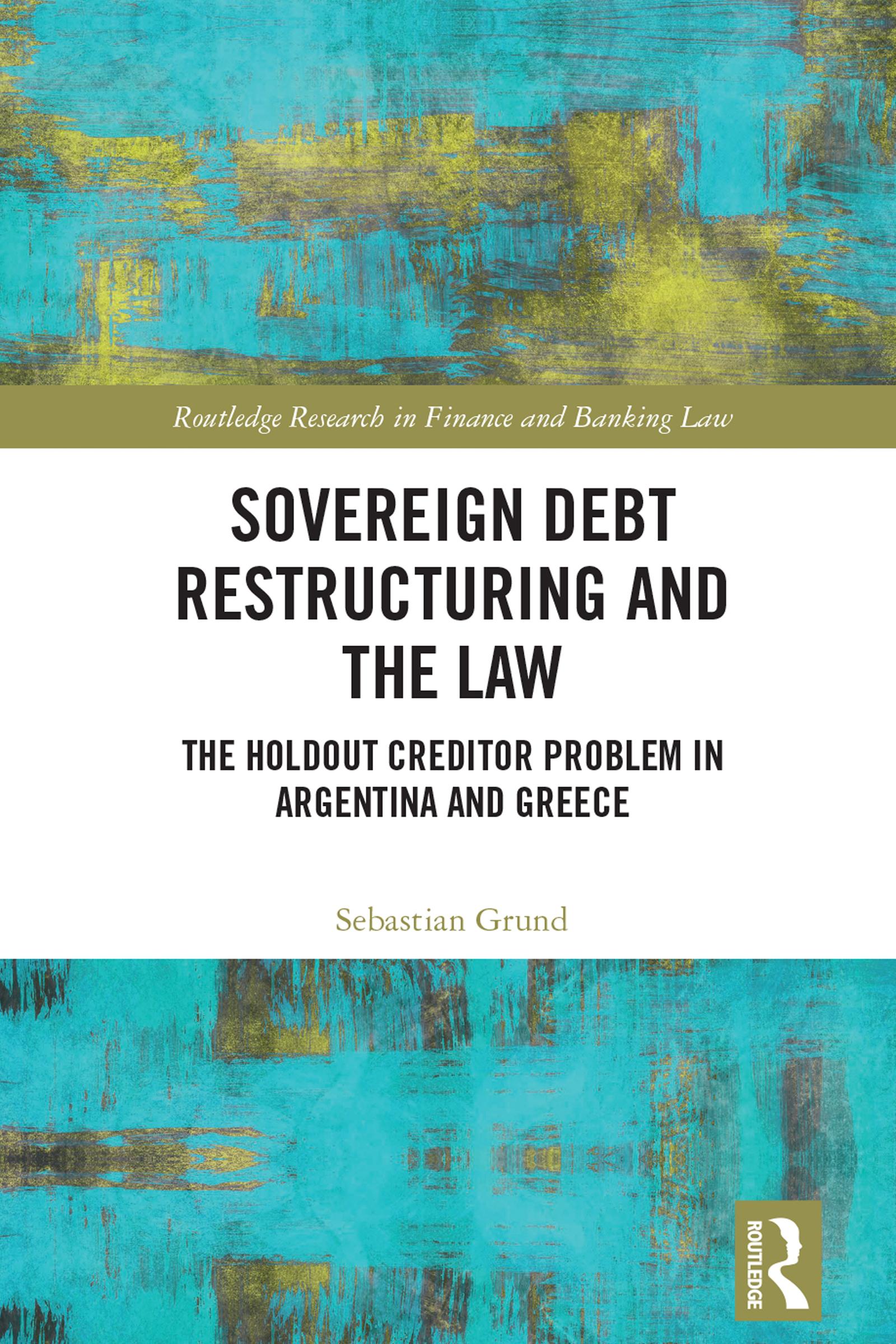
The book sheds light on the perhaps most important legal conundrum in the context of sovereign debt restructuring: the holdout creditor problem. Absent an international bankruptcy regime for sovereigns, holdout creditors may delay or even thwart the efficient resolution of sovereign debt crises by leveraging contractual provisions and, in an increasing number of cases, by seeking to enforce a debt claim against the sovereign in courts or international tribunals.
Following an introduction to sovereign debt and its restructuring, the book provides the first comprehensive analysis of the holdout creditor problem in the context of the two largest sovereign debt restructuring operations in history: the Argentine restructurings of 2005 and 2010 and the 2012 Greek private sector involvement. By reviewing numerous lawsuits and arbitral proceedings initiated against Argentina and Greece across a dozen different jurisdictions, it distils the organizing principles for ongoing and future cases of sovereign debt restructuring and litigation. It highlights the different approaches judges and arbitrators have adopted when dealing with holdout creditors, ranging from the denial of their contractual right to repayment on human rights grounds to leveraging the international financial infrastructure to coerce governments into meeting holdouts’ demands. To this end, it zooms in on the role the governing law plays in sovereign debt restructurings, revisits the contemporary view on sovereign immunity from suit and enforcement in the international debt context, and examines how creditor rights are balanced with the sovereign’s interest in achieving debt sustainability. Finally, it advances a new genealogy of holdouts, distinguishing between official and private sector holdouts and discussing how the proliferation of new types of uncooperative creditors may affect the sovereign debt architecture going forward.
While the book is aimed at practitioners and scholars dealing with sovereign debt and its restructuring, it should also provide the general reader with the understanding of the key legal issues facing countries in debt distress. Moreover, by weaving economic, financial, and political considerations into its analysis of holdout creditor litigation and arbitration, the book also speaks to policymakers without a legal background engaged in the field of international finance and economics.
Pay easily by card, Klarna, Apple Pay or Google Pay. Not happy? You always have a 14-day money-back guarantee. Read more in our terms. If you have any questions, email us at hello@memmo.org.
Memmo makes studying easier – wherever you are in the world. We bring your course books and smart study tools together in one place: summaries, quizzes, podcasts and flashcards. Plus Ted, your study buddy who answers anything you wonder. Over 50,000 students already study here – built to help you learn faster and stress less.