
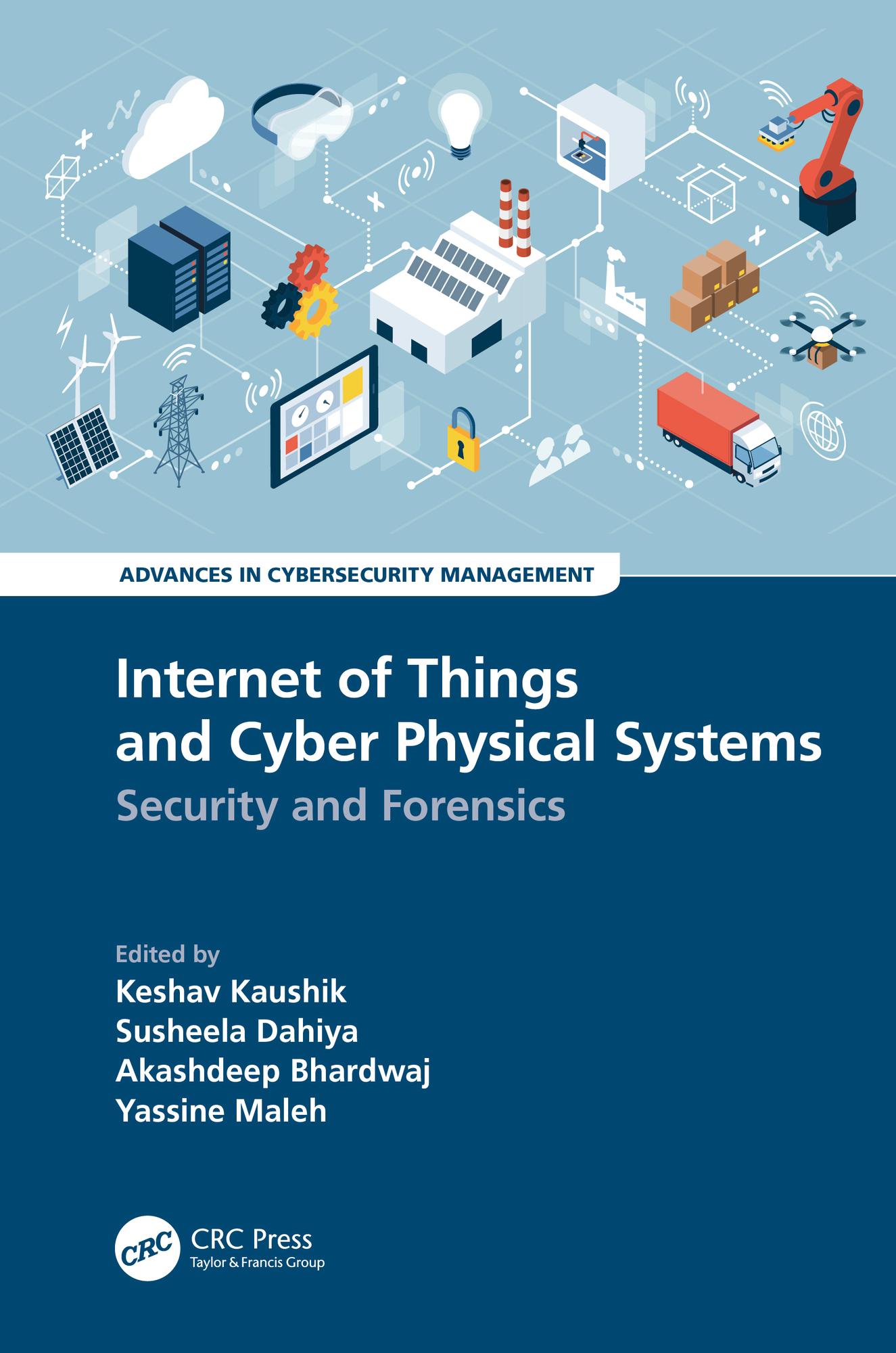
The quantity, diversity, and sophistication of Internet of Things (IoT) items are rapidly increasing, posing significant issues but also innovative solutions for forensic science. Such systems are becoming increasingly common in public locations, businesses, universities, residences, and other shared offices, producing enormous amounts of data at rapid speeds in a variety of forms. IoT devices can be used as suspects, digital witnesses, or instruments of crime and cyberattacks, posing new investigation problems, forensic issues, security threats, legal concerns, privacy concerns, and ethical dilemmas. A cyberattack on IoT devices might target the device itself or associated systems, particularly vital infrastructure.
This book discusses the advancements in IoT and Cyber Physical Systems (CPS) forensics. The first objective is to learn and understand the fundamentals of IoT forensics. This objective will answer the question of why and how IoT has evolved as one of the most promising and widely accepted technologies across the globe and has many widely accepted applications.
The second objective is to learn how to use CPS to address many computational problems. CPS forensics is a promising domain, and there are various advancements in this field. This book is structured so that the topics of discussion are relevant to each reader’s particular areas of interest. The book’s goal is to help each reader to see the relevance of IoT and CPS forensics to his or her career or interests.
This book not only presents numerous case studies from a global perspective, but it also compiles a large amount of literature and research from a database. As a result, this book effectively demonstrates the concerns, difficulties, and trends surrounding the topic while also encouraging readers to think globally. The main goal of this project is to encourage both researchers and practitioners to share and exchange their experiences and recent studies between academia and industry.
Pay easily by card, Klarna, Apple Pay or Google Pay. Not happy? You always have a 14-day money-back guarantee. Read more in our terms. If you have any questions, email us at hello@memmo.org.
Memmo makes studying easier – wherever you are in the world. We bring your course books and smart study tools together in one place: summaries, quizzes, podcasts and flashcards. Plus Ted, your study buddy who answers anything you wonder. Over 75,000 students already study here – built to help you learn faster and stress less.