
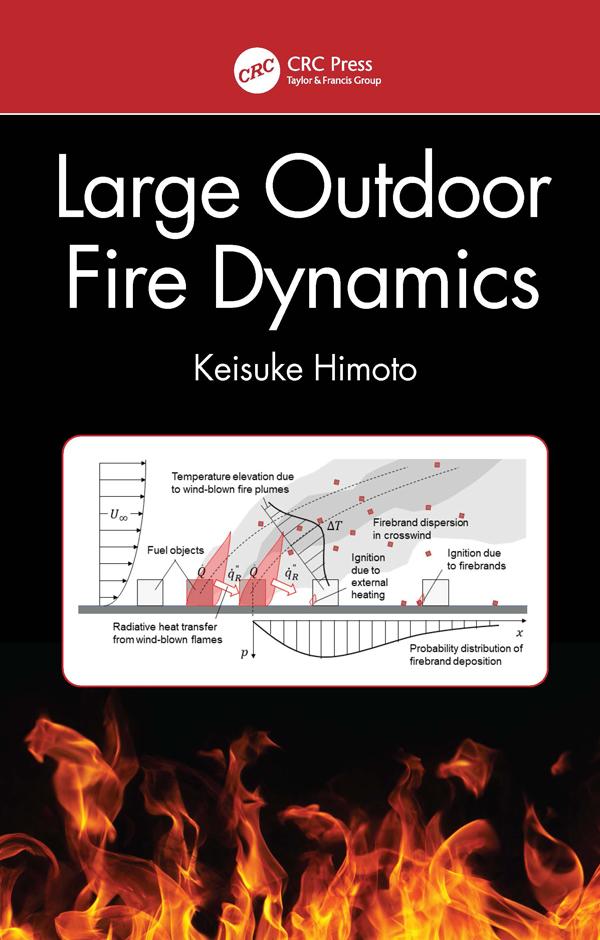
Large Outdoor Fire Dynamics provides the essential knowledge for the hazard evaluation of large outdoor fires, including wildland, WUI (wildland-urban interface), and urban fires. The spread of outdoor fires can be viewed as a successive occurrence of physical and chemical processes – solid fuel combustion, heat transfer to surrounding combustibles, and ignition of heated combustibles – which are explained herein. Engineering equations frequently used in practical hazard analyses are derived and then integrated to implement a computational code predicting fire spread among discretely distributed combustibles. This code facilitates learning the procedure of hazard evaluation for large outdoor fires.
Chapters cover underlying assumptions for analyzing fire spread behavior in large outdoor fires, namely, wind conditions near the ground surface and fundamentals of heat transfer; the physical mechanism of fire spread in and between combustibles, specifically focusing on fire plumes (both reacting and non-reacting) and firebrand dispersal; and the spatial modeling of 3D objects and developing the computational framework for predicting fire spread.
The book is ideal for engineers, researchers, and graduate students in fire safety as well as mechanical engineering, civil engineering, disaster management, safety engineering, and planning. Companion source codes are available online.
Pay easily by card, Klarna, Apple Pay or Google Pay. Not happy? You always have a 14-day money-back guarantee. Read more in our terms. If you have any questions, email us at hello@memmo.org.
Memmo makes studying easier – wherever you are in the world. We bring your course books and smart study tools together in one place: summaries, quizzes, podcasts and flashcards. Plus Ted, your study buddy who answers anything you wonder. Over 50,000 students already study here – built to help you learn faster and stress less.