
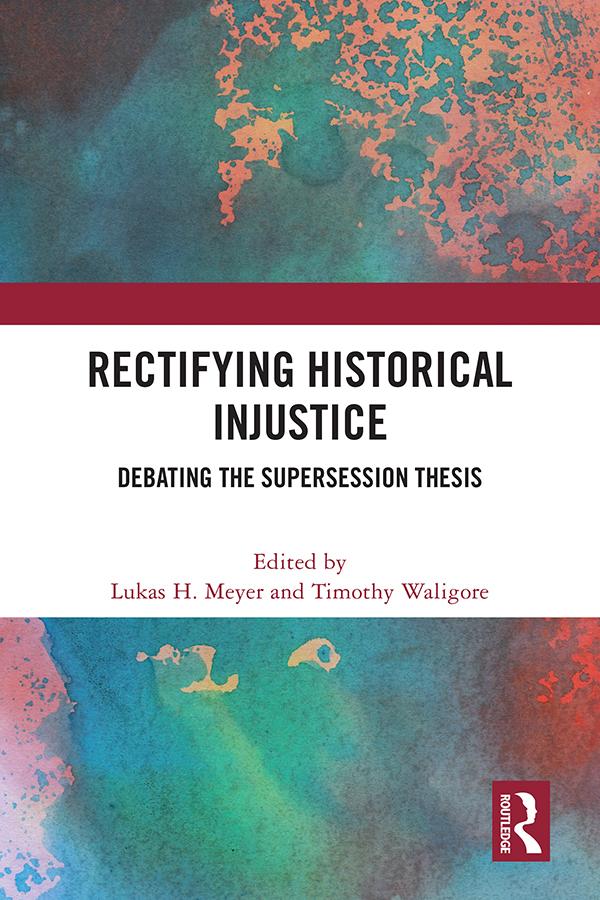
Calls for redress of historical wrongs regularly make headlines around the world. People dispute the degree to which justice should be concerned with righting past wrongs, with some arguing that justice should be primarily focused on claims arising from present disadvantage. Proponents and sceptics of restitution, compensation, and other forms of historical redress have engaged with the thesis that historical injustice can be superseded, the idea that changing circumstances following historical injustices can alter what justice later requires. The “supersession thesis,” developed by legal and political philosopher Jeremy Waldron, has been challenged, both conceptually and in terms of its possible application and implications.
This is the first book to critically assess how the supersession thesis might be reconstructed, challenged, or applied to empirical cases, with an eye toward larger questions surrounding the temporal orientation of justice. Cases examined include Indigenous peoples, linguistic injustice, and climate change. The edited volume includes contributions by established and junior scholars from philosophy, law, American Indian Studies, and political science, who draw from Indigenous thought, settler colonial theory, liberalism, theories of historical entitlements, and structural injustice theories. It concludes with a reply by Jeremy Waldron.
The chapters in this book were originally published as a special issue of Critical Review of International Social and Political Philosophy.
Pay easily by card, Klarna, Apple Pay or Google Pay. Not happy? You always have a 14-day money-back guarantee. Read more in our terms. If you have any questions, email us at hello@memmo.org.
Memmo makes studying easier – wherever you are in the world. We bring your course books and smart study tools together in one place: summaries, quizzes, podcasts and flashcards. Plus Ted, your study buddy who answers anything you wonder. Over 50,000 students already study here – built to help you learn faster and stress less.