
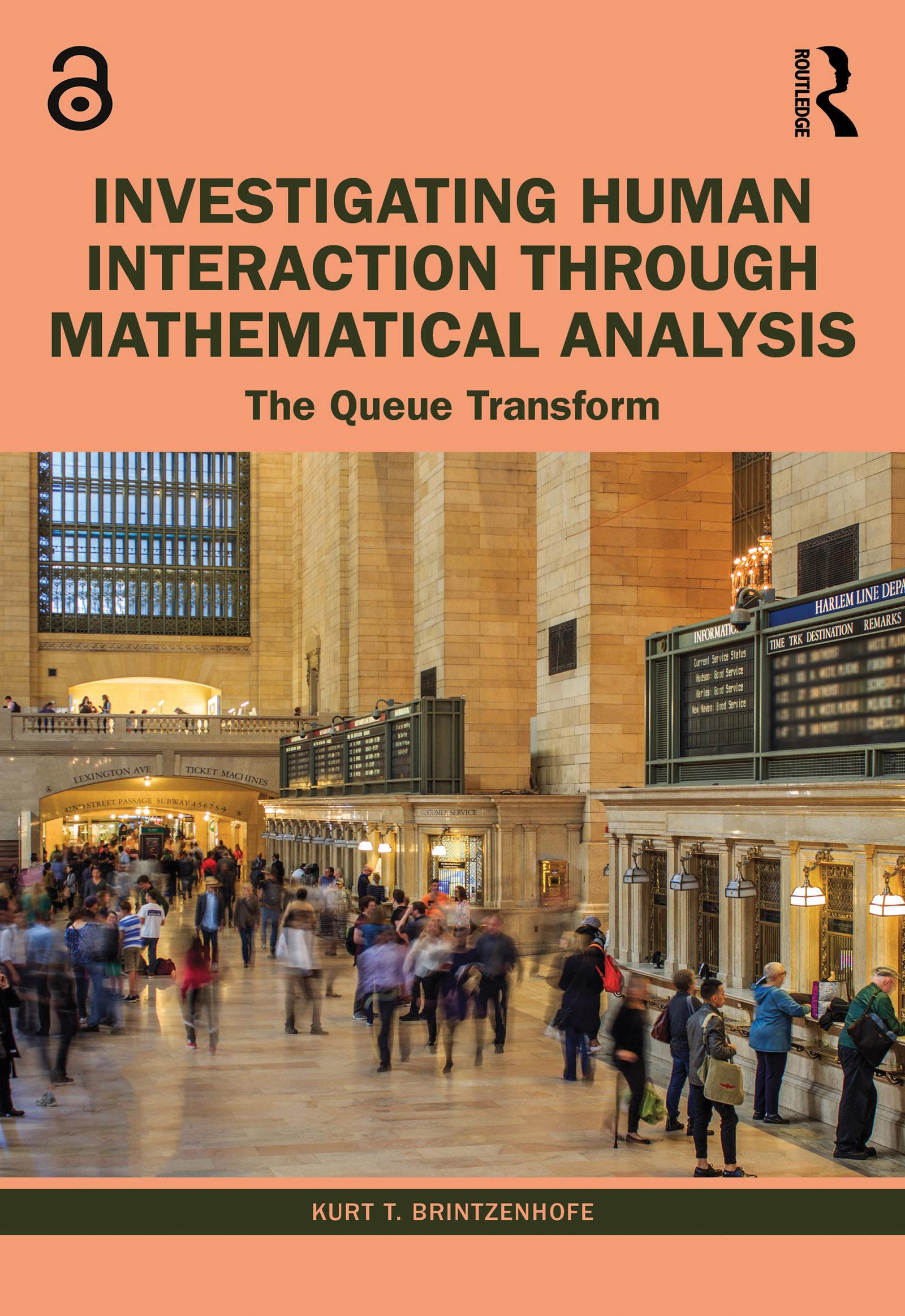
Investigating Human Interaction through Mathematical Analysis offers a new and unique approach to social intragroup interaction by using mathematics and psychophysics to create a mathematical model based on social psychological theories.
It draws on the work of Dr. Stanley Milgram, Dr. Bibb Latane, and Dr. Bernd Schmitt to develop an algebraic expression and applies it to quantitatively model and explain various independent social psychology experiments taken from refereed journals involving basic social systems with underlying queue-like structures. It is then argued that the social queue as a resource system, containing common-pool resources, meets the eight design principles necessary to support stability within the queue. Making this link provides a means to advance to more complex social systems. It is envisioned that if basic social systems as presented can be modeled, then, with further development, more complex social systems may eventually be modeled for the purpose of identifying and validating social structures that might eventually support stable governments in our common environment called Earth.
This is a fascinating reading for academics and advanced students interested in political theory, detection theory, social psychology, organizational behavior, psychophysics, and applied mathematics in the social and information sciences.
The Open Access version of this book, available at www.taylorfrancis.com, has been made available under a Creative Commons Attribution-Non Commercial-No Derivatives 4.0 license.
Pay easily by card, Klarna, Apple Pay or Google Pay. Not happy? You always have a 14-day money-back guarantee. Read more in our terms. If you have any questions, email us at hello@memmo.org.
Memmo makes studying easier – wherever you are in the world. We bring your course books and smart study tools together in one place: summaries, quizzes, podcasts and flashcards. Plus Ted, your study buddy who answers anything you wonder. Over 50,000 students already study here – built to help you learn faster and stress less.