
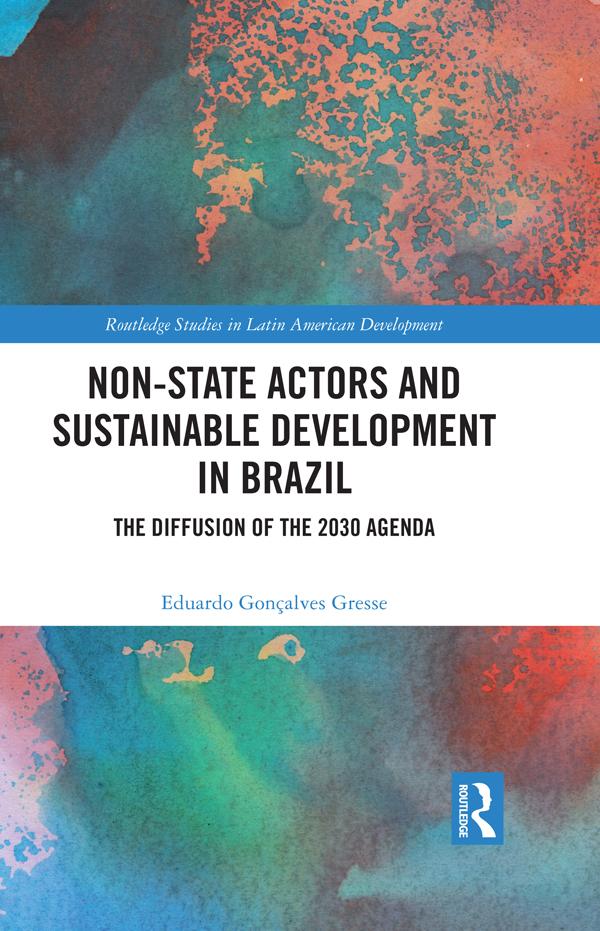
This book investigates how non-state actors have become key drivers of the diffusion of the UN 2030 Agenda for Sustainable Development in Brazil.
The UN ranks Brazil as the most biodiverse country in the world, but the country’s environment has never been under greater threat, with the rise of multiple crises bringing mounting challenges to socioeconomic development and environmental protection. As state support has fallen away, non-state actors have actively engaged and eventually mobilized other social actors towards the promotion of the SDGs and the implementation of the UN agenda. This book asks why it is that non-state actors have dedicated so much time, effort and resources to promote a non-binding agenda that was ratified by and is mainly assigned to state actors. Looking at the roles of academia, civil society, and the private sector, the book explores the different ways in which these social actors make sense of and translate the 2030 Agenda into practice within their respective local contexts. Drawing on extensive fieldwork, this book sheds light on a series of challenges, opportunities and contradictions within the global agenda and its implementation.
Assessing what the Brazil case can teach us about the diffusion of the 2030 Agenda and the SDGs more broadly, this book will be of interest to academics in the field of Sustainable Development, Latin America Studies and Environmental Politics as well as sustainable development researchers and policy makers.
Pay easily by card, Klarna, Apple Pay or Google Pay. Not happy? You always have a 14-day money-back guarantee. Read more in our terms. If you have any questions, email us at hello@memmo.org.
Memmo makes studying easier – wherever you are in the world. We bring your course books and smart study tools together in one place: summaries, quizzes, podcasts and flashcards. Plus Ted, your study buddy who answers anything you wonder. Over 50,000 students already study here – built to help you learn faster and stress less.