
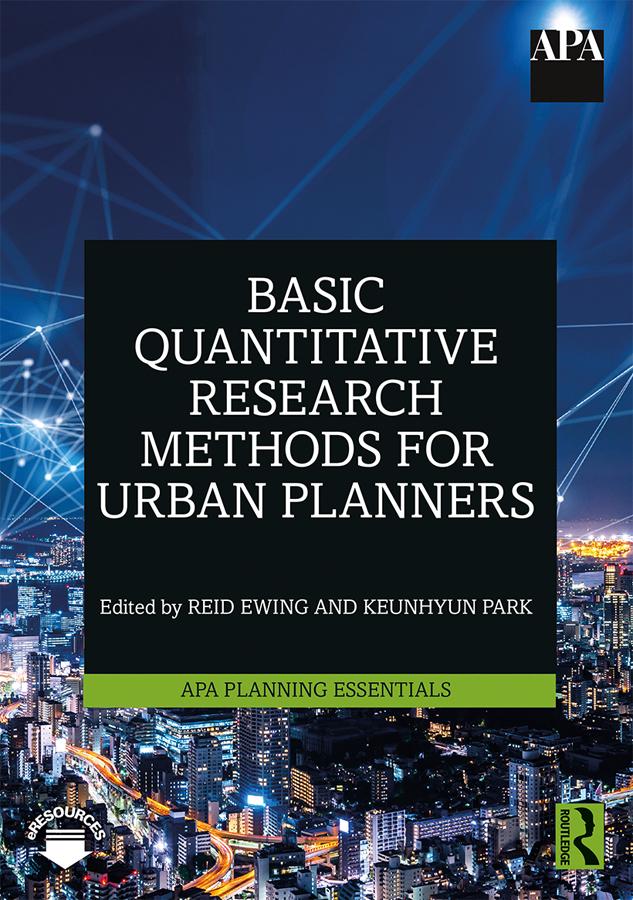
In most planning practice and research, planners work with quantitative data. By summarizing, analyzing, and presenting data, planners create stories and narratives that explain various planning issues. Particularly, in the era of big data and data mining, there is a stronger demand in planning practice and research to increase capacity for data-driven storytelling.
Basic Quantitative Research Methods for Urban Planners provides readers with comprehensive knowledge and hands-on techniques for a variety of quantitative research studies, from descriptive statistics to commonly used inferential statistics. It covers statistical methods from chi-square through logistic regression and also quasi-experimental studies. At the same time, the book provides fundamental knowledge about research in general, such as planning data sources and uses, conceptual frameworks, and technical writing. The book presents relatively complex material in the simplest and clearest way possible, and through the use of real world planning examples, makes the theoretical and abstract content of each chapter as tangible as possible.
It will be invaluable to students and novice researchers from planning programs, intermediate researchers who want to branch out methodologically, practicing planners who need to conduct basic analyses with planning data, and anyone who consumes the research of others and needs to judge its validity and reliability.
Pay easily by card, Klarna, Apple Pay or Google Pay. Not happy? You always have a 14-day money-back guarantee. Read more in our terms. If you have any questions, email us at hello@memmo.org.
Memmo makes studying easier – wherever you are in the world. We bring your course books and smart study tools together in one place: summaries, quizzes, podcasts and flashcards. Plus Ted, your study buddy who answers anything you wonder. Over 50,000 students already study here – built to help you learn faster and stress less.