
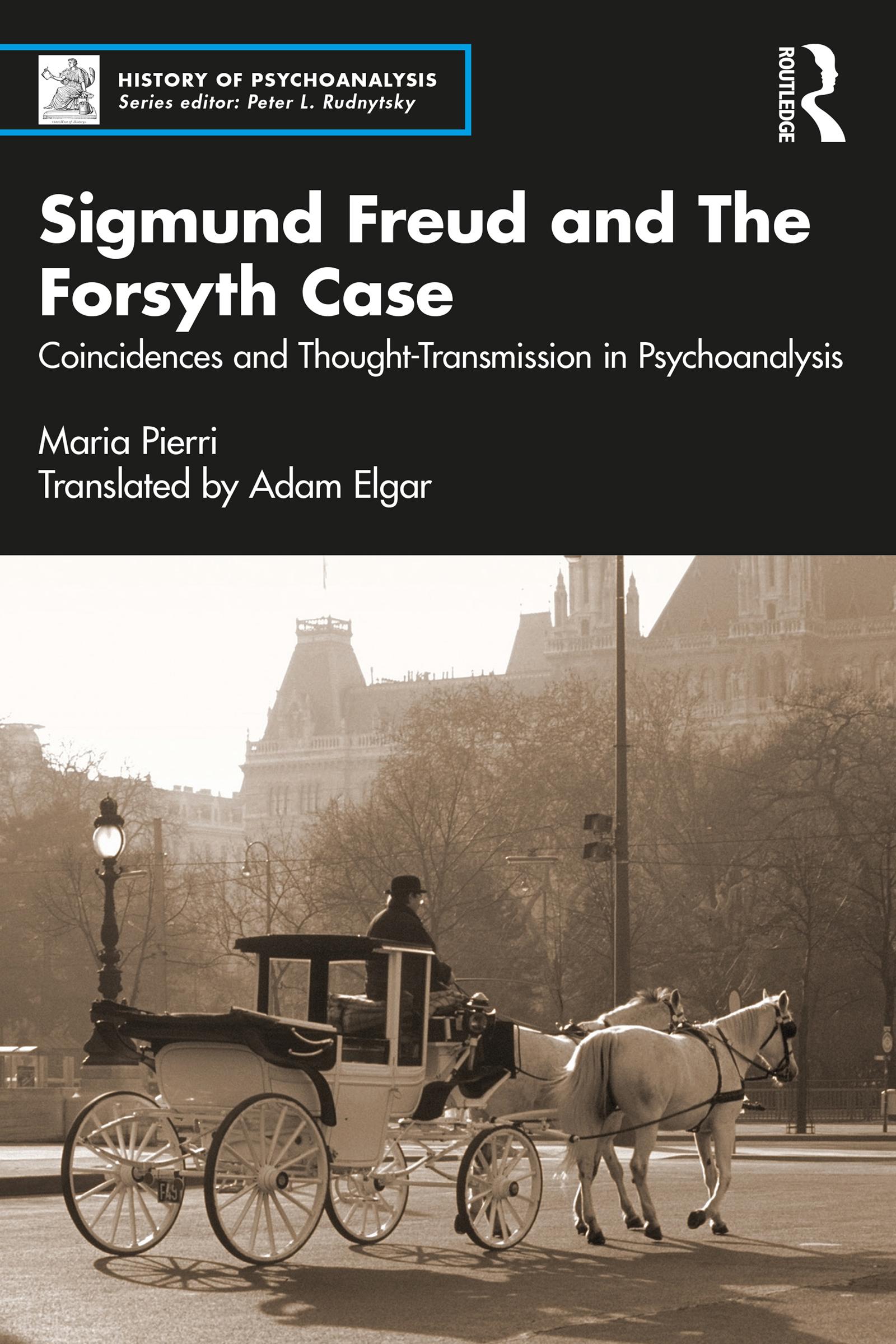
Sigmund Freud and The Forsyth Case uses newly discovered primary sources to investigate one of Sigmund Freud’s most mysterious clinical experiences, the Forsyth case. The book details Pierri’s attempts to recover the lost original case notes, which are published here for the first time, to identify the patient involved and to set the case into the broader frame of Freud’s work.
Maria Pierri begins with a preliminary illustration of the case, its historical context, and how it connects to Freud’s interests in "thought-transmission," or telepathy. The author illustrates the possibility of a psychoanalytic interpretation of the transference and countertransference elements potentially conveyed by certain "magical" coincidences during the analysis, introducing the reader to a psychopathology of everyday life of the setting. The book also explores Freud’s further investigations into thought transmission, focusing on a meeting of the Secret Committee in October 1919 and his clinical work with his own daughter Anna.
Sigmund Freud and The Forsyth Case features supplementary historical materials, adding valuable insight to the context and meaning of the case. It will be essential reading for psychoanalysts in practice and in training, as well as academics and scholars of psychoanalytic studies, spirituality, and the history of psychology. It is complemented by Occultism and the Origins of Psychoanalysis: Freud, Ferenczi and the Challenge of Thought Transference.
Pay easily by card, Klarna, Apple Pay or Google Pay. Not happy? You always have a 14-day money-back guarantee. Read more in our terms. If you have any questions, email us at hello@memmo.org.
Memmo makes studying easier – wherever you are in the world. We bring your course books and smart study tools together in one place: summaries, quizzes, podcasts and flashcards. Plus Ted, your study buddy who answers anything you wonder. Over 50,000 students already study here – built to help you learn faster and stress less.