
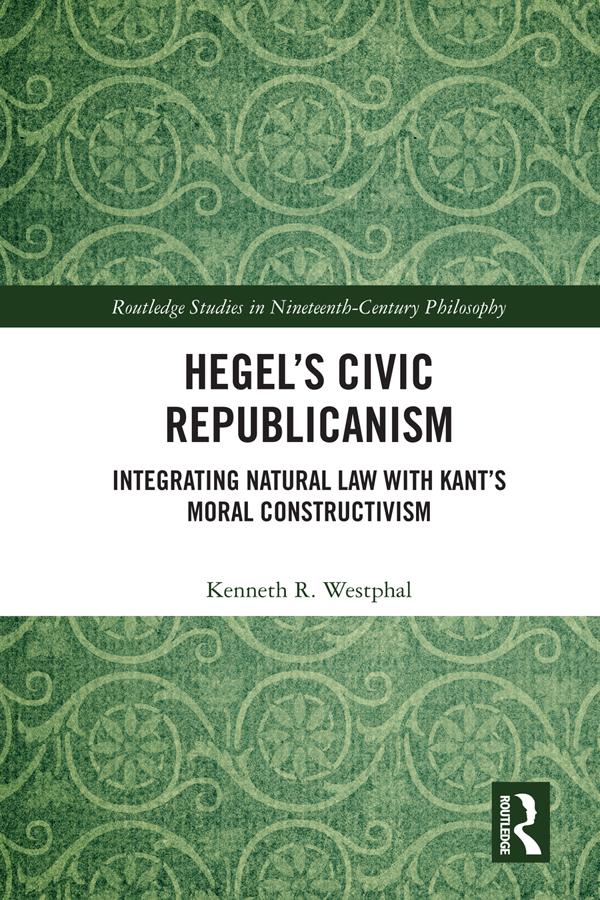
In this book, Westphal offers an original interpretation of Hegel’s moral philosophy. Building on his previous study of the role of natural law in Hume’s and Kant’s accounts of justice, Westphal argues that Hegel developed and justified a robust form of civic republicanism. Westphal identifies, for the first time, the proper genre to which Hegel’s Philosophical Outlines of Justice belongs and to which it so prodigiously contributes, which he calls Natural Law Constructivism, an approach developed by Hume, Rousseau, Kant, and Hegel. He brings to bear Hegel’s adoption and augmentation of Kant’s Critique of rational judgment and justification in all non-formal domains to his moral philosophy in his Outlines. Westphal argues that Hegel’s justification for the standards of political legitimacy successfully integrates Rousseau’s Independence Requirement into the role of public reason within a constitutional republic. In these regards, Hegel’s moral and political principles are progressive not only in principle, but also in practice. Hegel’s Civic Republicanism will be of interest to scholars of moral philosophy, social and political philosophy, philosophy of law, Hegel, eighteenth- and nineteenth-century philosophy.
Pay easily by card, Klarna, Apple Pay or Google Pay. Not happy? You always have a 14-day money-back guarantee. Read more in our terms. If you have any questions, email us at hello@memmo.org.
Memmo makes studying easier – wherever you are in the world. We bring your course books and smart study tools together in one place: summaries, quizzes, podcasts and flashcards. Plus Ted, your study buddy who answers anything you wonder. Over 50,000 students already study here – built to help you learn faster and stress less.