
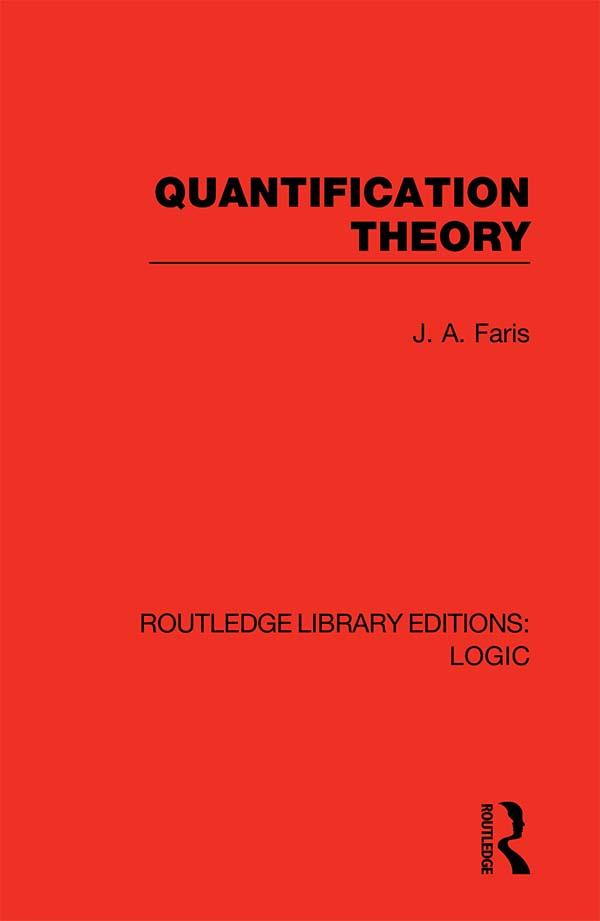
Originally published in 1964. This book is concerned with general arguments, by which is meant broadly arguments that rely for their force on the ideas expressed by all, every, any, some, none and other kindred words or phrases. A main object of quantificational logic is to provide methods for evaluating general arguments. To evaluate a general argument by these methods we must first express it in a standard form. Quantificational form is dealt with in chapter one and in part of chapter three; in the remainder of the book an account is given of methods by which arguments when formulated quantificationally may be tested for validity or invalidity. Some attention is also paid to the logic of identity and of definite descriptions. Throughout the book an attempt has been made to give a clear explanation of the concepts involved and the symbols used; in particular a step-by-step and partly mechanical method is developed for translating complicated statements of ordinary discourse into the appropriate quantificational formulae. Some elementary knowledge of truth-functional logic is presupposed.
Pay easily by card, Klarna, Apple Pay or Google Pay. Not happy? You always have a 14-day money-back guarantee. Read more in our terms. If you have any questions, email us at hello@memmo.org.
Memmo makes studying easier – wherever you are in the world. We bring your course books and smart study tools together in one place: summaries, quizzes, podcasts and flashcards. Plus Ted, your study buddy who answers anything you wonder. Over 50,000 students already study here – built to help you learn faster and stress less.