
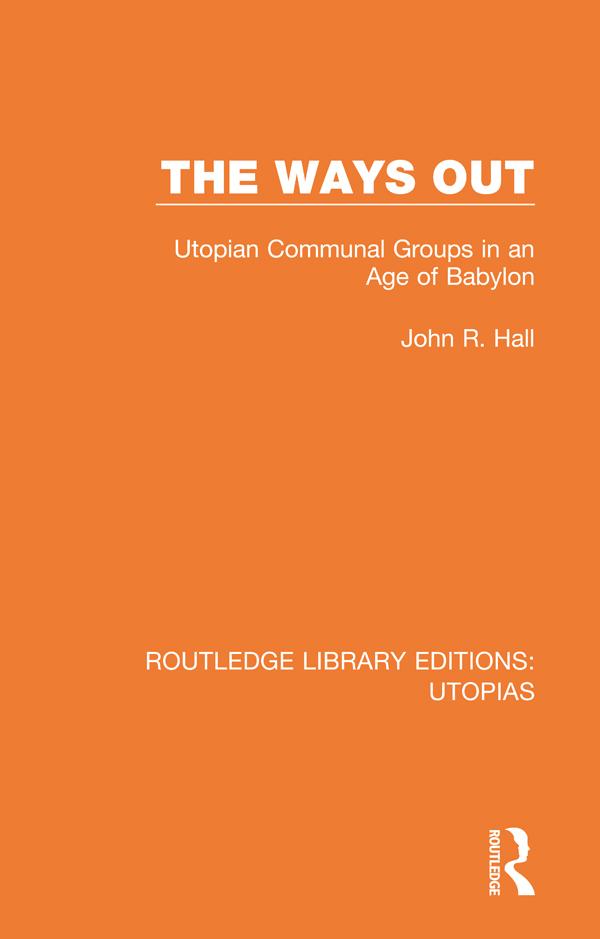
A comparative analysis of both secular and religious communal groups in contemporary America, this study, originally published in 1978, shows that contemporary communalists stand in relation to collectivism much the same as early Protestants stood in relation to individualism – as the self-proclaimed pioneers of the new age. There is great diversity among communal groups, a diversity which is found to stem from alternative orientations towards time and alternative assumptions about the cognitive status of the social world.
The author has made use of a phenomenologically derived typological framework to organize the data he has obtained through living in and visiting a number of communal groups. Within this framework, Alfred Schutz’s ‘mundane’ phenomenology and Max Weber’s interpretive sociology are employed as ways of approaching the situated sociology of knowledge in various communal groups.
Six ideal types of communal groups are described: the commune, the intentional association, the community, the warring sect, the other-worldly sect and the ecstatic association. Two of these types – the intentional association and the community – are identified as participants’ efforts to demonstrate ‘worldly utopian’ models for the reconstruction of society at large.
Pay easily by card, Klarna, Apple Pay or Google Pay. Not happy? You always have a 14-day money-back guarantee. Read more in our terms. If you have any questions, email us at hello@memmo.org.
Memmo makes studying easier – wherever you are in the world. We bring your course books and smart study tools together in one place: summaries, quizzes, podcasts and flashcards. Plus Ted, your study buddy who answers anything you wonder. Over 50,000 students already study here – built to help you learn faster and stress less.