
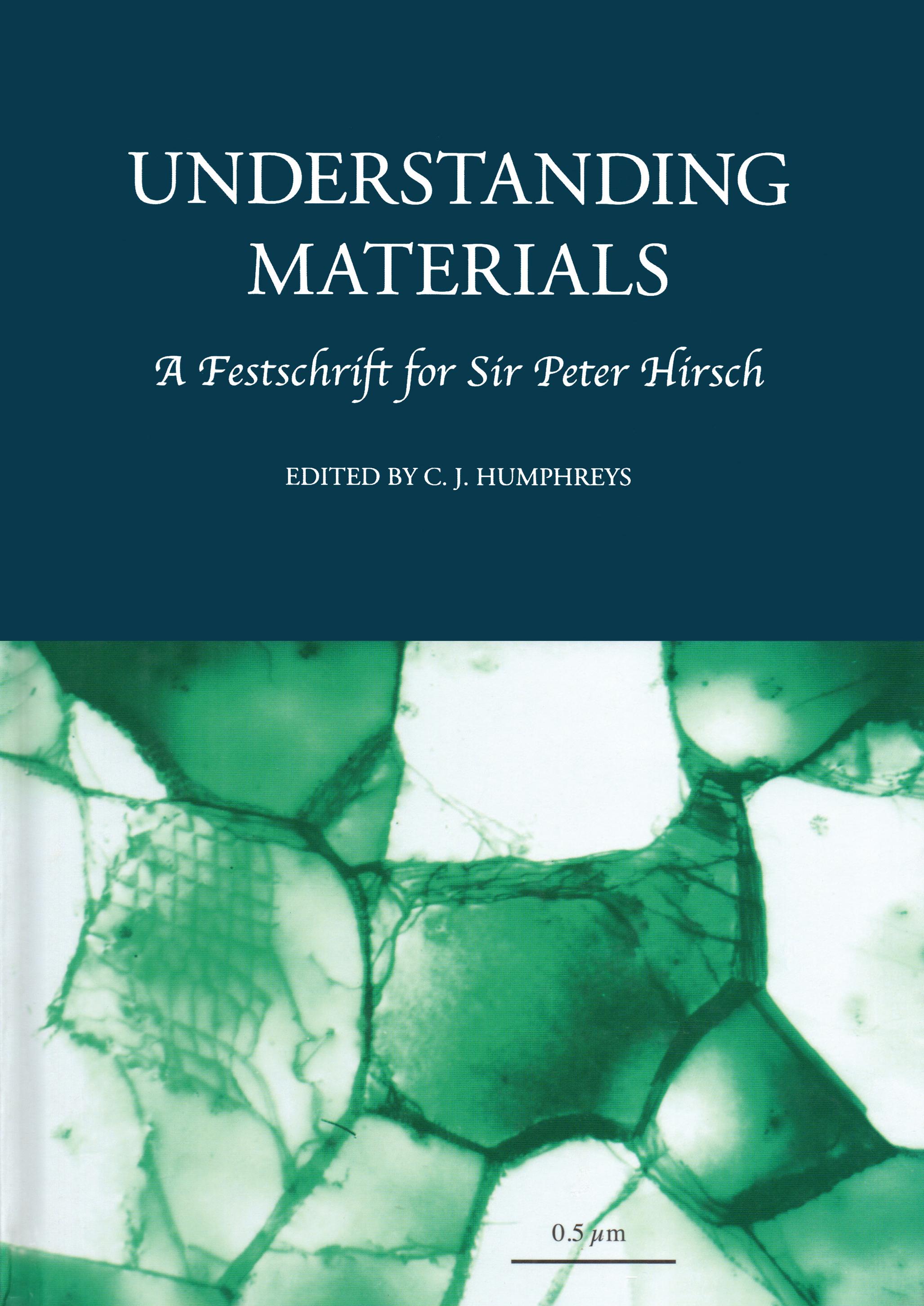
This is a very special book for two reasons. First, it is a tribute to Professor Sir Peter Hirsch from his students, colleagues and friends. Second, it is a collection of specially written review articles by world-class scientists that take the readers from the origins of modem materials science through to the cutting edge of the subject in the twenty- first century. The book will be a valuable resource for all researchers in materials science, particularly those specialising in electron microscopy and diffraction, and in the mechanical properties of materials. The front and back covers of this book are coloured images of historic electron micrographs depicting the first observation in the world of moving dislocations. The pictures were taken by Mike Whelan, then a research student of Peter Hirsch. The image on the front cover is before some dislocations have moved, and the back cover image is after the movement. See if you can spot the difference! This book had its genesis in a symposium organised by Mike Goringe, John Hutchison and myself to mark the retirement of Peter Hirsch from the Isaac Wolfson Chair of Metallurgy at Oxford. This symposium brought together a large number of Peter's former students and colleagues. Some of the most distinguished of these have now written the chapters in this book. The opening chapter, by Professor Ugo Valdre, provides a fascinating biographical sketch of Peter Hirsch from his early career in Cambridge to his retirement in Oxford. It contains many illuminating insights into the personality of Peter, both as a scientist and as a man. The next two chapters focus on the development of electron microscopy and diffraction. Professor Mike Whelan gives an eye-witness account of the seminal early work of Peter and his colleagues at Cambridge on the first observation of dislocations and their movements, using trans-mission electron microscopy. Professor Archie Howie extends this account to the present day, describing nanometer-scale resolution in scanning electron microscopes and atomic scale resolution in the scanning tunnelling microscope.
Pay easily by card, Klarna, Apple Pay or Google Pay. Not happy? You always have a 14-day money-back guarantee. Read more in our terms. If you have any questions, email us at hello@memmo.org.
Memmo makes studying easier – wherever you are in the world. We bring your course books and smart study tools together in one place: summaries, quizzes, podcasts and flashcards. Plus Ted, your study buddy who answers anything you wonder. Over 50,000 students already study here – built to help you learn faster and stress less.