
***Winner of the American Association for Italian Studies Book Prize 2022 and selected at the FAD Awards 2023***
After World War II, a wave of Italian films emerged that depicted the life and hardships of characters left helpless after the conflict, bringing to the screen the struggles of a time of existential angst and uncertainty. This form of filmmaking was associated with a broader artistic phenomenon known as ‘neorealism’ and is now considered a pivotal point in the history of Italian cinema. But neorealism was not limited to film any more than it was to literature. It spread to other areas of artistic production, including architecture. What was, then, neorealist architecture?
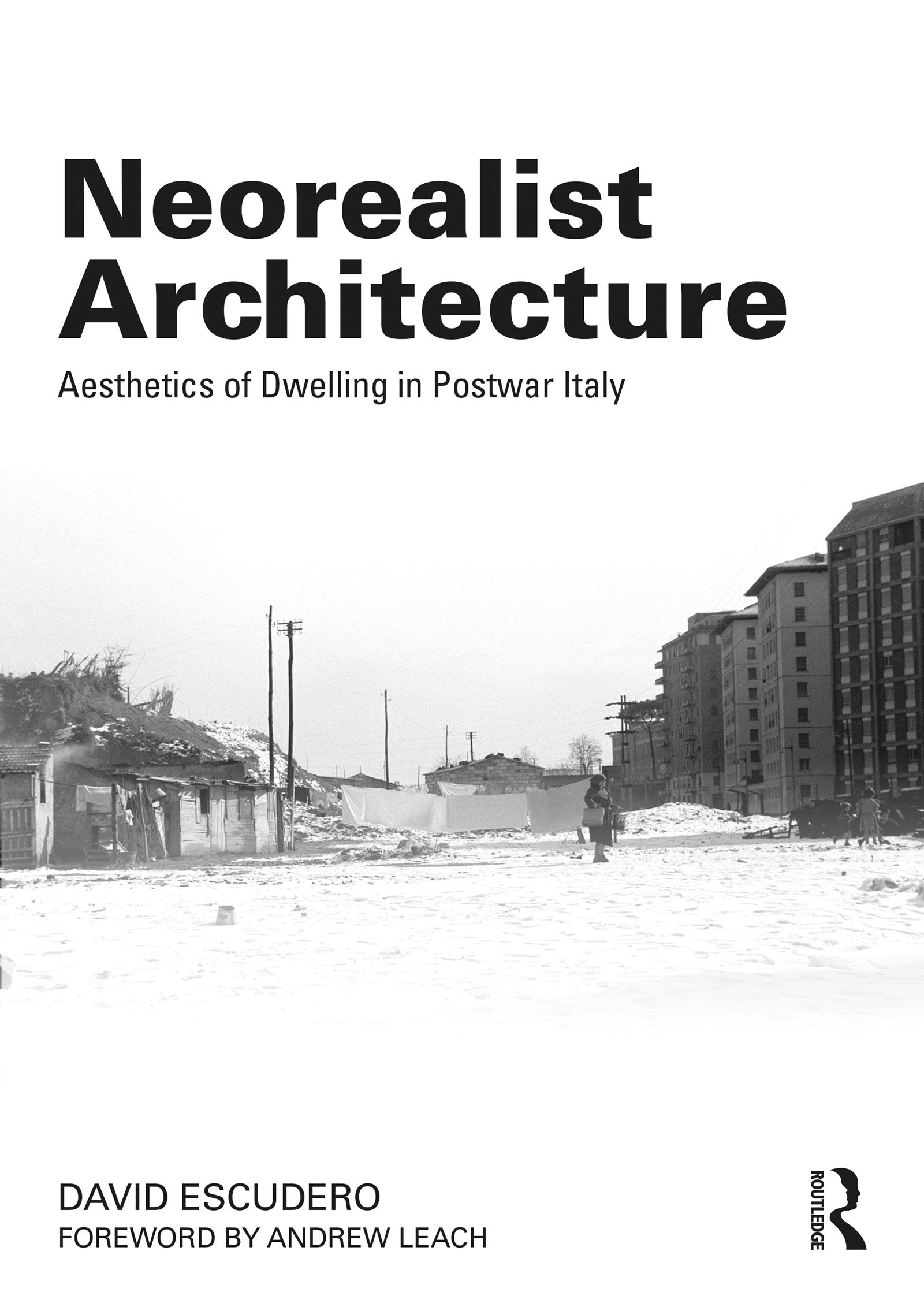
This book explores the links between architecture, filmmaking and the built environment in dopoguerra Italy (194X–195X) seeking to ascertain whether, and how, neorealism manifested itself in architecture. Terms such as ‘neorealist architecture’ or ‘architectural neorealism’ were hinted at in these years and recalled by historians of architecture in the following decades. Therefore, the concept was adopted ad hoc and popularized post hoc, in the absence of any declarations prior to 1955 that proclaimed what neorealism in architecture was or wanted to be. However, while the concept has been internalized by Italian architectural history, transfers between neorealism—as an aesthetic and ethic—and architecture—as one potential medium of its embodiment or expression—are still not fully understood. Therefore, its main goal is to provide an in-depth discussion of the concept ‘neorealist architecture’, the working assumption being that the connection between both terms is not meaningless.
The book is beautifully illustrated with over 100 black and white archival images and is the first book to be published on neorealism in architecture. It will appeal to scholars, professionals, and students interested in history and theory of architecture, Italian studies, art history, and cultural studies.
Pay easily by card, Klarna, Apple Pay or Google Pay. Not happy? You always have a 14-day money-back guarantee. Read more in our terms. If you have any questions, email us at hello@memmo.org.
Memmo makes studying easier – wherever you are in the world. We bring your course books and smart study tools together in one place: summaries, quizzes, podcasts and flashcards. Plus Ted, your study buddy who answers anything you wonder. Over 50,000 students already study here – built to help you learn faster and stress less.