
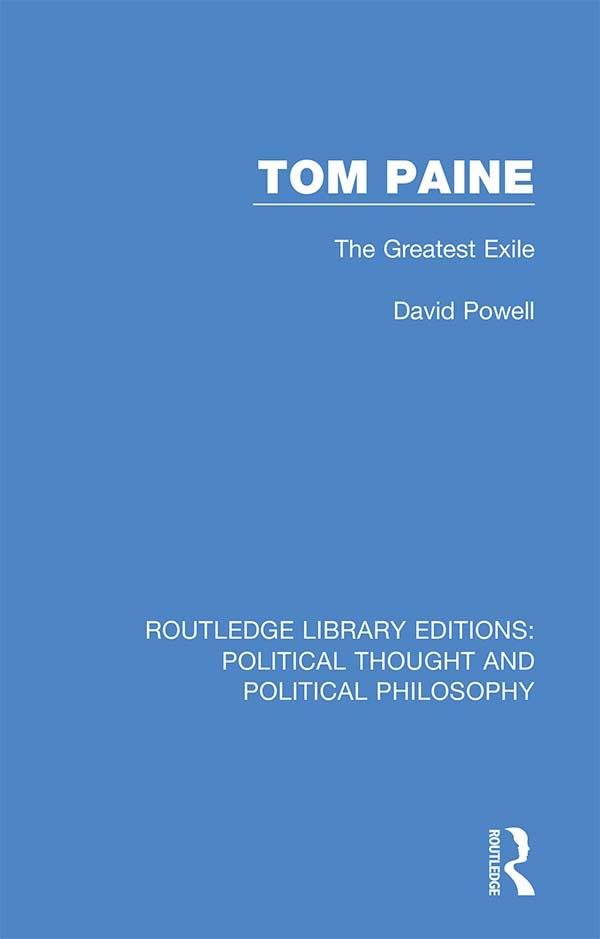
First published in 1985. In the late autumn of 1774 at the age of 37 Tom Paine arrived in Philadelphia. Eighteen months later he had established himself as a seminal figure in the Independence movement. It was the start of a career in which he became the first US Secretary of State for Foreign Affairs; was outlawed from England by Pitt for the publication of the second part of the Rights of Man; delivered a final plea for the life of Louis XVI in the National Convention of 1794; was imprisoned in the Luxembourg, and sentenced to death by Robespierre. After a sad and lonely death in New Rochelle Cobbett brought back his bones to England: ‘to light a taper for liberty.’
Yet Paine remains a man without a past; a man who seemingly burst on the world scene as a full-blown radical at 37 years of age. No one had attempted to explore and interpret the critical, shaping influences of his early and middle life. Yet such background is crucial to explaining all the rest. Without a clear understanding of his Quaker inheritance; of his childhood years in Thetford; of his early philosophical and political apprenticeship in London; and of the six formative years he spent at Lewes, the later man and his radicalism are totally incomprehensible.
Thus, the author’s objective is to place Paine in his times; to interpret the evolution of his political, social and theological ideas. Paine is little more than a cardboard cut-out moving through history in the majority of biographies that have already been published.
This book sees the world through Paine’s own eyes and provides a human interpretation not only of ‘the Age of Revolution’ but also of ‘the maker of revolutions’ himself. To Napoleon, Paine was the man to whom: ‘a statue in gold should be erected in every town’; to Theodore Roosevelt he was ‘that filthy little atheist’; to Michael Foot: ‘the greatest exile that has ever left England’s shores.’ To understand the thinking of a man who can provoke such reactions, it is necessary to understand both the man and the times through which he lived. This title will be of great interest to students of history, politics, and philosophy.
Pay easily by card, Klarna, Apple Pay or Google Pay. Not happy? You always have a 14-day money-back guarantee. Read more in our terms. If you have any questions, email us at hello@memmo.org.
Memmo makes studying easier – wherever you are in the world. We bring your course books and smart study tools together in one place: summaries, quizzes, podcasts and flashcards. Plus Ted, your study buddy who answers anything you wonder. Over 50,000 students already study here – built to help you learn faster and stress less.