
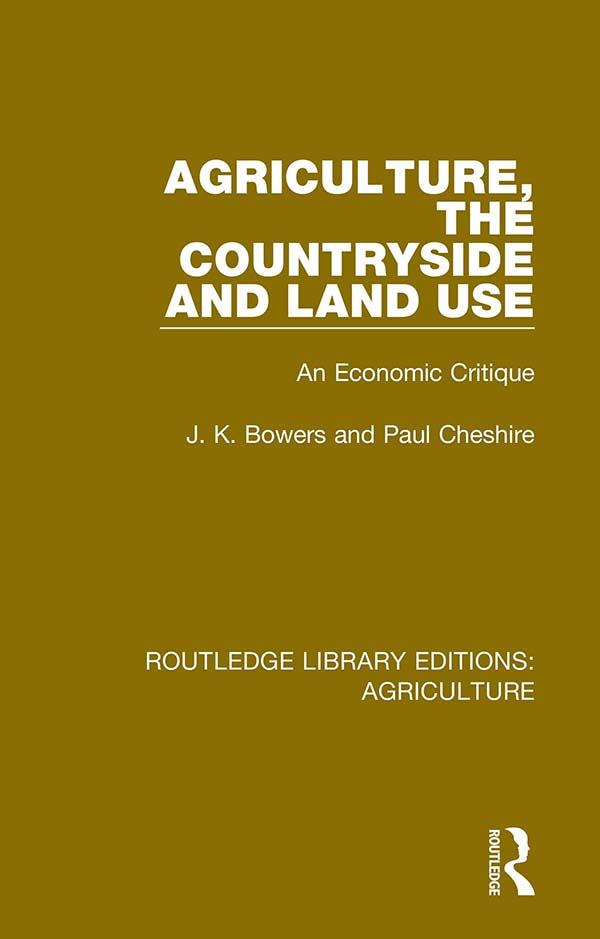
First published in 1983. How had the situation developed in which agriculture had become such a creature of state protection, where public money supported prosperous landowners while poor farmers received practically nothing? Where the value of agricultural support exceeded net farm income, and vastly exceeded the level of support available to British Steel or British Rail?
In answering these questions John Bowers and Paul Cheshire examined the real value of agricultural support in successive policy phases since the Second World War, and analysed the effects this support had on income distribution. Their thesis was that agricultural change, including the transfer of land from traditional farmers to institutions and corporations, was not the product of impersonal progress, but the direct result of agricultural support policies, resting on specious economic arguments.
The authors’ analysis of this subject has inescapable relevance for the policymaker, for the taxpayer and consumer of foodstuffs, for the urban user of the British countryside and indeed for farmers and the farming lobby. Agriculture, the Countryside and Land Use will be an important book for all these groups and also for students of agriculture, geography and economics.
Pay easily by card, Klarna, Apple Pay or Google Pay. Not happy? You always have a 14-day money-back guarantee. Read more in our terms. If you have any questions, email us at hello@memmo.org.
Memmo makes studying easier – wherever you are in the world. We bring your course books and smart study tools together in one place: summaries, quizzes, podcasts and flashcards. Plus Ted, your study buddy who answers anything you wonder. Over 50,000 students already study here – built to help you learn faster and stress less.