
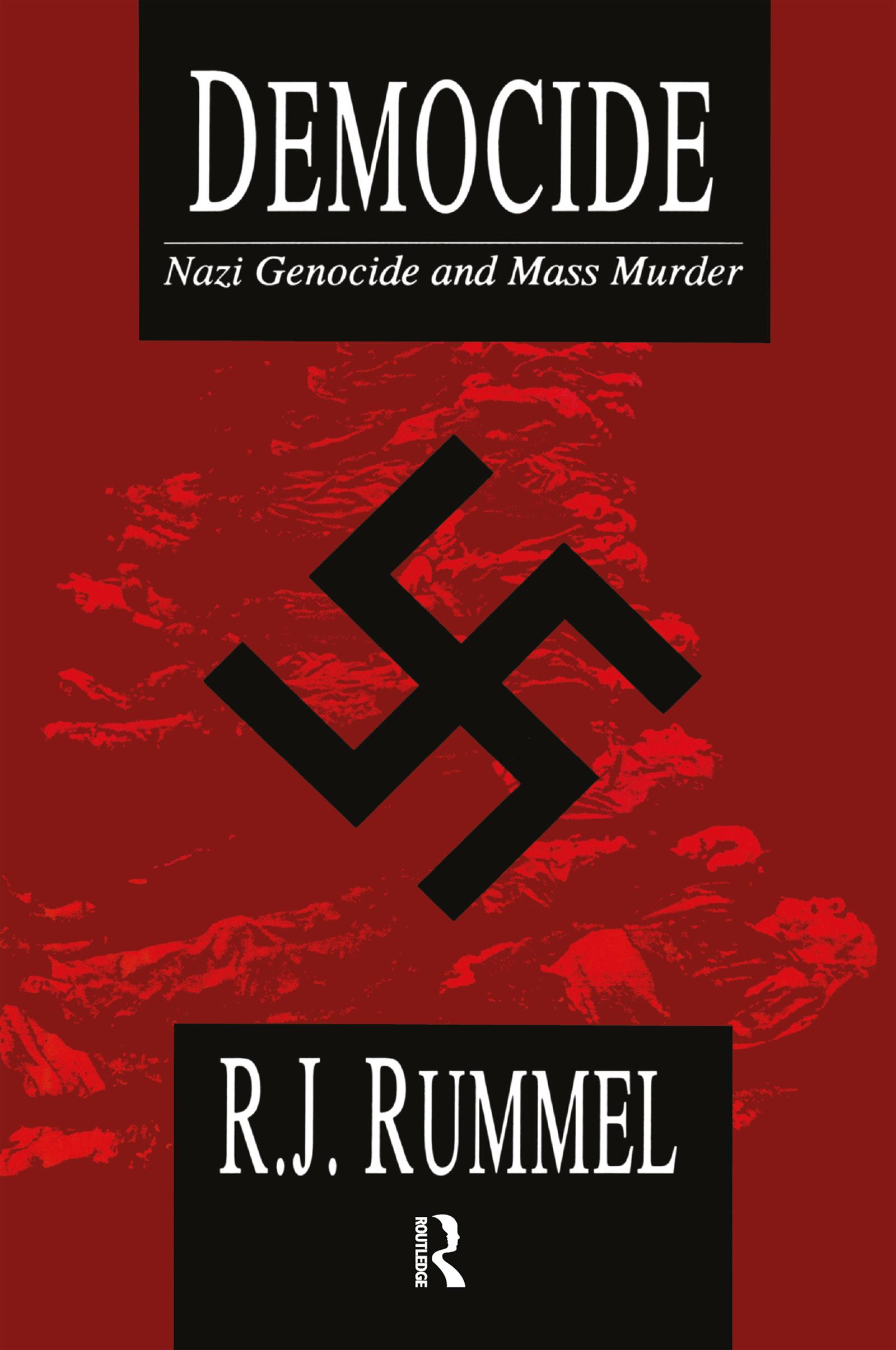
This volume is part of a comprehensive effort by Professor Rummel to understand and place in historical perspective the entire subject of genocide and mass murder-what is herein called Democide. It is the third in a series of volumes in which Rummel offers a comprehensive analysis of the 120,000,000 people killed as a result of government action or direct intervention.
Curiously, while we have a considerable body of literature on the Nazi Holocaust, we do not have a total accounting-at least not until now with the issuance of Democide. In addition to the quantitative lacunae, there remains a paucity of theoretical information distinguishing the historical descriptive and the anecdotal accounts. This study of Nazi killings in cold blood is a path-finding effort in political psychology.
While Rummel does not claim to give a definitive accounting, his explanation for the numbers reached-and they are high-is compelling. In addition, we now have a correlation of information on the murder of diverse groups: Jews, Gypsies, Poles, Ukranians, and even Germans themselves. It is now possible to fathom the Nazi genocidal poiicies-which were collective and which were selective.
Rummel's volume is a clear guide to a murky past. It offers the first systematic effort to ascertain the nature and the extent of the Nazi genocide from the point of view of the perpetrator's aims rather than the victims' consequences. This is not a pretty picture, but it is not a partisan one either. The materials are presented in a clinical as well as a systemic fashion.
Rummel has a deep sense of the life-saving instincts of individuals and the life-taking propensities of impersonal state machinery. It is thus, a humanistic effort, one that plumbs the effects of the Nazi war-machine on innocents in order to better understand present conditions. Professionals ranging from social scientists to demographers will find this a quintessential effort at political reconstruction.
Pay easily by card, Klarna, Apple Pay or Google Pay. Not happy? You always have a 14-day money-back guarantee. Read more in our terms. If you have any questions, email us at hello@memmo.org.
Memmo makes studying easier – wherever you are in the world. We bring your course books and smart study tools together in one place: summaries, quizzes, podcasts and flashcards. Plus Ted, your study buddy who answers anything you wonder. Over 50,000 students already study here – built to help you learn faster and stress less.