
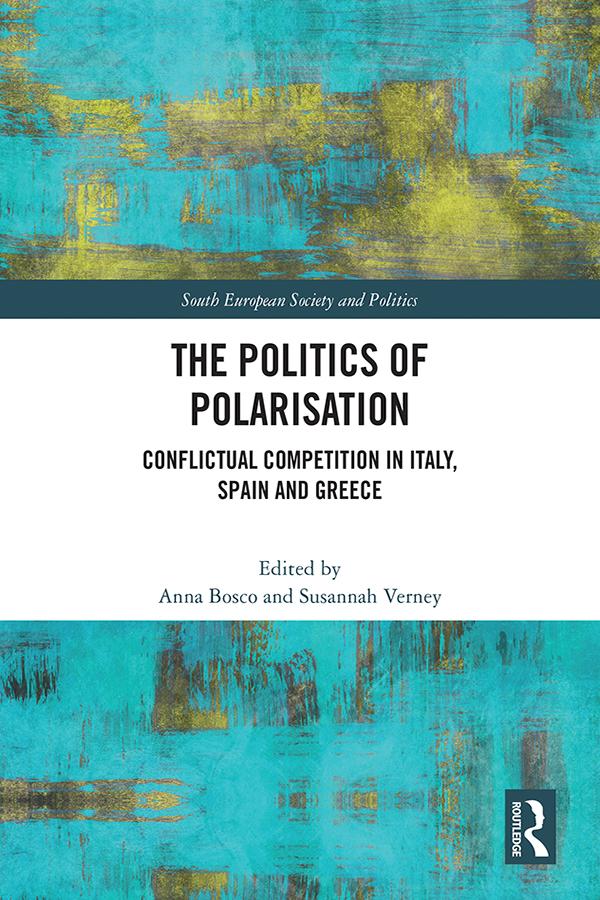
Focusing on Italy, Spain and Greece, this book explores the extent of polarisation, as well as its causes, characteristics and consequences. It investigates varied manifestations of polarised politics including leader polarisation, policy polarisation and affective polarisation as well as providing case studies of polarised elections taking place at multiple levels.
In recent years, polarisation has been a key feature of South European politics. Deep antagonism has moved party leaders against each other, hindered parliamentary and governmental cooperation, and triggered a cascade effect of harsh divisions among elites and citizens. Beyond the left-right axis, the chapters in this volume highlight multiple dimensions around which parties and voters polarise: the split around sovereign bailouts in Greece, the territorial cleavage in Spain, the divisions around immigration and European integration in Italy. This volume offers essential understanding of the specific features of polarisation in different national contexts and the consequences for political competition and government instability.
The chapters in this book were originally published as a special issue of South European Society and Politics.
Pay easily by card, Klarna, Apple Pay or Google Pay. Not happy? You always have a 14-day money-back guarantee. Read more in our terms. If you have any questions, email us at hello@memmo.org.
Memmo makes studying easier – wherever you are in the world. We bring your course books and smart study tools together in one place: summaries, quizzes, podcasts and flashcards. Plus Ted, your study buddy who answers anything you wonder. Over 50,000 students already study here – built to help you learn faster and stress less.